
Houghton’s Lost Gold
When Douglass Houghton surveyed the Keweenaw in the 1840s, he recorded the many possible mineral deposit locations. In one river or stream near Copper Harbor, he panned down into the water and came up with something unexpected: gold.
He wrote to colleagues, explaining his findings. Along with many other incredible discoveries, the location of gold was recorded in his notes, which would be assembled later into a formal report. However, Houghton was lost to Lake Superior before that report could be completed, and the location of the gold was lost with him.
Houghton is remembered today for copper. His reports helped trigger the mining rush that transformed the Upper Peninsula and laid the foundation of the copper industry. But he is also credited with being the first person to identify gold in Michigan. In the early 1840s, while conducting survey work near Copper Harbor, he panned placer gold from a small stream. Before that location could be formally documented, he drowned on Lake Superior. The discovery died with him.
Houghton was only twenty-one years old when he came west. Born in 1809 in Troy, New York, he showed early promise in the sciences. He studied chemistry and the natural sciences at the Rensselaer Scientific School, one of the first institutions in the country devoted to technical and scientific education. His training emphasized practical fieldwork as well as theory, an approach that would define his career.
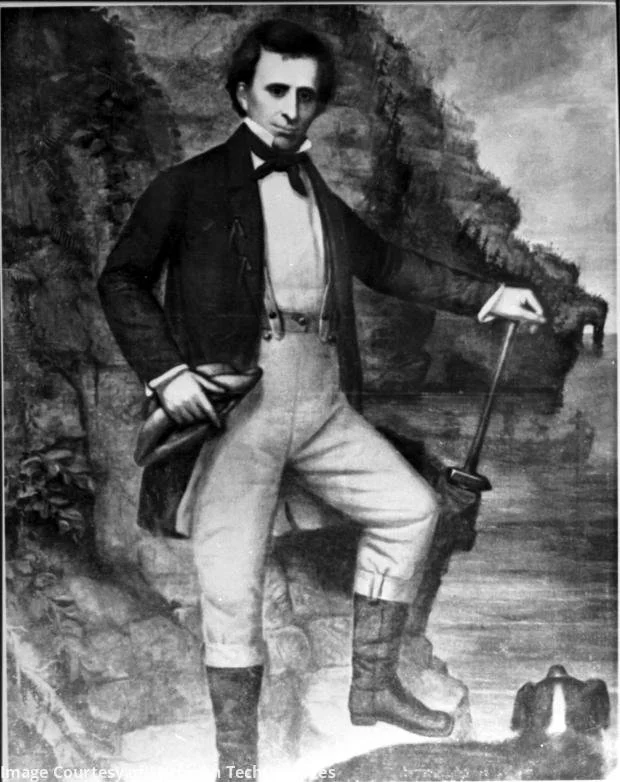
Douglass Houghton with his dog. Biography – Douglas Houghton. Photo. MTU Neg 01103. MTU Vertical Photograph File. MTU Archives and Copper Country Historical Collections.
Houghton arrived in Detroit from New York in the winter of 1830, when Michigan was still a frontier territory with around 20,000 citizens of European descent within its borders. He had been invited to lecture on chemistry and geology, and his ability to explain complex subjects clearly earned him immediate respect. In 1831 he was admitted to medical practice and quickly became active in Detroit’s professional community. That same year he was appointed physician and botanist for a federal expedition to explore the sources of the Mississippi River. During that expedition he treated smallpox among the Chippewa community. The experience required endurance and diplomacy, and it gave him firsthand knowledge of travel and work in remote regions.
When Michigan became a state in 1837, Governor Stevens T. Mason appointed Houghton as its first State Geologist and placed him in charge of organizing the State Geological Survey. Beginning in 1838, Houghton personally conducted many of the early surveys, including traveling by canoe, horseback, and on foot through areas that had scarcely been mapped. Much of the Upper Peninsula remained unfamiliar to American settlers. Forest, inland lakes, and rocky shoreline stretched northward into a region explored by few outsiders and home to indigenous Americans.
An 1849 land survey map of the Keweenaw showing Houghton’s name. Weber and Balto, Michigan Upper Peninsula (General Land Survey map, 1849), digital image, Wikimedia Commons.
His reports contributed to the formation of county boundaries and provided some of the first systematic assessments of Michigan’s natural resources. Copper brought investors, laborers, and national attention. It also secured Houghton’s reputation during his lifetime. His findings on the copper deposits of the Keweenaw Peninsula were especially influential. Although he cautioned that more study was needed before estimating the amount of high-value copper present, publication of his reports helped trigger the mining rush that reshaped the Upper Peninsula.
Not only was Houghton an academic and surveyor, but he was a well-known figure and politician in his lifetime as well. In 1842 he was elected Mayor of Detroit, reportedly unaware he had been nominated. He accepted the office and served two consecutive terms. In 1844, after facing limited state funding for his mineral surveys, he traveled to Washington, D.C., where he successfully secured federal support to continue his geological work.
In addition to documenting copper deposits, Houghton is credited with being the first to identify gold in Michigan. While surveying near Copper Harbor in the early 1840s, he panned placer gold from a small stream. Before that site could be revisited and formally documented, Houghton’s life was cut short. Had the stream been clearly labeled, Michigan’s early mineral history might have included a gold rush alongside copper. Instead, the location was lost. Houghton’s drowning came in October 1845, just months after the wild country he was surveying had been named in his honor.
The circumstances were later described in an account titled “The Story of the Death of Douglass Houghton and the Sketch of Peter McFarland, the Last Survivor of the Expedition.” On October 13, 1845, after camping near Eagle Harbor, Houghton set out by boat toward Eagle River. Peter McFarland, John Baptiste Bodrie, Tousin Piquette, and Oliver Larime were with him. The boat carried field notes, instruments, three barrels of flour, peas, pork, a tent, bedding, and Houghton’s traveling portfolio. His black and white spaniel, Meeme, was also aboard.
McFarland later recalled that when they departed there was “a gentle land breeze and a heavy sea from the outside.” He warned that he feared the wind would increase. Houghton replied, “No, I guess not; a land breeze can’t hurt us.”
As they rowed west, snow began to fall and the wind shifted northeast. The sea grew heavier. Near what McFarland called the sand beach, he suggested going ashore. Houghton answered, “We had better keep on—we are not far from Eagle River, pull away boys, pull hard.”
The wind increased and waves broke over nearby rocks. The men struggled among the breakers for more than an hour. McFarland advised Houghton to put on his life preserver. The bag was handed to him, but “instantly a heavy sea struck the boat and filled it.”
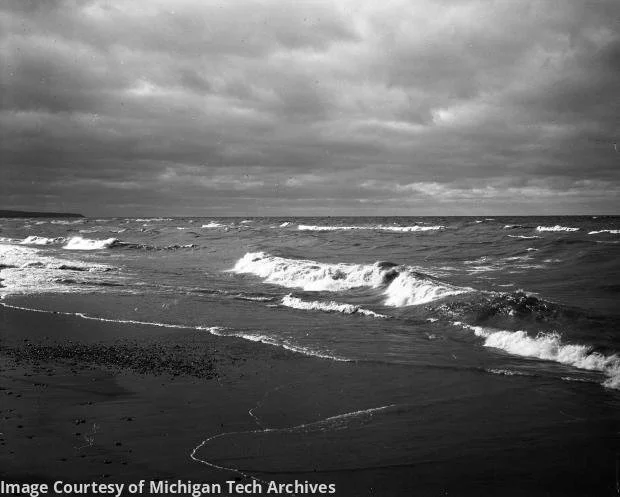
Lake Superior Storm. Reeder, John T. Black and white glass plate negative. Reeder Photographic Collection. MTU Archives and Copper Country Historical Collections. MS042-05-53-375.
Within about two hundred yards of shore, another wave struck, followed by a larger billow. The boat capsized “with all hands under her.” McFarland surfaced first and grasped the keel. He saw “a man’s arm about halfway out of the water” and pulled him up by the collar. It was Dr. Houghton. McFarland urged him to remove his gloves and hold onto the boat. Houghton complied and then said, “Peter, never mind me, try to go ashore if you can; I will go ashore well enough.”
Moments later, “a heavy sea struck the boat, throwing it perpendicularly into the air.” It fell backward, and “Dr. Houghton disappeared forever.”
McFarland and Bodrie survived after being dashed repeatedly against the rocks before reaching shore. Meeme washed ashore as well, but without her master. They reached Eagle River between eleven and twelve that night. Within an hour, miners and residents were searching along the shoreline. Snow fell to a depth of three feet that night and the following day.
In the spring of 1846, Houghton’s remains were found near the scene, half covered with sand. He was returned to Detroit and interred in Elmwood Cemetery. He was thirty-six years old. In 1914, a monument built of native stone was erected along the Lake Superior shoreline near the site of the capsizing.
Today his name remains across the Upper Peninsula: Houghton County, the city of Houghton, and Houghton Township in Keweenaw County. His geological reports helped launch the copper industry that defined the region’s economy for more than a century.
Although copper built the Copper Country, the location of Houghton’s gold remains one of its unanswered mysteries. Somewhere in Michigan’s northernmost peninsula there was once a stream where Douglass Houghton panned traces of gold. While gold has been mined elsewhere in the Upper Peninsula, Houghton’s discovery is among the only recorded references to gold in the Keweenaw itself.
The exact location was never fixed on a map. Anyone up for an adventure?
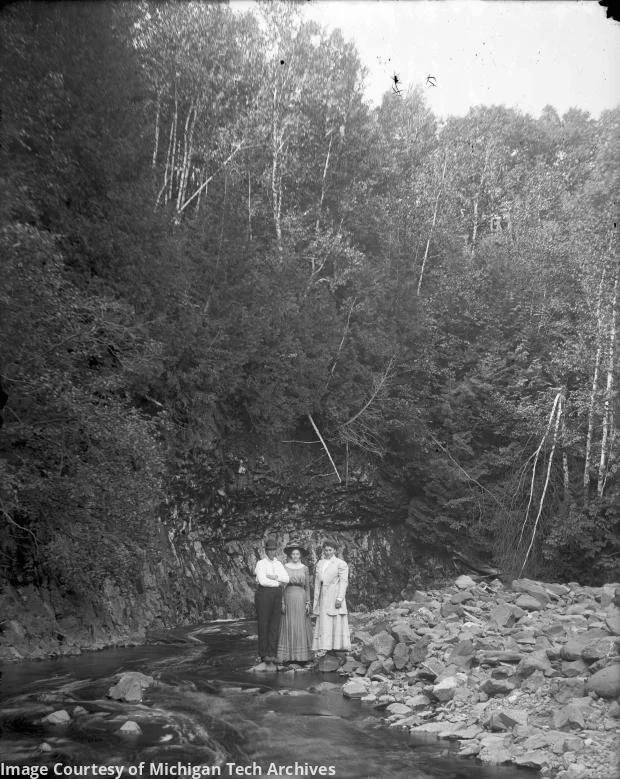
Crest View Forest. Black and white photographic print, undated. Roy Drier Collection, MTU Neg 00253. Michigan Technological University Archives and Copper Country Historical Collections.
Thanks for reading! Please consider contributing to our research with a one-time donation. Let’s keep Copper Country history alive together.
Contribute to Copper Country history
Sources:
AE Seaman Mineral Museum. “Gold in Michigan.” Michigan Technological University. https://museum.mtu.edu/pdfs/GOLD.pdf
Allen, R. C. “Dr. Douglass Houghton.” In Some Upper Peninsula Pioneers: From Michigan Pioneer and Historical Collections, 1–8. Iron Mountain, MI: Mid- Peninsula Library Federation, 1974.
Bornhorst, T. J., and L. J. Molloy. “Douglass Houghton – Pioneer of Lake Superior Geology.” A. E. Seaman Mineral Museum Web Publication. 2017. https://museum.mtu.edu/sites/default/files/2019-11/AESMM_Web_Pub_4_Douglass_Houghton.pdf
History of the Upper Peninsula of Michigan. Chicago: Western Historical Co., 1883. https://archive.org/details/arg9598.0001.001.umich.edu/mode/2up
Monette, Clarence. The History of Eagle River, Michigan. Lake Linden, MI: Welden H. Curtin, 1978.
Thurner, Arthur W. Strangers and Sojourners: A History of Michigan’s Keweenaw Peninsula. Detroit: Wayne State University Press, 1994.
