
The Old German Hotel
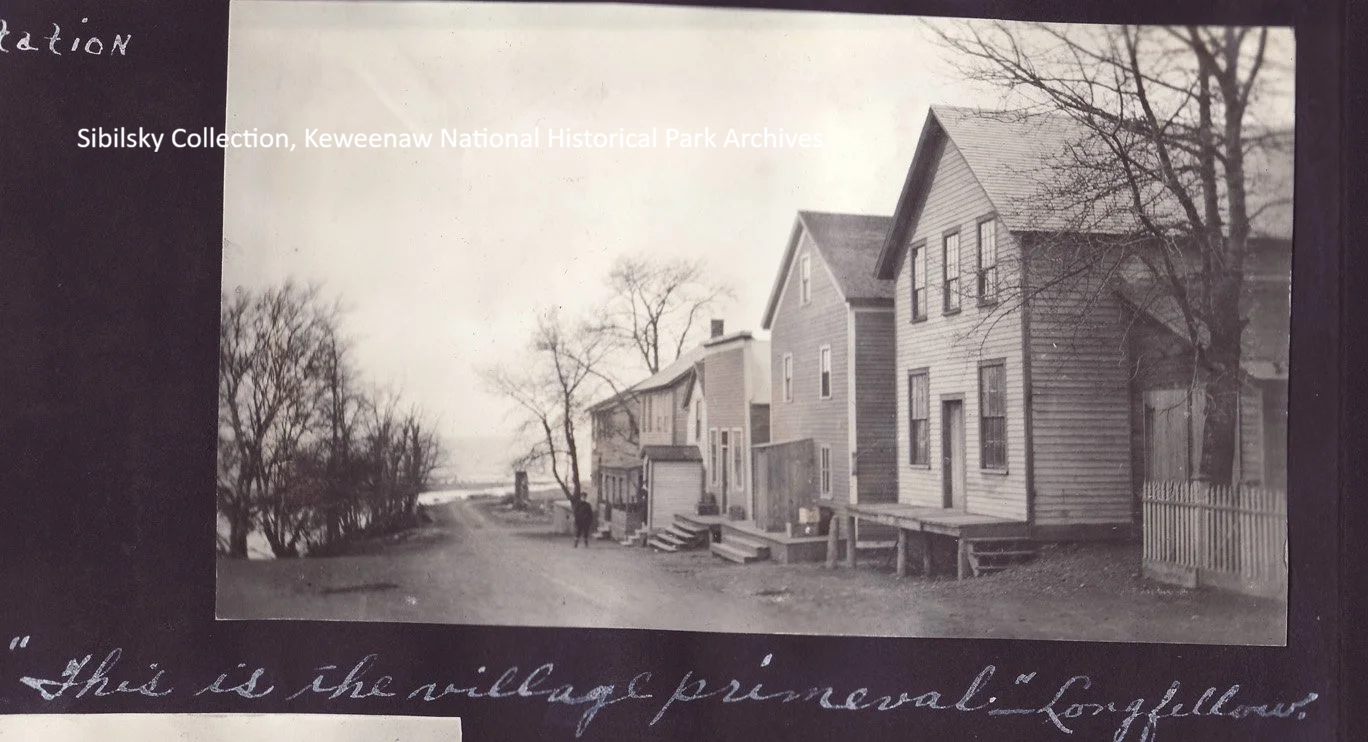
“East Main Street,” photograph, ca. 1920, Album 3, p. 67, Sibilsky Collection, Keweenaw National Historical Park Archives.
Eagle River was part of the opening chapter in the history of America’s mining boomtowns. Five years before gold was discovered in California, copper mining was underway in the Keweenaw. In 1843, the first permits for mining were granted. Groups of men were dropped off by boat in the fall of 1844. These men held spots over the winter at valuable locations near Fort Wilkins and Eagle River. According to the 1883 book History of the Upper Peninsula of Michigan,“in the spring of 1845, a grand rush [to the region] was made of speculators, scientific men, capitalists and miners.” That year, the Lake Superior Copper Company began operations near Eagle River and used the location there as its shipping port. Naturally, a warehouse and office were needed. The Pittsburgh and Boston Mining Company, owners of the nearby Cliff Mine, added a long pier on the shore that extended out onto the lake for ships to deliver and receive goods. Around these first structures, other businesses and dwellings were erected, creating the beginnings of Main Street.
The name of the village, “Eagle River,” is older than those newly arrived European immigrants and comes from the local Ojibwe people. The river was called Me-qu-zeh Se-bah, “Eagle River,” long before the immigrant miners and their families arrived at the place where the river meets the lake. The first French trappers and surveyors also called it the same: La rivière nid d’aigle.
Although a post office was established in Eagle River in 1845, mail was not given a swift arrival. At this point, there was only one road out of Eagle River, to the Cliff Mine location. It was extremely rough and had “corduroy” rows of logs to bridge gaps, ditches, and puddles. In addition to this short road, there was a rough trail through the woods that connected clusters of houses and tiny villages to Green Bay. It was on this trail that mail was delivered: in the summer by horse, in the winter by a dogsled team. If the mail became too heavy for the dogs, the driver threw the bag of mail into a tree, where it would be retrieved in the spring.
When Houghton County was organized in 1845, Eagle River was chosen as the county seat. This was certainly because for many years, with no roads or railways to and from the Copper Country, the port at Eagle River was one of the main entry points to the county and its mines and rural communities. The Methodist minister Reverend John Pitezal visited the village in 1848 and described its necessity as a commercial port, calling it a “central rallying point for all parts of the lake.”
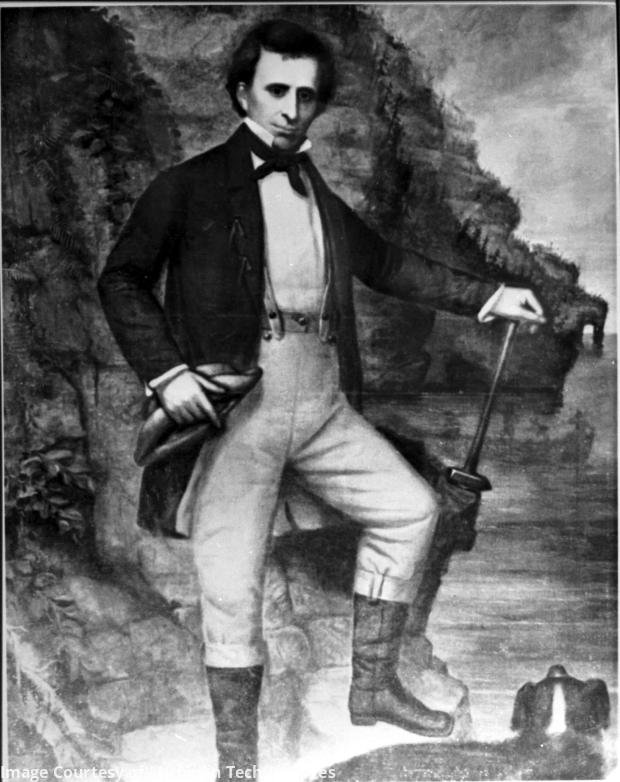
“Douglass Houghton with his dog.” MTU Neg 01103. MTU Vertical Photograph File. Michigan Technological University Archives and Copper Country Historical Collections.
The county was already named “Houghton” before the famous death of its namesake. Douglass Houghton arrived in Detroit from New York in the winter of 1830, when Michigan was still a frontier territory with around 20,000 citizens of European descent within its borders. Much of the northern peninsula remained unfamiliar to American settlers. Houghton was only twenty-one years old when he came west to the new territory. He had studied chemistry and other natural sciences at the Rensselaer Scientific School and was invited to Detroit to lecture. He was admitted to medical practice in 1831 and quickly became active in Detroit’s professional community. That same year he was appointed physician and botanist for a federal expedition to explore the sources of the Mississippi River. During the expedition he treated smallpox among the Chippewa community. The experience gave him practical knowledge of travel and work in remote regions.
When Michigan became a state in 1837, Governor Stevens T. Mason appointed Houghton as its first State Geologist and placed him in charge of organizing the State Geological Survey. Beginning in 1838, he personally conducted many of the early surveys. His work contributed to the formation of county boundaries and provided some of the first assessments of the state’s natural resources. His reports on the copper deposits of the Keweenaw Peninsula were especially influential. Although he warned that further study was needed before estimating the amount of high-value copper present, publication of his findings helped trigger the mining rush that transformed the Upper Peninsula and laid the foundation of the copper industry. It also helped establish his fame, and Houghton was well-known in his lifetime.
In 1842 he was elected Mayor of Detroit, reportedly unaware he had been nominated. He accepted the office and served two consecutive terms. In 1844, after facing limited state funding for his mineral explorations, he traveled to Washington, D.C., where he successfully lobbied Congress for federal support of his geological work.
By the mid-1840s, Houghton remained actively engaged in survey work along the Lake Superior shoreline. One of many mysteries that died with Houghton was the location of gold in the Copper Country. He is credited with being the first to find gold in Michigan, having panned placer gold from a stream near Copper Harbor. The exact location was never recorded before his death.
Houghton’s drowning came just months after the wild country he was surveying was named after him. The circumstances were described in a piece from 1893 titled “The Story of the Death of Douglass Houghton and the Sketch of Peter McFarland, the Last Survivor of the Expedition.” On October 13, 1845, after camping near Eagle Harbor, he set out by boat that morning toward Eagle River. Peter McFarland, John Baptiste Bodrie, Tousin Piquette, and Oliver Larime were with him. The boat carried field notes, instruments, three barrels of flour, peas, pork, a tent, bedding, and Houghton’s traveling portfolio. His black and white spaniel, Meeme, was also aboard.
Peter McFarland later described the events that followed. When they left, there was “a gentle land breeze and a heavy sea from the outside.” McFarland warned that he feared it would blow harder. Houghton replied, “No, I guess not; a land breeze can’t hurt us.” As they rowed west, snow began to fall and the wind shifted northeast. The sea grew heavier. Near what McFarland called the sand beach, he suggested going ashore. Houghton answered, “We had better keep on—we are not far from Eagle River, pull
away boys, pull hard.”
The wind increased and waves broke over rocks nearby. The men struggled among the breakers for more than an hour. McFarland advised Houghton to put on his life preserver. The bag was handed to him, but “instantly a heavy sea struck the boat and filled it.”
Within about two hundred yards of shore, another wave struck, followed by a larger billow. The boat capsized “with all hands under her.” McFarland surfaced first and grasped the keel. He saw “a man’s arm about halfway out of the water” and pulled him up by the collar. It was Dr. Houghton. McFarland urged him to remove his gloves and hold onto the boat. Houghton complied and then said, “Peter, never mind me, try to go ashore if you can; I will go ashore well enough.”
Moments later, “a heavy sea struck the boat, throwing it perpendicularly into the air.” It fell backward, and “Dr. Houghton disappeared forever.”
McFarland and Bodrie survived after being dashed repeatedly against the rocks before reaching shore. Meeme, too, washed ashore, but without her master. They arrived in Eagle River between eleven and twelve that night. Within an hour, miners and residents were searching along the shoreline. Snow fell to a depth of three feet that night and the following day.
In the spring of 1846, Houghton’s remains were found near the scene, half covered with sand. He was returned to Detroit and interred in Elmwood Cemetery. He was thirty-six years old. Today his name remains across the Upper Peninsula: Houghton County, the city of Houghton, and Houghton Township in Keweenaw County. In 1914, a monument built of native stone was erected near the site of the capsizing along the Lake Superior shoreline.
For the first decades of the town, Eagle River was the home of many immigrants from Germany. Joseph Austrian, an early arrival to the town, described in his autobiography how poverty, crop failure, and few opportunities at home led to a chain migration effect in his family. He was born in Wittelshofen, Bavaria, in the early 1830s and left his home country at the age of only 15. He stayed for some time in Mackinac City before making his way to Ontonagon on a winter journey in the late 1840s, breaking ice on rivers along the way to get through by boat. He arrived in Eagle River aboard a steamship in 1852, ready to work for Henry Leopold’s store. He described the village at the time as “a small settlement of not over one hundred inhabitants” that had “but two stores, the smaller one 18x24 situated on top of a hill facing the lake was Leopold’s.” He wrote that otherwise the business portion simply had a few saloons and boarding houses.
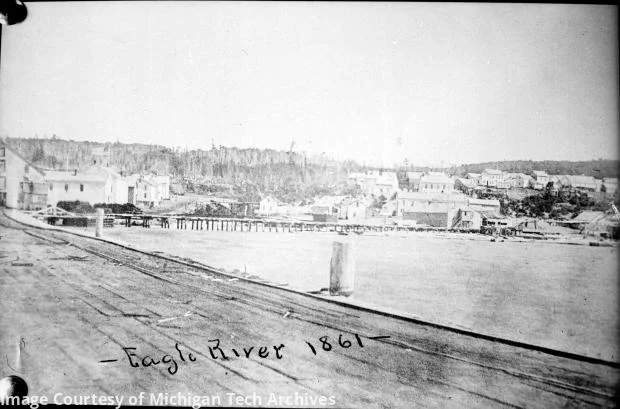
Reeder, J. T. Eagle River in 1861. MS042-062-999-Z-471. Reeder Photograph Collection. Michigan Technological University Archives and Copper Country Historical Collections.
Joseph Long, born Joseph Lang, and his family owned one of those boarding houses. The Long family owned the German Hotel for around 120 years. Joseph, from the Grand Duchy of Baden, and his wife, Catherine Neidermeier, from Bavaria, were immigrants escaping uncertainty. The period from 1820 to 1871 in Germany marked the collapse of the old agricultural society and the rise of the modern industrial age. In the decades before the American Civil War, the German states were undergoing deep economic and social change. In southwestern Germany, including the Grand Duchy of Baden, the old agricultural order was breaking down. Peasants were displaced from farming as agriculture modernized, and artisans were pushed out of work by the growing industrial economy. Improved agricultural production and lower death rates led to overpopulation, placing additional strain on land and jobs. When severe crop failures struck in the 1840s, including the potato blight between 1845 and 1849, many families faced real hardship. Nearly one million Germans emigrated to the United States during this period.
Political conditions added further instability. In neighboring Württemberg, King William I granted a constitution in 1819 that remained in force, with modifications, until 1918. Although this ushered in a period of relative quiet and attention to education, agriculture, trade, and finance, public demands for greater political freedom did not disappear. After 1830, unrest surfaced, and during the revolutionary movement of 1848 the king dismissed conservative ministers and briefly called more liberal leaders to power, even proclaiming a democratic constitution. Once the movement lost strength, however, the liberal ministers were removed and conservative leadership returned in 1849. In Baden, by contrast, revolutionary tensions escalated into a serious uprising that had to be put down by force. In Bavaria, King Ludwig I moved in a more reactionary direction after 1830, modifying or annulling liberal constitutional provisions and enforcing strict censorship, before ultimately abdicating in March 1848 amid unrest. Together, these events reflected widespread political uncertainty across southwestern Germany.
At the same time, the United States presented powerful attractions. America promised religious and civil freedom, political security, upward mobility, and economic opportunity. Travel became cheaper and faster with clipper ships, railroads, and steamships, and companies actively recruited immigrants. Letters from earlier arrivals encouraged relatives and neighbors to follow. Many German newcomers had enough resources to travel inland to the Midwest in search of farmland and work. These combined economic and political pressures help explain why so many immigrants from Germany left in the 1840s and 1850s and eventually made their way to developing communities such as Eagle River, Michigan.
Joseph and Catherine Long were among these immigrants. The pair came to the United States separately and met in Detroit. They married there on January 7, 1847. Six months later, on the Fourth of July, the pair landed at Eagle River aboard a steamship.
For the first time, Catherine, well into her first pregnancy, stepped onto the pier into the town she would call her home for the next sixty-two years. That October, the pair welcomed their son Henry. He was touted as the “first male child born in Eagle River,” although obviously this means the first male child of European descent. In the 1850 census, Joseph is listed as owning real estate worth $500 and having no employment. This may mean that he worked for himself in some form instead of being traditionally employed, as $500 in real estate was nothing to scoff at in the 1850s.
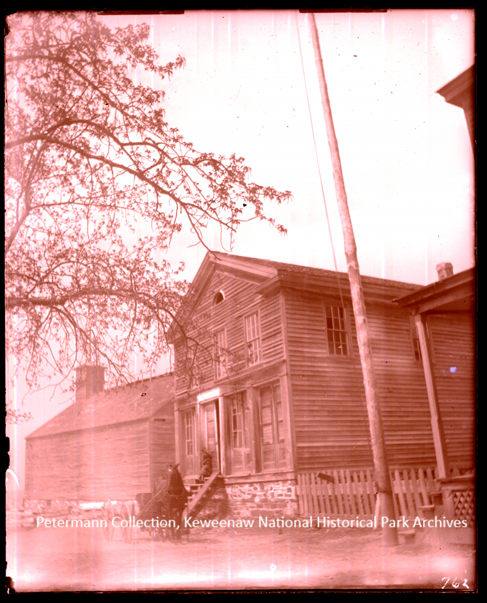
“Old Senter Store,” Eagle River, Michigan, photograph, ca. 1900, Glass Plate no. 762, Petermann Collection, Keweenaw National Historical Park Archives.
The town the Longs and other immigrants arrived in was small but, perhaps because of that size, had a strong sense of community. Peter White, one of the original settlers of the Upper Peninsula, visited Eagle River in 1851 in his position as Marquette County clerk and discovered a kind and hospitable town. According to the 1883 book covering the history of the Upper Peninsula, the men of the town insisted that he stay for a two-week visit and were so determined in keeping their winter visitor that White thought he ought to stay, for fear that he would upset them. The town, perhaps bored and sick of keeping the same company throughout the long winter, promptly threw White a party as a guest of honor. He had not packed the correct clothing, so John Senter took him into his general store and procured him a proper outfit. White later explained, “for the next eight or ten days I was put through such a round of pleasures and hospitable attentions never before nor since witnessed by me. I could not have been more civilly feasted and toasted had I been the President.”
John Senter was an early Eagle River resident who was a jack-of-many-trades. Born in New Hampshire, he moved to Eagle River in 1846 and was first employed with the Phoenix Mine. The next year, he established a large general store in town. He also managed the pier and warehouse as the local exchange agent. Later, he held an office at the Phoenix Hotel, a large hotel at the end of Main Street, selling insurance and explosives. From 1847-1857, he operated the post office from this location in addition to his other duties. His name appears in many positions and records in Eagle River around this time. He later served as the Treasurer of Houghton County.
Joseph Long’s German Hotel was built around 1846 by fellow German immigrant Frank Mayworm. The lot, originally plotted by the Lake Superior Copper Company, had bounced between owners before then but Mayworm is noted as the one who had the hotel constructed. It is a large 3,700 square foot building on Main Street. Next to it, built later, is a saloon building. At the time, Mayworm was already operating a hotel in Houghton. Both buildings used logs and lumber purchased from the sawmill of the Lake Superior Copper Company. According to the Keweenaw County Tour Guidebook, “the structure was likely raised onto its stone foundation sometime after original construction, when a room was added onto the rear to incorporate a well, whose remnants survive under a modern plywood cover in the basement.” Joseph Long operated the hotel, apparently for Mayworm but under his own name, as the real estate itself did not change hands for a few decades. The agreement between the two men is unknown, but Long’s House was established by the 1850s, so although Joseph did not own the property yet, he was certainly living on it and managing businesses there.
There is evidence that by at least 1854 he was operating his saloon and boarding house in town. Joseph Austrian wrote about staying at “Long’s House” in his autobiography. In 1854, when he arrived at Eagle River to work for Leopold’s store, he roomed at the hotel with his boss. He described the boarding house as having only the basics. During their days at the hotel, Mr. Leopold stayed up late in the night in the front room of the house playing cards while Austrian kept watch at the store down the block. He was not watching for thieves but for fires; the store had a simple wood stove and no fire insurance. Austrian described how the town had almost no meat in the winter. Boats would bring it occasionally and Long’s cook would try to keep it fresh by keeping it outside and marinating it in vinegar; the boarder was not a huge fan of this method of curing. Fruits, vegetables, and other fresh food were hard or impossible to come by. Scurvy in Eagle River was not unheard of in the mid-nineteenth century. Austrian soon took over Leopold’s store as Mr. Leopold moved to the new town of Hancock, further south on the peninsula, to open a new store there.
Two more children were added to the Long family: Elizabeth in 1851 and William in 1856. In August of 1852, Joseph became a naturalized United States citizen. Interestingly, in order to gain naturalization, Joseph had to renounce his allegiance to the King of Bavaria, which is separate from the Grand Duchy of Baden, where he was actually born. It may have been a generalization on the part of the court that Joseph did not correct.
On the 1860 census, Joseph is listed as a farmer with a real estate value of $1000. Because the deeds show he did not officially own the German Hotel until 1875, this may just be confusion on the part of the census worker, or he may be referring to another building or property. Although it may be hard to picture now, the “farm” the census is referring to Joseph running is the back property of the German Hotel and the saloon next door. The family owned or managed several plots further into the neighborhood, allowing them to have a small working farm right on Main Street. These lots have been part of the property since the 1850s, when Mayworm acquired them and shared the lots with a neighbor. A sort of alley or through-way went down the center of these lots. On this farm, the Longs had cows, chickens, and horses. Down the road, somewhere on the edge of town, the family also maintained a vegetable garden to provide food for themselves and for their guests.
The 1863 Michigan State Gazetteer lists all the businesses in the town that year. A number of spelling mistakes are made in the listing, but the information can still be ascertained. For example, “Kinvel” is listed in place of Knivel and “Bockway” instead of Brockway. Joseph “Lott” (presumably Joseph Long) is listed as a saloon owner.

Katherine Long at the first Keweenaw County jail, courtesy of Mary Long
Because of the frequent roughhousing in town, a jail needed to be built. The German Hotel held these first simple jail cells. While the building was being constructed, Mayworm was granted $150 per year by the county to build and operate two jail cells in the attic of his hotel. According to Bessie Phillips in her article for the Daily Mining Gazette, “it contained two cells and one large room, double planked with two inch planking and planked floors. The doors were made of heavy two-inch planking and the one entering the cell had a small opening about 9x12 inches which admitted a little light to the occupant.” The saloons of Eagle River in the early mining days became infamous for their increasingly rough-and-tumble crowds that would spill out on the streets in brawls and arguments. Sunday, the traditional day off for the mines, became a wild party of men drinking, picking fights, battling it out, and ending up battered or worse in a snowbank or riverbank. An Englishman visiting Eagle River said that the men drank so heavily and carried on so long into the night it was like watching the Royal Navy on its one night in port. Apparently as many as thirty men were thrown into the two attic cells over one raucous weekend.
One miner known for his antics was a man named Jemmie. Allegedly an efficient miner, the mining officials were lenient toward his drinking and brawling habits. This leniency had to be capped when Jemmie’s antics would land half a dozen miners unable to get to their shifts Monday due to being so badly beaten by Jemmie. Eventually, as soon as Jemmie began showing signs of violence, he was placed into one of the cells, where he waited out his captivity in a drunken stupor. However, due to his size at six feet tall and, according to legend, a shoulder width the same length, the sheriff could not fit him in the cell along with the dozen other weekend misfits. A ball-and-chain was ordered from Detroit. The next Sunday, when Jemmie began spiraling, the two-hundred-pound ball was attached to his foot and he was set in the yard of the German Hotel. The sheriff placed it there himself and then walked to his home down the road to have dinner. After dinner, walking through town, Jemmie was gone from where the sheriff left him. To his astonishment, he found Jemmie in a saloon in town, beer in one hand, two-hundred-pound iron ball in the other, talking smack to Irishmen in the bar.
For several decades in the nineteenth century, Eagle River supported not just one but two breweries. In a village whose population never grew large, brewing became part of its working economy alongside mining supply and shipping. Commercial brewing in the Lake Superior Basin followed immigration patterns. While earlier settlers had made spruce beer in the region, large-scale brewing in the Upper Peninsula began in the 1850s when German immigrants opened breweries in mining communities. They brought with them brewing knowledge and cultural traditions that made beer production both practical and expected. In mining towns across the Keweenaw, breweries and saloons became part of daily life. Eagle River fit squarely into that larger Lake Superior brewing history.
Frank Knivel was born in Germany in 1822. He immigrated to the region in 1850 and spent four years working in the mines. In 1854, he moved to Eagle River and constructed a brewery, which began operating in 1855. The Knivel Brewery, later known as the Eagle River Brewing Company, was one of the oldest established breweries on Lake Superior. The brewery stood on the west side of the river near the bend, at the south end of Elm Street. The property had a building that was three stories high with wooden chutes connecting it to a lower structure that housed large wooden vats.
By 1865, the Eagle River Brewery produced an estimated 670 barrels of beer. In 1877, it was 888 barrels. The brewery had the capacity to produce 1,200 barrels annually, and two-thirds of that production was bottled. For a village with a population of only about 250 in 1877, much of the beer was likely shipped to local mining communities rather than consumed locally. Frank Knivel Jr. later operated a bottling works in Eagle River and served as agent for other breweries.
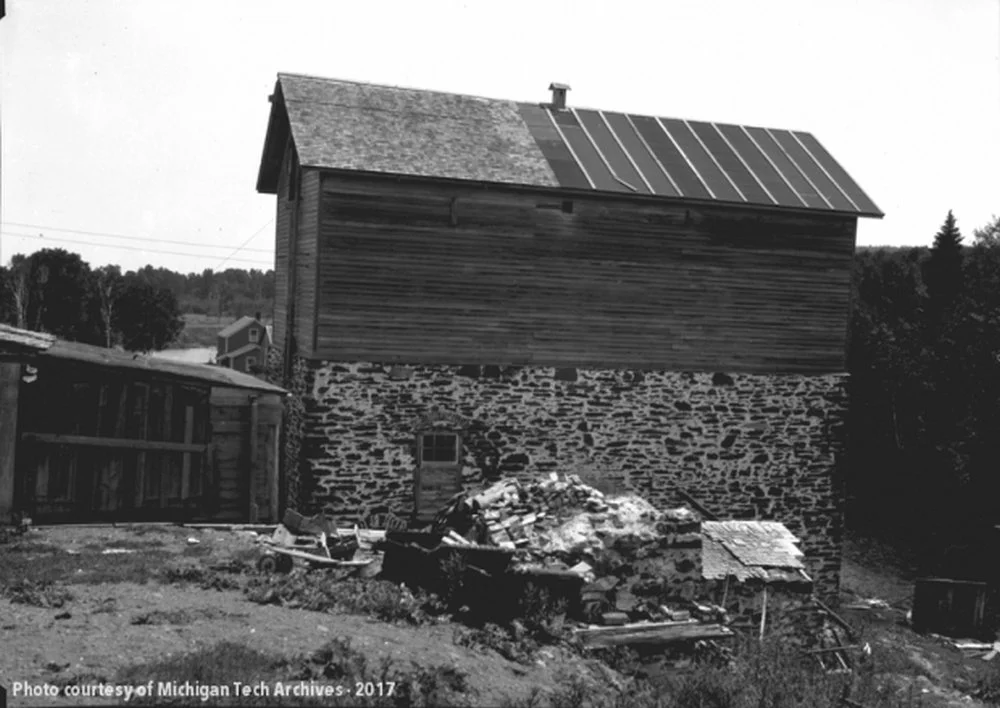
“Knivel Brewery.” J.T. Reeder. MS042-045-U-208. Reeder Photograph Collection. Michigan Technological University Archives and Copper Country Historical Collections.
Eagle River was also home to a second brewery. Farther down the river near the center of the village stood the Clemens Brewery. It was described as having roughly the same capacity as the Knivel operation. The Clemens Brewery was destroyed in the June 1867 fire that burned much of Eagle River’s business district and was not rebuilt. Today, little remains except for a cave that was used to store beer. For a time, however, Eagle River supported two brewing operations within a small geographic area. That fact reflects both the size of the workforce and the importance of beer in mining communities during the mid-nineteenth century.
Like many industries in the Keweenaw, Eagle River’s breweries depended on transportation. The town had access to lake shipping, but it had not secured a railroad connection. Moving goods over rough roads limited commercial growth and made it difficult to compete with larger brewing centers. Efforts were made in 1890 and 1891 to revive the old brewery, and local newspapers encouraged support for reopening the business. Without a railroad, however, transportation remained a serious obstacle.
As Frank Knivel Jr. prepared to leave Eagle River for Lake Linden, he composed a short poem that reflected both disappointment and hope. The verses were later printed in the Calumet and Red Jacket News in May of 1890:
We leave our revered homes,
Which causes our hearts to yearn;
For the building of a railroad,
And then we will return.
When the mines shall be developed,
It will cause us to rejoice,
When there'll be plenty work and labor,
And business will have a chance.
Then come, ye men with money,
And listen to what we say;
The mineral wealth of Keweenaw,
If managed right, will pay.
Without improved transportation and renewed mining development, reopening the brewery was unlikely to succeed. In time, brewing in Eagle River came to an end. It is easy to forget that Eagle River once supported two breweries within a village of only a few hundred people. For several decades in the nineteenth century, brewing formed part of the town’s industrial identity alongside shipping and mining supply. The remains of those operations are minimal today, but the record shows that beer was manufactured here, bottled here, and distributed from this river port into the surrounding mining country.
The Copper boom area was expected to grow quickly, and it was decided that it needed its own county. Keweenaw County was formally established in 1861 by the state of Michigan. Eagle River remained the county seat, with Houghton becoming the new county seat of that southern county. When a courthouse and jail were decided to be built in 1863, John Senter was appointed as agent for the county to construct the buildings. The jail in the attic of the German Hotel was no longer doing the job; it was often filled to the brim and had little oversight from county officials. The first courthouse in Eagle River was built in 1866. Later, a residence for the sheriff that also housed a larger jail was built next door in the same style. The sheriff’s wife traditionally provided meals for the inmates. Amazingly, this tradition continued until the 2010s when Sheriff Lahti and his wife retired.
Around this time, an Eagle River resident was attentively noting his days and the world around him. From 1867 until the 1890s, William S. Tyler, the former county clerk of Keweenaw County, kept a weather and botany log, a detailed personal diary, and spent time photographing around Eagle River. His diary contemplates religion and man’s place in the world. He often debated to himself the current cases developing at the courthouse. On August 1, 1869, Tyler wrote: “The weather has been in moderation for the last month in temperature though we had 2 or 3 pretty hot days it has rained on average 2 times a week and sometimes been rainy for 2 days at a time.” Almost every day’s weather from the late 1860s until the early 1870s was diligently logged by Tyler.
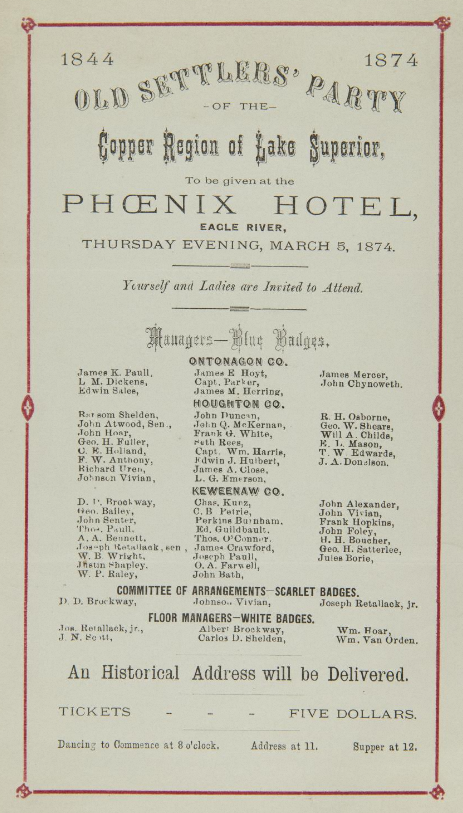
Program of Old Settlers Party, Object ID 2019.147.5, March 5, 1874, Henry Ford Museum.
The largest hotel in town was not the Longs’ but the Phoenix Hotel near the shoreline. It was advertised and known as the finest hotel in the Upper Peninsula. The hotel was built by William B. Wright. He was the Du Pont explosives representative to the mining companies and had been ordered to Fort Wilkins as its government caretaker in 1846. Before the courthouse was built, a large room at the hotel served as a makeshift courtroom. Among its fine guests was President James Garfield and a mayor of Detroit. Famous Copper Country pioneer Daniel Brockway served as manager of the hotel in the early 1860s. It was renamed the Eagle River Hotel by its final owner, J.P. Petermann. He purchased the original warehouse and pier to tear them down to provide a better view for his guests. The hotel was later destroyed by a fire in 1912.
In its earliest years, Eagle River’s manufacturing centered around three different industries: brewing, blacksmithing, and fuse-making. Of the three, the fuse factory became the most significant and the most enduring.
Joseph Blight, Sr., had arrived in the Lake Superior region in 1854. Born in Cornwall, England, in 1832, he trained as a carpenter and joiner before emigrating to America in 1852. After time in New York and North Carolina, he came north to Copper Harbor and later settled in Eagle River. He worked as a mining carpenter at the Copper Falls Mine until 1862, when he began the fuse business that would define much of the village’s industrial history.
The Eagle River Fuse Company was headed by Richard Uren, Thomas Dunstone, and Joseph Blight. In the fall of 1862, it began operations beside the falls under the name of Superior Safety Fuse Company. From the beginning, it was taken as a serious industrial endeavor. The partners patented their machinery and built their own equipment. Five men worked ten-hour shifts in the early years, producing approximately 25,000 feet of fuse per day. By 1882, production had increased to 50,000 feet daily. The plant operated year-round, powered by water drawn from the thirty-five-foot drop of Eagle River Falls.
The idea of safety fuse did not originate in Michigan. It began in the mines of Cornwall, where miners needed a safer and more reliable way to ignite black powder charges. Earlier attempts used hollow goose quills or plant reeds filled with powder, but those methods proved unreliable. In 1831, Bickford, Smith & Co. of Cornwall patented a fuse made by drawing black powder into twisted fiber and coating it with waterproof asphalt. That innovation changed mining practices across the world.
Joseph’s wife, Mary Ann Terrill Blight, was essential to the operation. Before she came to Michigan, Mary Ann had worked in fuse manufacturing in Cornwall. When the factory was established at Eagle River, she already understood the process. Her experience from England became part of the foundation of the factory.
From its location beside the river, the factory supplied fuse to major mining companies in the region, including Calumet & Hecla and others operating across the Keweenaw. Production buildings were separated from one another, both to reduce the risk of explosion and to protect the details of the manufacturing process. Though small compared to larger eastern firms, the Eagle River plant developed a reputation for quality that extended well beyond the Upper Peninsula. A notice published in The Calumet News on January 17, 1896, congratulated the Blight Sons’ Fuse Company on what was described as the best year of business since its founding. The article noted that the firm’s reputation “for making the best fuse, has not suffered any,” and pointed to steadily increasing orders. By that point, the company also held the exclusive rights to sell Gold Medal blasting caps.
That work, however, was never without danger. On January 2, 1900, nearly nine tons of powder exploded on the highway between Phoenix and Eagle River. Two men, Joseph St. Louis and Joseph Mannerstrom, were killed along with four horses. The blast was heard as far away as Calumet. The exact cause was never fully determined. The explosion remains one of the most dramatic industrial tragedies connected to the village’s fuse trade. On May 1, 1957, a devastating fire destroyed the fuse factory. Much of the surrounding area was damaged, and the plant that had operated beside the falls since 1862 was gone. A nearby powder magazine was saved, preventing an even greater disaster. With the destruction of the factory, nearly a century of continuous manufacturing at that site came to an end.
A larger fire occurred in Eagle River in 1867, when the Long children were teenagers. Around midnight on June 23, a great fire began near Main Street and ten businesses and homes were lost. According to a Daily Mining Gazette article at the time, “almost the entire business portion of the town was destroyed.” Because there was no fire station, simple buckets of water from the nearby lake were used to attempt to douse the flames. Both sides of the street were eventually enveloped in fire, with the blaze only ceasing when there were no more buildings in the direction the wind was blowing. Misspellings were common at the time, and the “Loth’s Hall” referred to in the article is most likely Long’s House, which was sometimes called a hall. The fire insurance claim list shows that Joseph had a loss of $5000 but was only insured for $2500. It is unknown how much of the building had to be rebuilt after the fire, but we know some of the original structure survived because the attic jail cells are still intact.
The first Long child to get married was Elizabeth in 1869. She married Johann Clemens, relative of the Clemens Brewery family, in Cliff Mine in September of that year. Elizabeth and John, as he was known, had two children: Phillip, in 1872, and Anna, in 1873. The family then moved to Detroit, where many Clemens remained. Sadly, just a short time later Elizabeth died at only 22 years old. It is unknown how she died so young. Phillip and Anna remained in Detroit and later had families and many children of their own
Joseph and Catherine’s oldest son also married a German American. Margaret Barth and Henry Long were married in Eagle River in June 1872. The couple remained in Eagle River for the first years of their marriage. Together they had nine children: Joseph, Jacob, Catherine, William, Elizabeth, Anna Matilda, Maria, John, and Clara. Around 1890 they left Eagle River. They made their home in Hubbell and Henry worked as a teamster for the Calumet and Hecla Mine. In 1917 he became a watchman before retiring with a pension in 1919. He received a silver medal for service in 1920.
William Long, Joseph and Catherine’s youngest son, married a woman from his father’s homeland of Baden. Maria Meder arrived in the United States in 1882 and married William in Eagle Harbor in October of 1883. As Joseph passed in 1882, leaving Catherine a widow with a hotel and saloon to manage, William and his wife remodeled the buildings and managed the businesses. The 1887 and 1891 Michigan business directories both list him as a saloon-owner. In 1898 William placed an advertisement in The Calumet News, encouraging guests to stay at his newly renovated hotel, noting that it had excellent stabling facilities. The 1900 census also lists William as a hotel keeper, solidifying that he carried on the family’s business after his father’s passing. William and Maria had four children: Frank, Henry, Katherine, and William.
Catherine Neidermeier Long, the first European immigrant to give birth in the Keweenaw, passed away in 1909 at the age of 93. She had lived on Main Street in Eagle River longer than anyone else and it was widely reported on when she died. William eventually kept the house strictly as a family home but maintained the saloon until shortly before his death. He was probably the one who moved the front door to the left side of the building and added the front porch. His saloon was just as legendary and busy as his father’s.
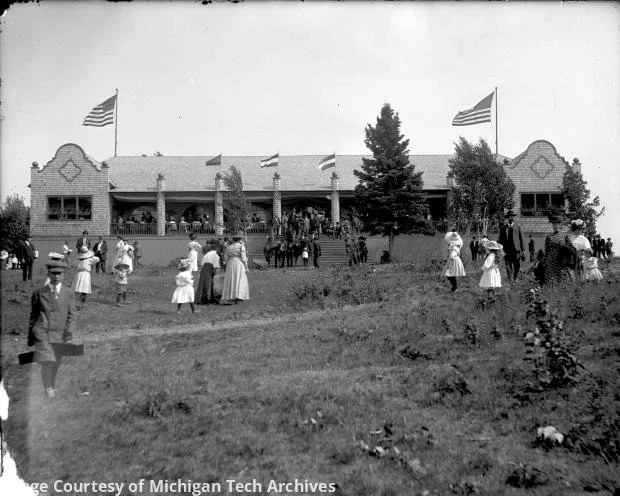
Photo of the Crestview Casino. Buildings - Pavilions. MTU Neg 00055. Roy Drier Photograph Collection. Michigan Technological University Archives and Copper Country Historical Collections.
When the Crestview Casino, which did not allow alcohol or gambling, opened, business in town grew immensely. The railway finally reached Keweenaw County in 1905, when the Keweenaw Central Rail Road was established. It quickly built a route between Mohawk and Phoenix, then extended its lines up the Keweenaw in the years that followed. In 1909 the Keweenaw Central Rail Road opened the Crestview Casino between Phoenix and Eagle River. As many as five trains arrived from Calumet to the park daily during the summer season. Only a fifty-cent train ride from Calumet or a short walk from Eagle River, the resort had a pavilion with a lunch counter, a restaurant, a casino, and a dance floor. Its most popular attractions were the live bands that would play while people mingled, ate, and danced. Its name came from its position at the crest of the hill above Eagle River, from which an observer could see a beautiful view of the lake.
Naturally, many people drifted from the resort down to the shore at Eagle River. Crestview itself advertised that the hotels in town were an excellent place to stay to enjoy the park for a few days. The Long Hotel was mentioned as an option, along with The Eagle River Hotel and the Eagle Hotel. On some occasions, many potential guests walked away disappointed and without a room. On the opening day of Crestview, the lunch counter and restaurant both ran out of food. According to a Daily Mining Gazette article about the Crestview Casino, as many as 250 guests were served on Main Street that day and “it was mentioned that this food was the finest ever served to people in a village as small as the county seat.” The resort was a popular attraction until it closed in 1925.
After Prohibition and the Great Depression, the Long saloon closed its bar for the last time. The family remains in the town to this day. Katherine Long, William’s daughter, became the town’s postmistress as an adult. From 1923 to 1958 she maintained the position in a building across from the German Hotel, her childhood home where she lived into old age. Eagle River was the first non-military post office in the Copper Country, and it was a position to be proud of. She passed in 1975 but is still remembered as a former kind, friendly neighbor in town.
Down the block from the hotel was Anton Sibilsky’s Eagle River General Store. After the declining population of the county due to the closure of the mines, most businesses in Eagle River closed or moved. At the front of Main Street is the enduring general store, opened in 1866. Sibilsky was a German immigrant who came to the U.S. in hopes of joining the California gold rush. Instead, once in America he heard of the next great mineral rush, one of copper, happening on Lake Superior. His obituary from 1910 describes his exceptional life: “By far the greatest number of the old pioneers had, at one time, traded at Mr. Sibilsky's general mercantile store at Eagle River, most of them were his personal friends. He passed away in the little town on the bleak Keweenaw peninsula where he had conducted a prosperous business nearly 45 years. He was one of those sterling characters who came into this Lake Superior district in its very young days, the days survived only by the rugged and the strong, and who not only watched this great copper camp grow to a leading place in the line of the world's mining localities but helped it materially in its growth.” He had managed his store until his death. The family then managed the store into the 1970s.
The German Hotel was the Long family home until the 1990s, when it passed to the Vivian family, descendants of Cornish Copper Country immigrants. Later, the Coles operated it as a vacation rental, and today the Shields own and manage the historic property. Though ownership has changed, the building remains one of the few visible links to the years when Eagle River was new and growing.
There were dozens of more photos, as well as a full genealogical chart of the Long family, in the original printed project that could not be included here.
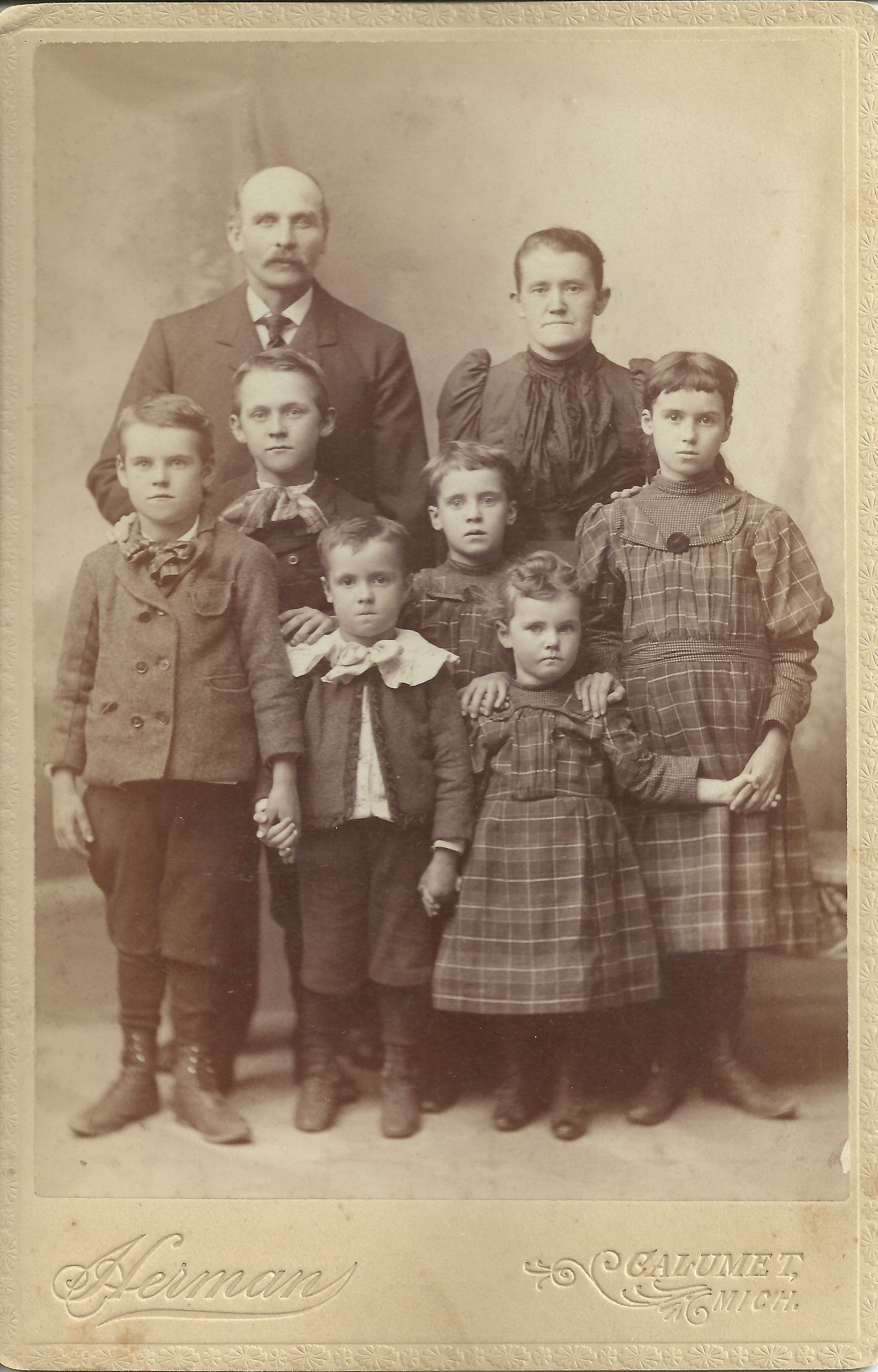
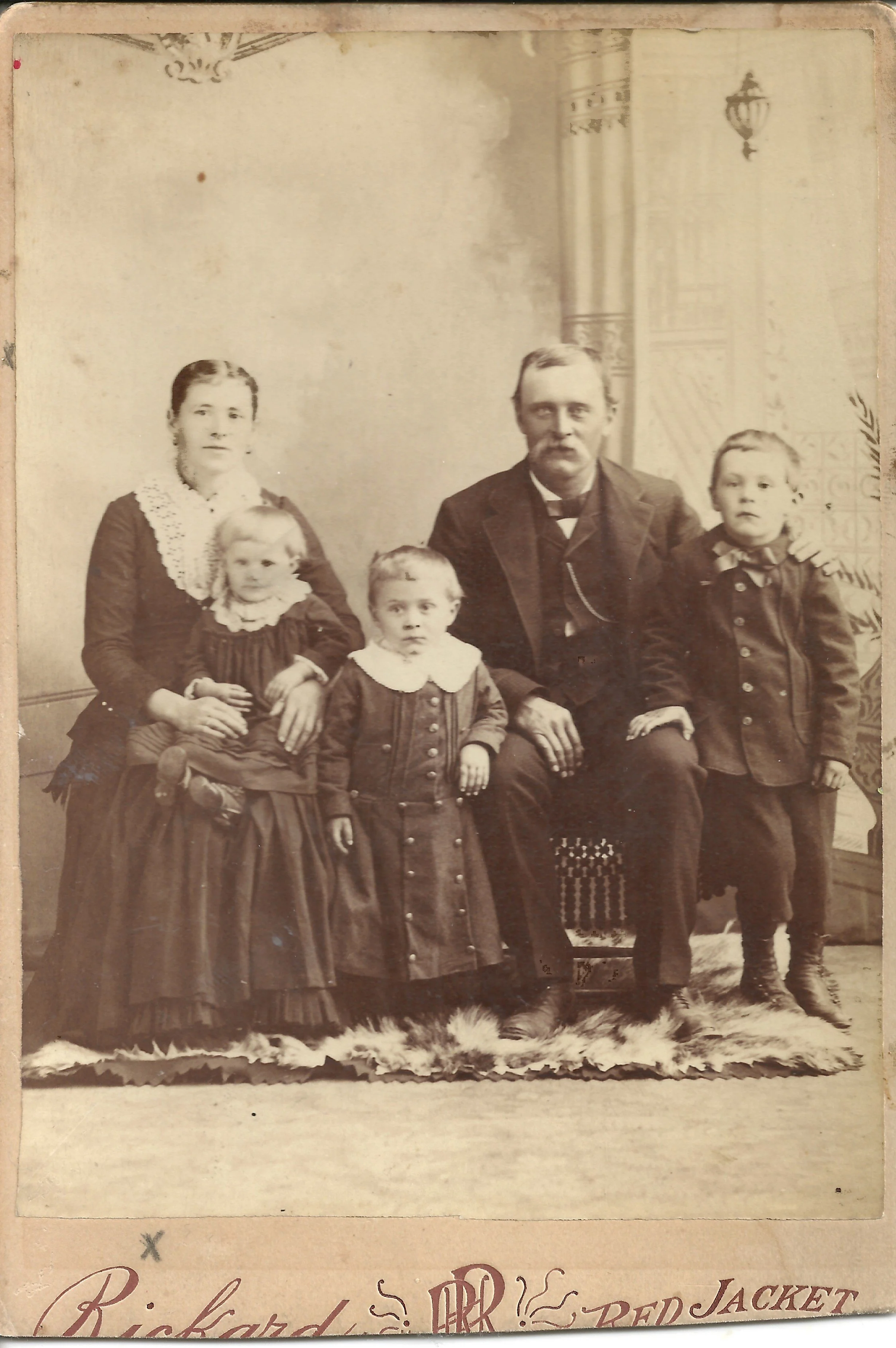
Photos of the Long family courtesy of Mary Long.
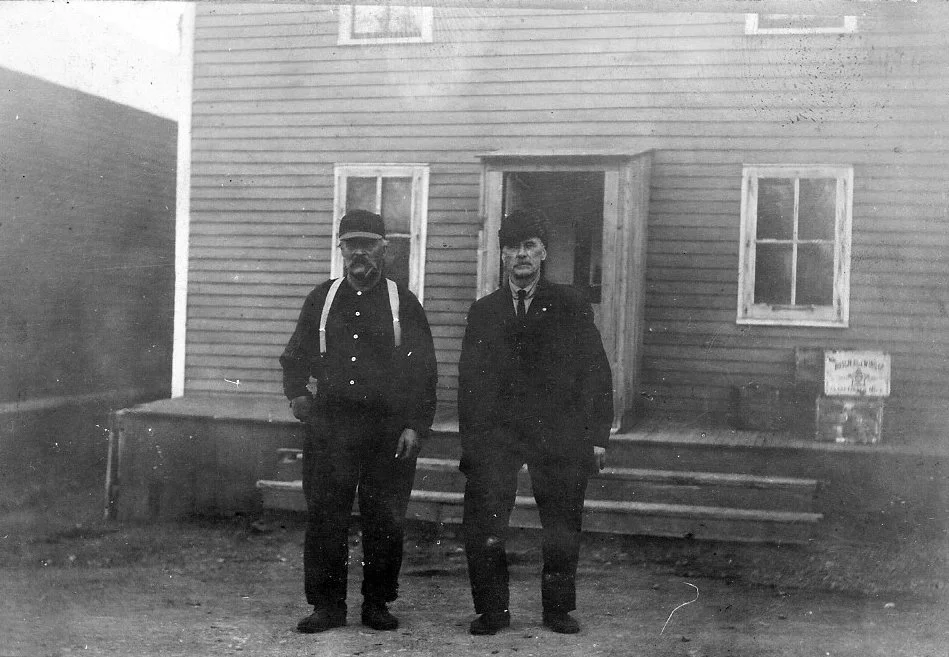
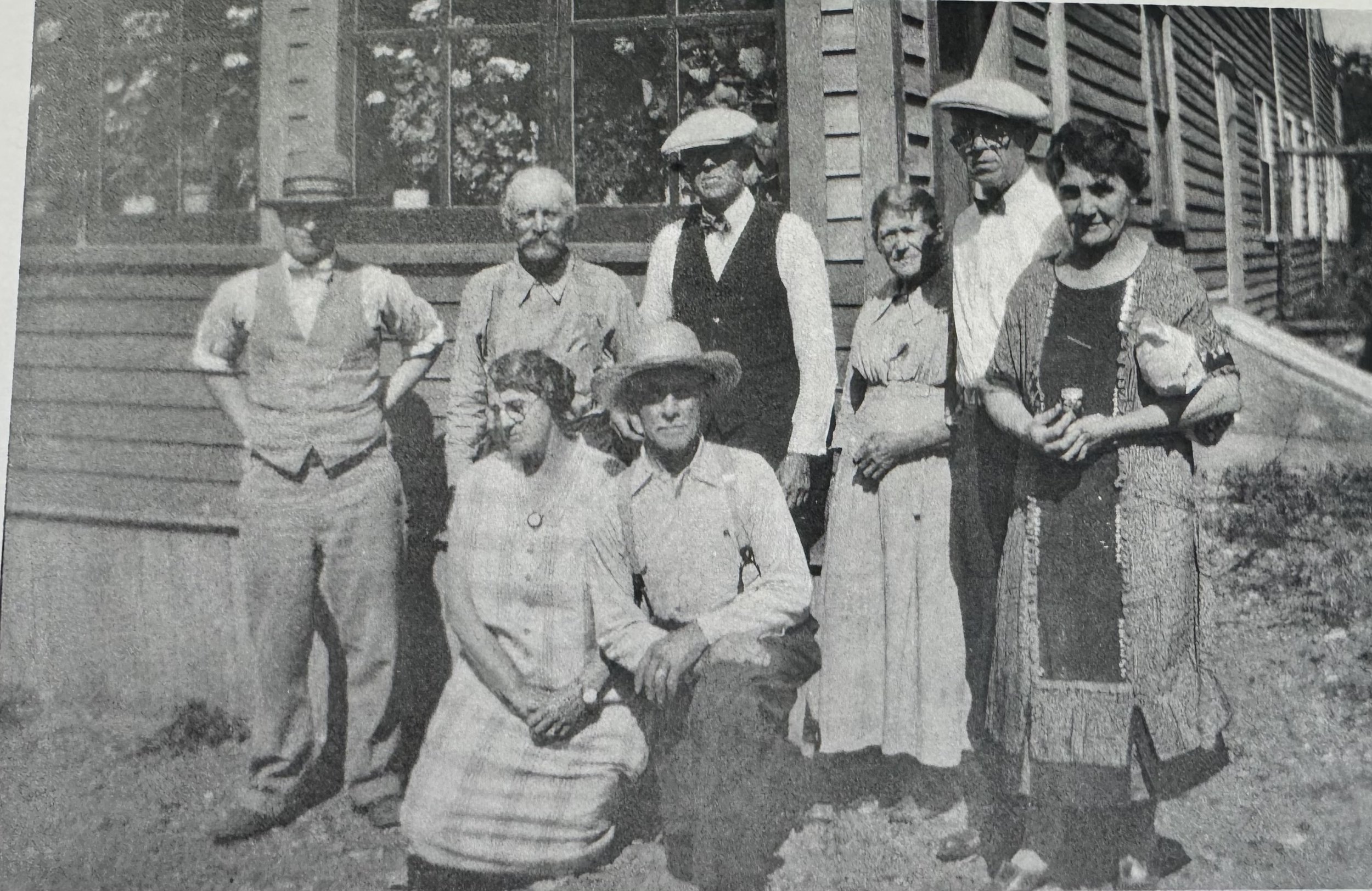
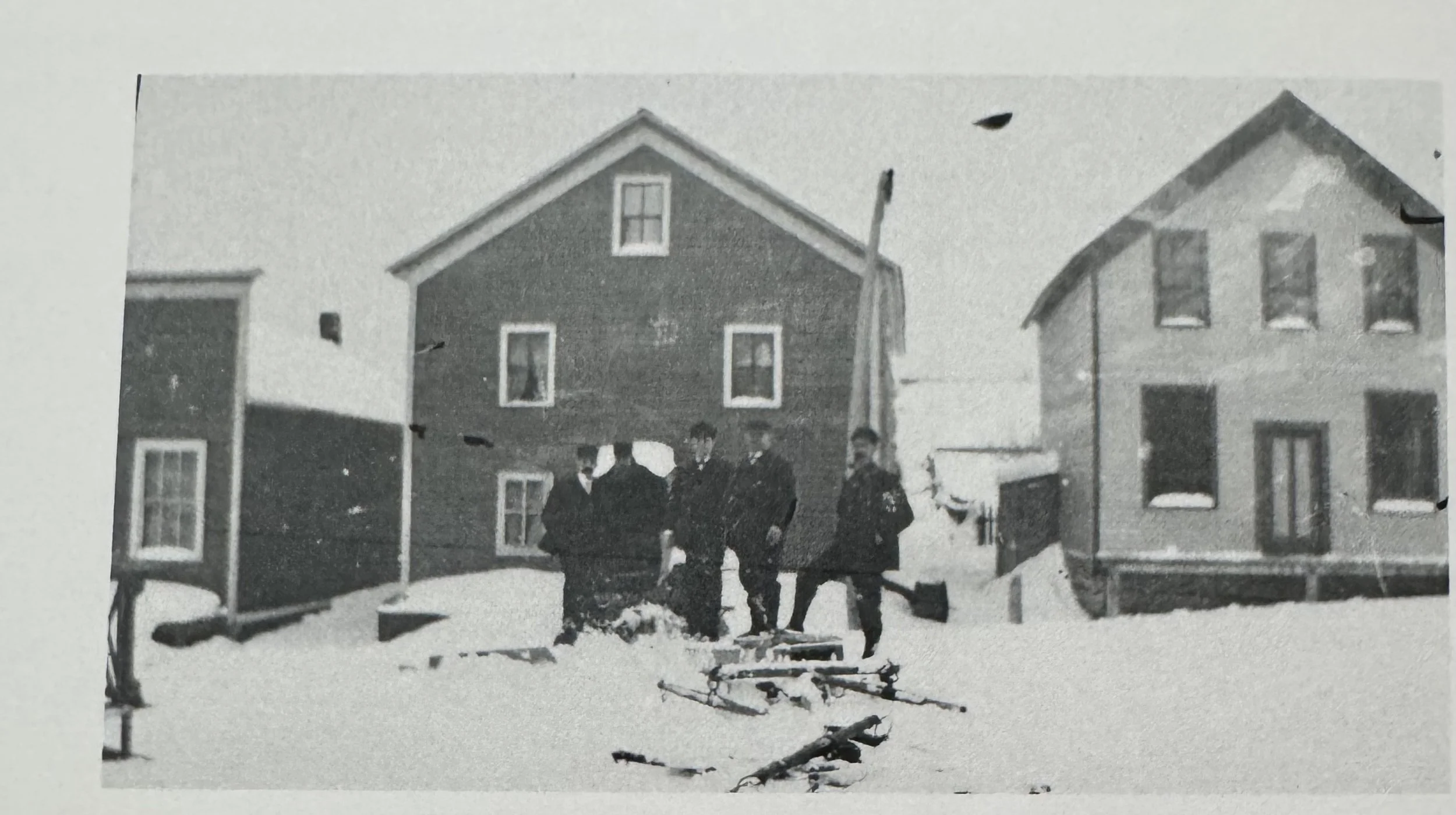
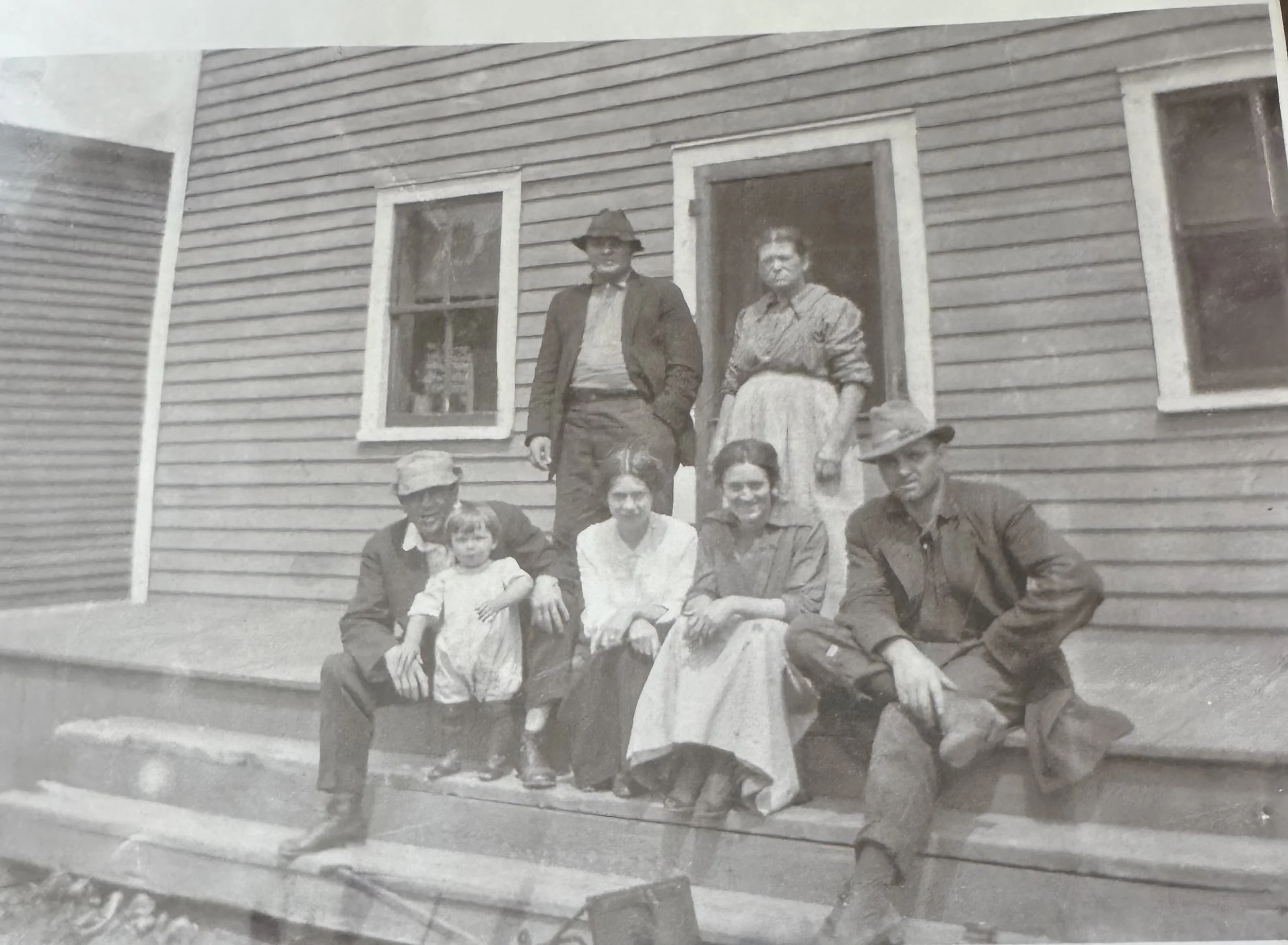
Thanks for reading! Please consider contributing to our research with a one-time donation. Let’s keep Copper Country history alive together.
Contribute to Copper Country history
Sources
"Eagle River 1900," Photograph. 1900. Library Card no. 172. Foster Collection. Keweenaw National Historical Park Archives.
“Anton Sibilsky.” The L’Anse Sentinel, November 12, 1910. Reprinted at Genealogy Trails. https://genealogytrails.com/mich/keweenaw/obitS.html
“August at Eagle River Store,” photograph, ca. 1920, Album 1, p. 52, Sibilsky Collection, Keweenaw National Historical Park Archives.
“Breweries.” In R. L. Polk’s Michigan State Gazetteer and Business Directory, 1880. Detroit: R. L. Polk & Co., 1880.
“Brockway Mountain Drive.” SAH Archipedia. https://sah-archipedia.org/buildings/MI-01-KW4
“Douglass Houghton with his dog.” Undated. Photographic strip, negative. MTU Neg 01103. MTU Vertical Photograph File. Michigan Technological University Archives and Copper Country Historical Collections.
“Eagle River Fuse Company.” The Calumet News (Calumet, Michigan), January 17, 1896, 2. Newspapers.com.
“Eagle River.” In Michigan State Gazetteer and Business Directory, 1863–1864. Detroit: R. L. Polk & Co., 1863.
“Eagle River.” In Michigan State Gazetteer and Business Directory, 1891–1892. Detroit: R. L. Polk & Co., 1891.
“Eagle River.” In Michigan State Gazetteer and Business Directory, 1887–1888. Detroit: R. L. Polk & Co., 1887.
"Eagle River ca. 1915," Curto Collection. Photograph. Ca. 1915. Album 14, no. 30. Keweenaw National Historical Park Archives.
"Eagle River.” Photograph. Ca. 1865. Treganowan Collection. Keweenaw National Historical Park Archives.
"Obituary of Catherine Myers Long." Collection of Mary Long.
“East Main Street,” photograph, ca. 1920, Album 3, p. 67, Sibilsky Collection, Keweenaw National Historical Park Archives.
“Entries for August and September 1869,” in “Weather Journal,” MS-584 William S. Tyler Papers, Box 1, Folder 2, p. 23, Michigan Technological University Archives and Copper Country Historical Collections.
“Grand Duchy of Baden,” Wikipedia, last modified February 17, 2026, https://en.wikipedia.org/wiki/Grand_Duchy_of_Baden
"Group photo." Photograph. Mary Long Collection.
“Henry and William Long.” Photograph. Mary Long Collection. Ancestry. https://www.ancestry.com/mediaui-viewer/collection/1030/tree/208979588/person/262735193040/media/835152a2-457a-414e-9f80-0d967898d177
“Henry Long Obituary.” The Daily Mining Gazette (Houghton, Michigan), December 3, 1935, 8. Michigan Technological University Archives and Copper Country Historical Collections.
“Henry Long Portrait.” Photograph. Mary Long Collection. Ancestry. https://www.ancestry.com/mediaui-viewer/collection/1030/tree/208979588/person/262735193040/media/d57a0037-fe84-47fc-b897-6983e2a72be8
“Henry Long Younger Portrait.” Photograph. Mary Long Collection. Ancestry. https://www.ancestry.com/mediaui-viewer/collection/1030/tree/208979588/person/262735193040/media/016b1fa8-67d9-40f4-9908-cce654e0e9f4.
“Houghton, Douglass.” Encyclopedia of Detroit. Detroit Historical Society. https://www.detroithistorical.org/learn/online-research/encyclopedia-of-detroit/houghton-douglass
“John Senter.” Photograph. MS019-07-05-01. Michigan Technological University Archives and Copper Country Historical Collections.
“Katherine Long Obituary.” The Daily Mining Gazette (Houghton, Michigan), June 5, 1975, 2. Michigan Technological University Archives and Copper Country Historical Collections.
“Keweenaw Central Railroad.” Michigan Railroads. https://www.michiganrailroads.com/railroads-in-history/463-k-l/3529-keweenaw-central-railroad-company
“Knivel Brewery.” Photograph. Copper Country Bottles. Michigan Technological University Archives.
“Long – William with Fish.” Photograph. Mary Long Collection.
"Long - Henry and Margaret." Photograph. Mary Long Collection.
"Long - Mary Katherine Henry." Photograph. Mary Long Collection.
"Long Saloon." Photograph. Mary Long.
“Mar 20-11.” Pasty.com Discussion Forum. https://www.pasty.com/discus/messages/6609/6770.html
“Margaret Barth Long.” Photograph. John Vertin Adams Collection. Ancestry.
"Men Working." Photograph. Mary Long.
“Miss Minnie Blight Is Stricken Today,” The Daily Mining Gazette, February 18, 1941, Keweenaw County Historical Society Collection, Vertical File—People—Long Family—Eagle River, Keweenaw National Historical Park Archives.
“Old Post Office, Eagle River, MI.” Pasty.com Discussion Forum, September 15, 2002. https://www.pasty.com/discuss/messages/994/1543.html.
“Old Senter Store,” Eagle River, Michigan, photograph, ca. 1900, Glass Plate no. 762, Petermann Collection, Keweenaw National Historical Park Archives.
“Photo of Eagle River,” in “Photo Album,” MS-584 William S. Tyler Papers, Box 1, Folder 1, p. 1, Michigan Technological University Archives and Copper Country Historical Collections.
“Thursday April 27 2006 10:31pm.” Pasty.com Discussion Forum. https://www.pasty.com/discus/messages/713/734.html.
“William Long Hotel.” The Calumet News (Calumet, Michigan), May 19, 1898, 4.
“William Long Obituary.” The Daily Mining Gazette (Houghton, Michigan), April 27, 1939, 8. Michigan Technological University Archives and Copper Country Historical Collections.
“William Miller Obituary.” The Calumet News (Calumet, Michigan), January 6, 1896, 4.
Allen, R. C. “Dr. Douglass Houghton.” In Some Upper Peninsula Pioneers: From Michigan Pioneer and Historical Collections, Volumes 1–40, 1–8. Iron Mountain, MI: Mid-Peninsula Library Federation, 1974.
Blight, Joseph. Civil War draft registration, July 1, 1863, Copper Falls, Keweenaw County, Michigan. Record Group 110. National Archives and Records Administration, Washington, DC.
Bornhorst, T. J., and L. J. Molloy. Douglass Houghton – Pioneer of Lake Superior Geology. A. E. Seaman Mineral Museum Web Publication 4. 2017.
Fancy, Marisa. “The Legacy of Blight’s & Sons: Pioneers of Fuse Manufacturing in Michigan’s Mining Era.” Northern Michigan History.
Farmer, Silas. The Michigan Book: A State Cyclopedia, with Sectional County Maps Alphabetically Arranged. Detroit: S. Farmer & Co., 1901. Image 123. Library of Congress. https://www.loc.gov/resource/gdcmassbookdig.michiganbookstat01farm/?sp=123
Genealogy Trails. “Eagle River,” Genealogy Trails: Keweenaw County, Michigan Genealogy and History, https://genealogytrails.com/mich/keweenaw/cityeagleriver.htm
Genealogy Trails. “Eagle River, Michigan (East Main Street – 1910).” Genealogy Trails: Keweenaw County Michigan Genealogy and History.
Genealogy Trails. “Obituaries – Keweenaw County, Michigan.” Genealogy Trails: Michigan Genealogy and History. https://www.genealogytrails.com/mich/keweenaw/obitL.html
Henry C. Long, Employment Card, Calumet & Hecla Mining Company, record no. 120922, Calumet & Hecla Mining Company Records, Michigan Technological University Archives and Copper Country Historical Collections, accessed via Miner’s Database, https://miners.mtu.edu/ecm/record/120922
Isler, Adolf. Eagle River about 1889–90. 1889–1890. Glass plate positive. MS042-042-999-T-397. Reeder Photograph Collection. Michigan Technological University Archives and Copper Country Historical Collections.
Jaehnig, Graham. “A Look at Eagle River, Michigan.” LinkedIn, September 15, 2016. https://www.linkedin.com/pulse/look-eagle-river-michigan-graham-jaehnig-ma.
Jaehnig, Graham. “German Hotel Is Former Cooler for Brawlers.” Ours: The Magazine of Our Copper Country 4, no. 1 (2017).
Jaehnig, Graham. “Looking for a Fine Place to Sleep.” The Mining Gazette, May 16, 2015. https://www.mininggazette.com/news/features/2015/05/looking-for-a-fine-place-to-sleep/
Joseph Austrian, Autobiography, MS-505 Joseph Austrian Autobiography, Box 1, Folder 1, various pages, Michigan Technological University Archives and Copper Country Historical Collections.
Long, Joseph. Citizenship form. December 20, 1848. District Court of Houghton County, Michigan. Ancestry. https://www.ancestry.com/mediaui-viewer/collection/1030/tree/208979588/person/262735166798/media/1c1715ce-f938-48d3-b73f-4a0eec48dcc5
Magnaghi, Russell M. “Breweries in the Lake Superior Basin: An Essay.” Upper Country: A Journal of the Lake Superior Region, November 2021.
Meisner, Bernard N. Pushes, Pulls and the Records. Dallas Genealogical Society, German Genealogy Group. https://dallasgenealogy.org/DGS_Docs/GermanSIG/Handouts/2020_01_Pushes_Pulls_and_the_Records.pdf
Monette, Clarence. The History of Eagle River, Michigan. Lake Linden, MI: Welden H. Curtin, 1978.
MTU Neg 00052. Photograph. Michigan Technological University Archives and Copper Country Historical Collections. https://cchi.mtu.edu/MTU%20Neg%2000052
MTU Neg 00055. Photograph. Roy Drier Collection. Michigan Technological University Archives and Copper Country Historical Collections. https://cchi.mtu.edu/MTU%20Neg%2000055
Pasty Central. “Crestview Casino.” YouTube video, 2014. https://www.youtube.com/watch?v=jse5QvBFxBk
Program of Old Settlers Party, Object ID 2019.147.5, March 5, 1874, Henry Ford Museum, accessed February 24, 2026, https://www.thehenryford.org/collections/explore/artifact/496959
Reeder, J. T. Eagle River Hotel. September 4, 1922. Glass plate positive. MS042-062-999-Z-349. Reeder Photograph Collection. Michigan Technological University Archives and Copper Country Historical Collections.
Reeder, J. T. Eagle River in 1861. 1861. Glass plate negative. MS042-062-999-Z-471. Reeder Photograph Collection. Michigan Technological University Archives and Copper Country Historical Collections.
Scarlett, Sarah F., and Alison K. Hoagland. “Tour 2 Guidebook – Keweenaw County: From Frontier Ports to Northwoods Resorts.” Vernacular Architecture Forum 2024 Annual Conference. Department of Social Sciences, Michigan Technological University, May 2024. Digital Commons @ Michigan Tech.
Seaman Mineral Museum. Gold in Michigan. Michigan Technological University.
The Superior Signal. Vol. 20, no. 2 (May 2005). Keweenaw County Historical Society.
Thurner, Arthur W. Strangers and Sojourners: A History of Michigan’s Keweenaw Peninsula. Detroit: Wayne State University Press, 1994.
Todd Taskila, “Long and Whelan in Front of Hotel,” Facebook, https://www.facebook.com/photo/?fbid=6067915063268256&set=pcb.5942961992446696
U.S. Dept. of the Interior, National Register of Historic Places Inventory‒Nomination Form: Eagle River, Michigan (1984), National Archives and Records Administration, https://catalog.archives.gov/id/25339757
Western Historical Company. History of the Upper Peninsula of Michigan. Chicago: Western Historical Co., 1883.
Williams, Bessie. “First Jail in Keweenaw County Built in Eagle River in 1846.” The Daily Mining Gazette. Keweenaw County Historical Society Collection, Vertical File—People—Long Family—Eagle River. Keweenaw National Historical Park Archives.
