
Early Copper Country Immigrant Stories: Chinese
Like many growing industrial regions in the late nineteenth and early twentieth centuries, the Copper Country was shaped by immigration. When we speak about those immigrants today, we most often picture Finnish miners, Cornish captains, French-Canadian laborers, or Italian families who built homes along the rough streets of Hancock, Calumet, and Houghton. The names from European immigrant communities fill local census pages, church registers, and cemetery stones. Their stories are told in museums and family histories. Far less remembered is another small but visible group of immigrants who made their living not underground in the mines, but in steamy laundry rooms and behind restaurant counters.
At a time when Chinese laborers were subject to federal exclusion laws and mandatory registration requirements, the Chinese men in Houghton County appear in census records and newspapers almost entirely as laundrymen and restaurant proprietors. Their livelihoods were built in small businesses that they operated themselves, in contrast to the wage labor that defined much of the Copper Country economy.
With Lunar New Year coming next week, it seems fitting to pause and focus on this lesser-known community. In 1900, the federal census recorded sixty-three Chinesemen living in Houghton County. The 1903 Houghton County directory (to the right) lists twenty-four laundries, almost all owned by men of Chinese descent. Others ran chop suey restaurants, offering warm and unique food to local families. They provided their services across the mining towns of the Copper Country. Though small in number, they were visible in the daily life of the Copper Country.
Newspapers of the period reveal the hostility they faced. The men were routinely referred to as “Chinamen” and “Celestials,” their businesses mocked as “washee washee joints.” Articles made fun of their language and customs. When money went missing, suspicion quickly fell on a Chinese laundry. When disputes broke out, headlines emphasized race before facts. Federal officers traveled to Calumet and Hancock to arrest men believed to lack proper certificates of residence under the Chinese Exclusion Act, and some were jailed or threatened with deportation. While local newspapers did not note a married pairing of European immigrants, any marriage between a Chinese man and white woman was presented as gossip.
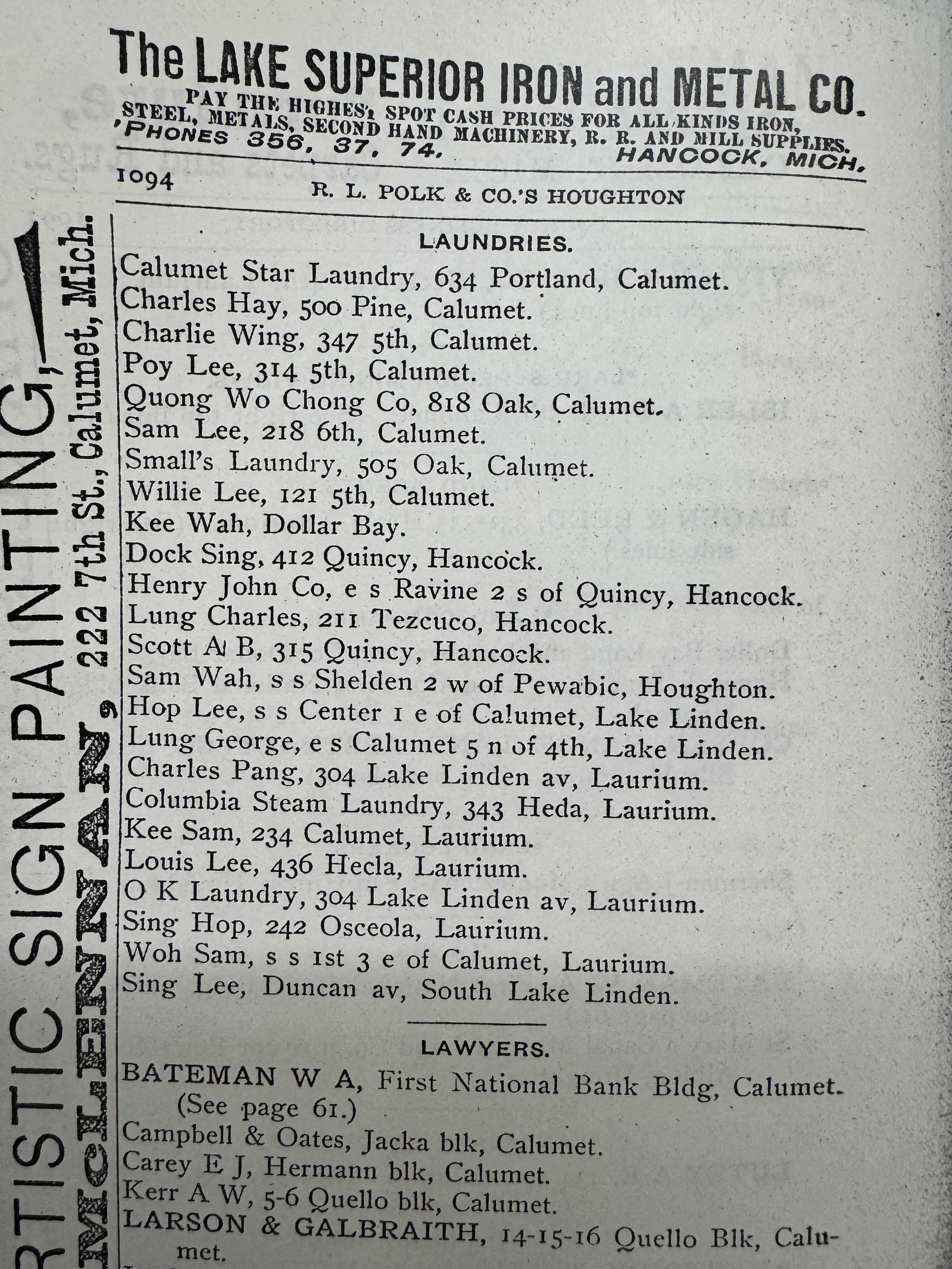
R. L. Polk & Co. “Laundries,” 1094. In Polk’s Houghton County, Michigan Directory, 1903–1904. Detroit: R. L. Polk & Co., 1903.
Yet these same pages also show Chinese residents celebrating their own holidays, joining local Fourth of July festivities, flying the new Chinese Republic’s flag alongside the American flag, and marrying European immigrant women. Men such as Willie Lee appear repeatedly in the local press, sometimes as a business owner hosting gatherings, sometimes as the subject of harassment or investigation.
Although the early Chinese population in the Copper Country was small, their presence left a mark on local history.
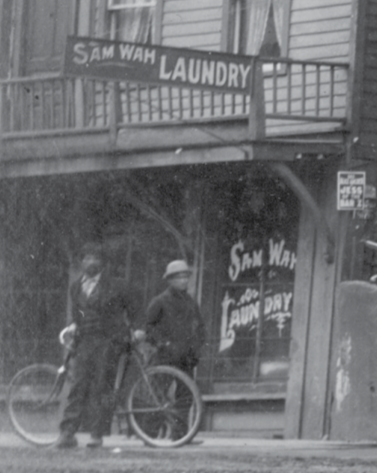
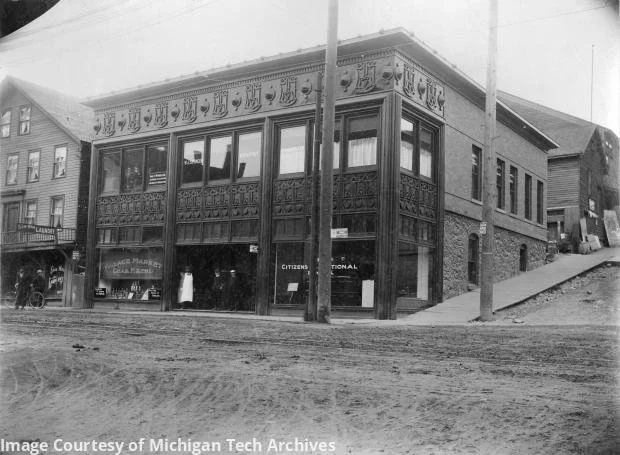
Unknown photographer. Downtown Houghton. Undated. Photographic print. No Neg 10-18-2005-001. Michigan Technological University Archives and Copper Country Historical Collections.
Sam Wah’s Laundry on Shelden Street in Houghton is featured in the 1903 directory above and in this undated photo.
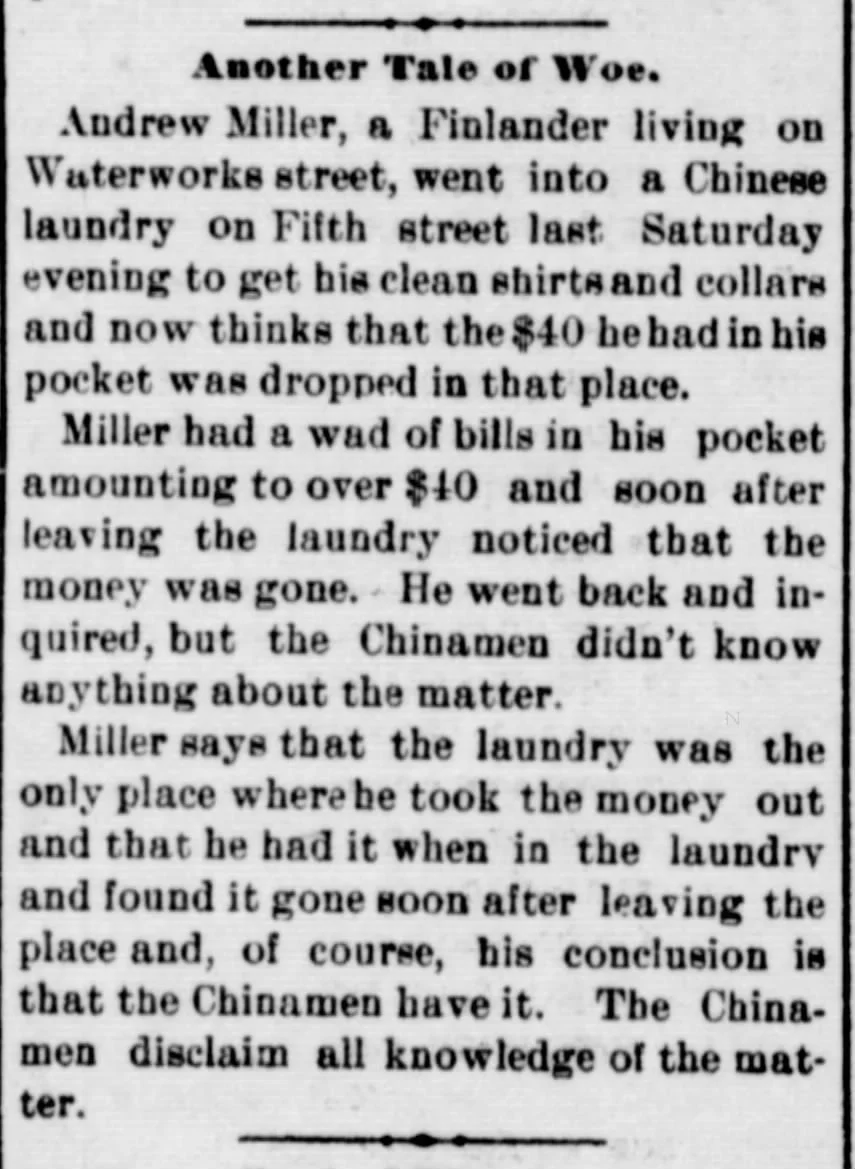
The Calumet News. March 17, 1886, pg 4. Newspapers.com.
https://www.newspapers.com/article/the-calumet-news-chinese-laundry-accused/188825225/
Another Tale of Woe.
Andrew Miller, a Finlander living on Waterworks street, went into a Chinese laundry on Fifth street last Saturday evening to get his clean shirts and collars and now thinks that the $40 he had in his pocket was dropped in that place.
Miller had a wad of bills in his pocket amounting to over $40 and soon after leaving the laundry noticed that the money was gone. He went back and inquired, but the Chinamen didn’t know anything about the matter.
Miller says that the laundry was the only place where he took the money out and that he had it when in the laundry and found it gone soon after leaving the place and, of course, his conclusion is that the Chinamen have it. The Chinamen disclaim all knowledge of the matter.
TAKE TO WASHING.
WHY THE CHINESE LIKE THAT BUSINESS IN THIS COUNTRY.
In the Most Other Places There Is None In China—Washing Is Covered Ponds or Cleaning Out the Dirt With Stones—Very Small Pay.
Among the thousands of Chinamen in this city few, besides the store and restaurant keepers on Race street, follow any other calling than that of laundryman. Consequently many Americans believe that the majority of China’s millions are laundrymen, who when not squirting water through their teeth upon shirts and linen, spend their time eating rats and puppies or indulging in the questionable “opium habit” of the “flower kind.” The truth is that the Celestial kingdom’s 40,000,000 of toilers find no smaller percentage of washing than any other large country. What little washable clothing they wear is cleansed in the paddy fields near the wearer’s home, and only the Emperor and other elite of native figure the assistance of a washman.
That important item of expense, the wash bill, is reduced to a minimum in China, where the European’s clothing is eagerly sought by young and old male natives, who are glad to do up in first class order white shirts, white underwear, coats or anything at all for 75 cents per hundred. This will partly explain why our Chinese residents prefer to do our laundry work to washing on our tables or sweating on a farm, as the money received for ironing and finishing a single white shirt will support him two days at his native country. Another reason is that when at work behind his ironing board, breathing the close air of his little shop, he appreciates the one hundred and one conveniences that he could not afford in China. Tabs, hot water, self acting soaps and washboards have not yet been introduced in his native home and have never been thought of by the poor beggars doing up shirts at three-quarters of a cent apiece. There they stand on the low stools or paddy field, ankle deep in the mud and even at times soaking the clothes slap them against the smooth stones put there for this purpose until the dirt becomes loosened and can be rubbed out with the hands.
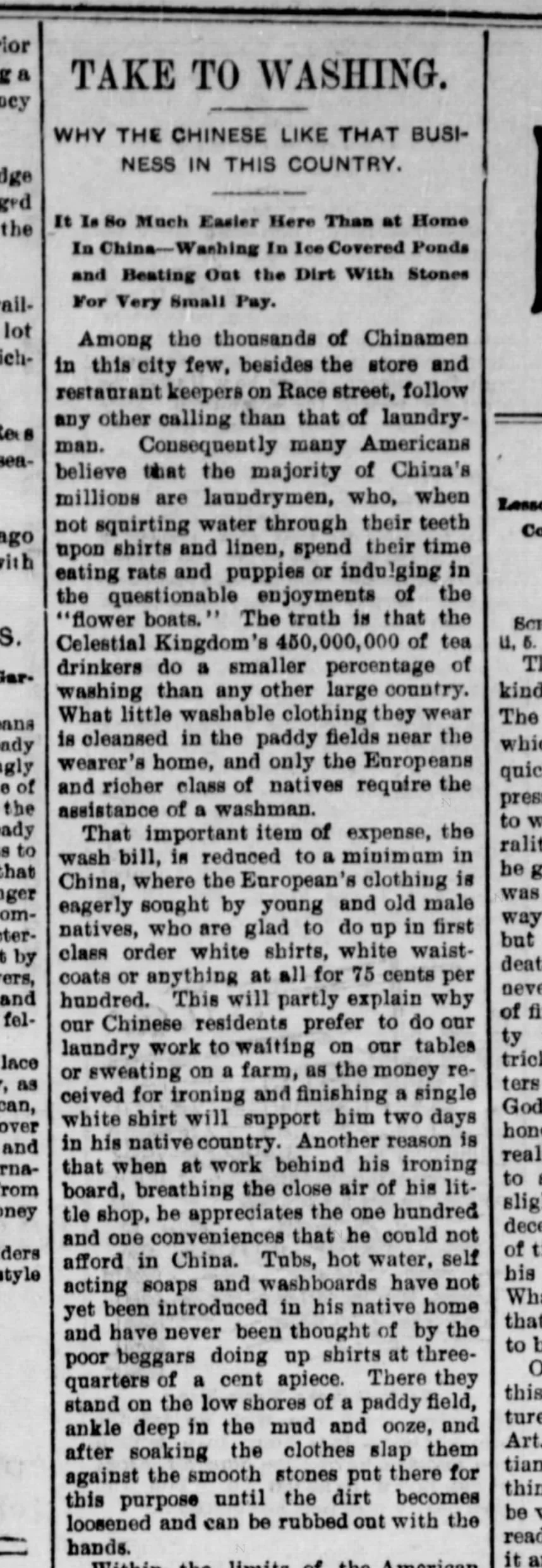
The Calumet News. March 25, 1896, pg. 3. excerpt from The Philadelphia Times. Newspapers.com. https://www.newspapers.com/article/the-calumet-news-article-about-chinese-l/187774009/
Chinese residents were often written about in local newspapers in a way that minimized and stereotyped them. Local Copper Country readers were told that the Chinese men living among them were so desperate that they must be happy with their apparent lowly work and status. The piece above claims to explain why Chinese men worked in laundries, but it does so by repeating exaggerated and offensive ideas. Chinese men preferred laundry work because even small wages here were better than what they could earn at home, according to this author. But what they do not mention are the federal exclusion laws, the required registration papers, or the discrimination the men faced that limited their job opportunities. Instead, it suggests they were naturally suited to laundry work or even content with that position.
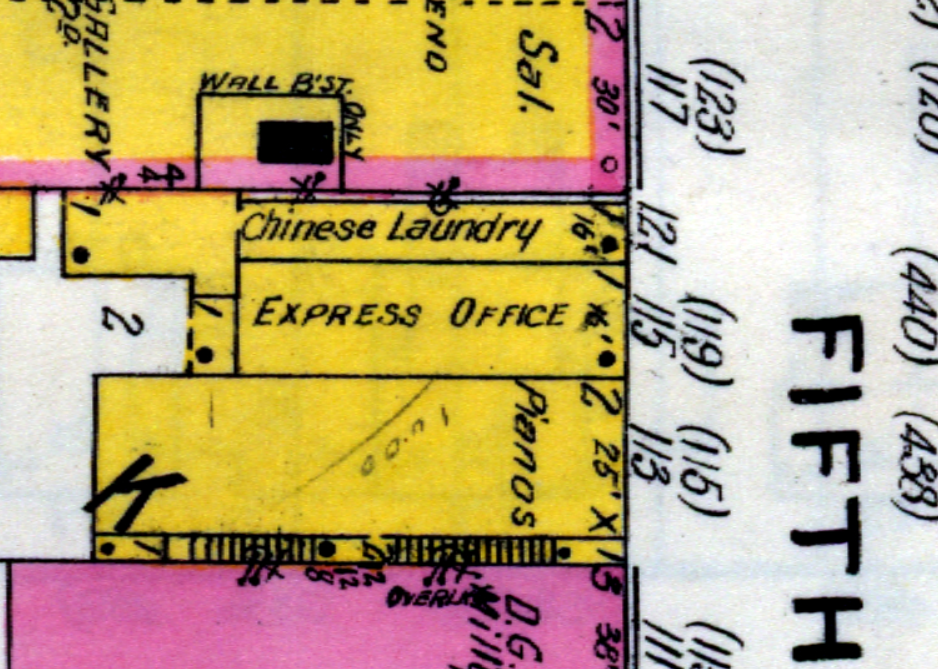
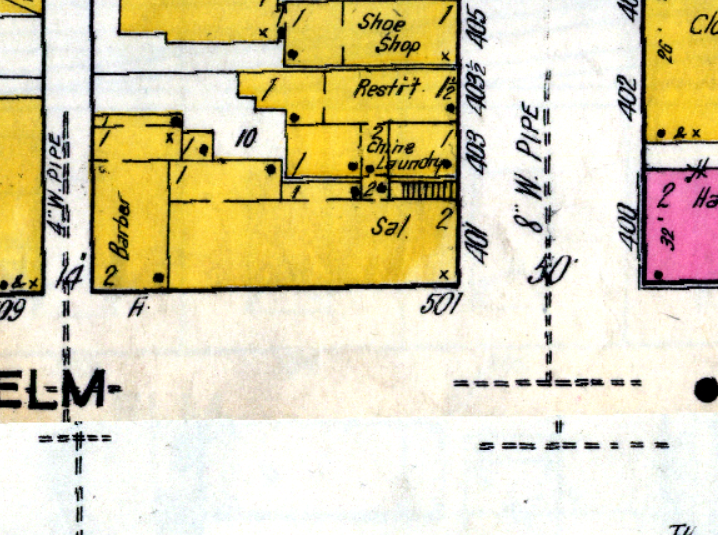
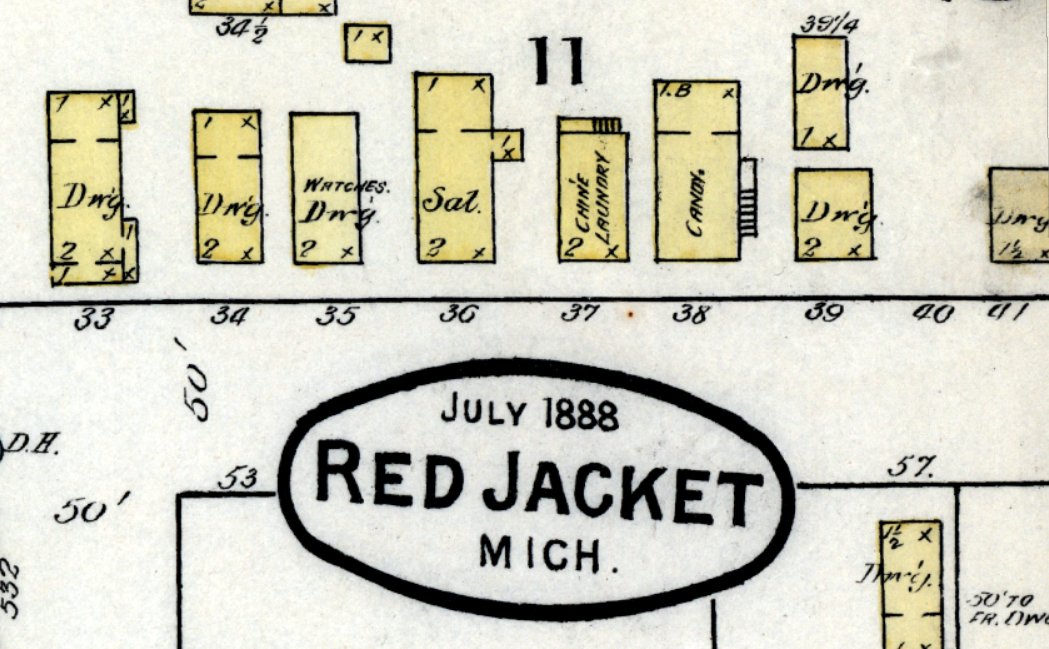
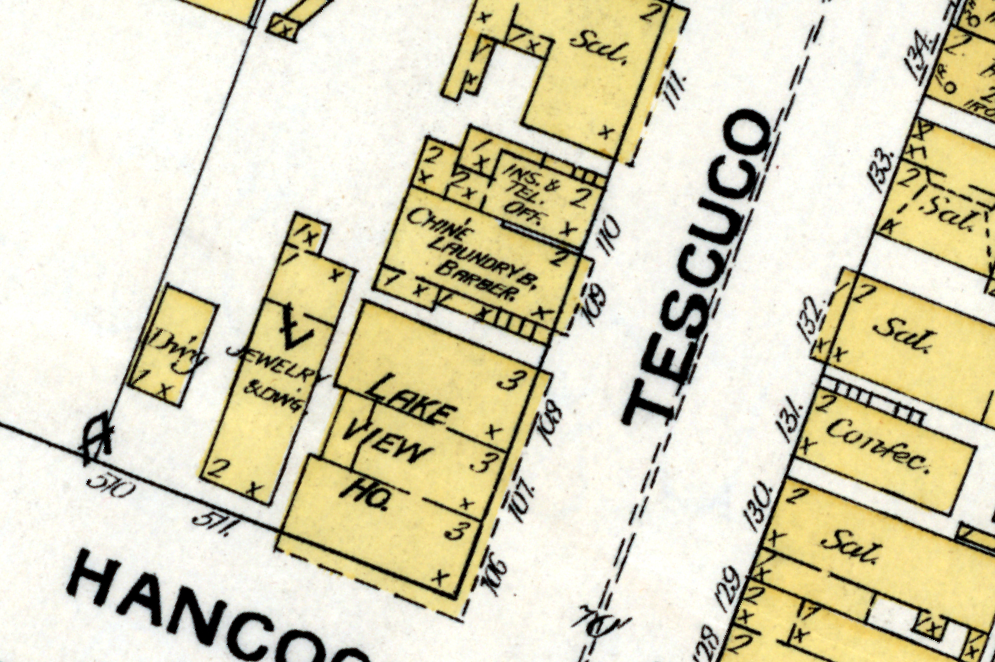

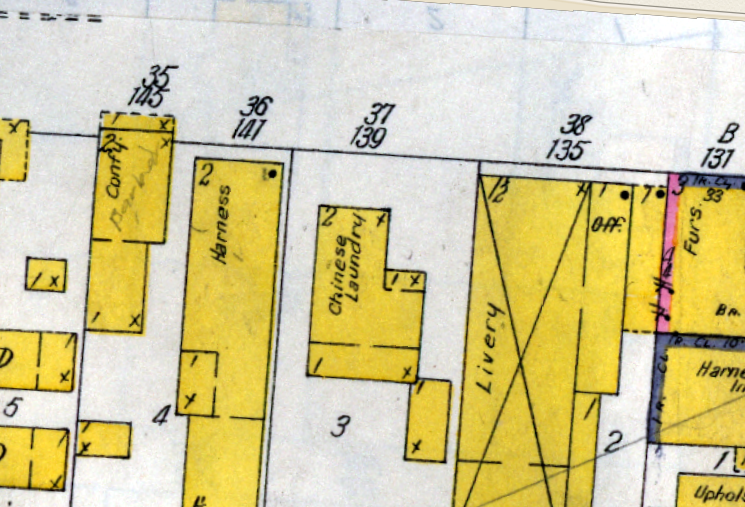
See bottom of page for map citations.
At the turn of the 20th century, Chinese laundries dotted the streets in most Copper Country towns. The maps above show them on various streets in Hancock, Houghton, and Calumet. Below, an early photo of Hubbell features a laundry on main street.
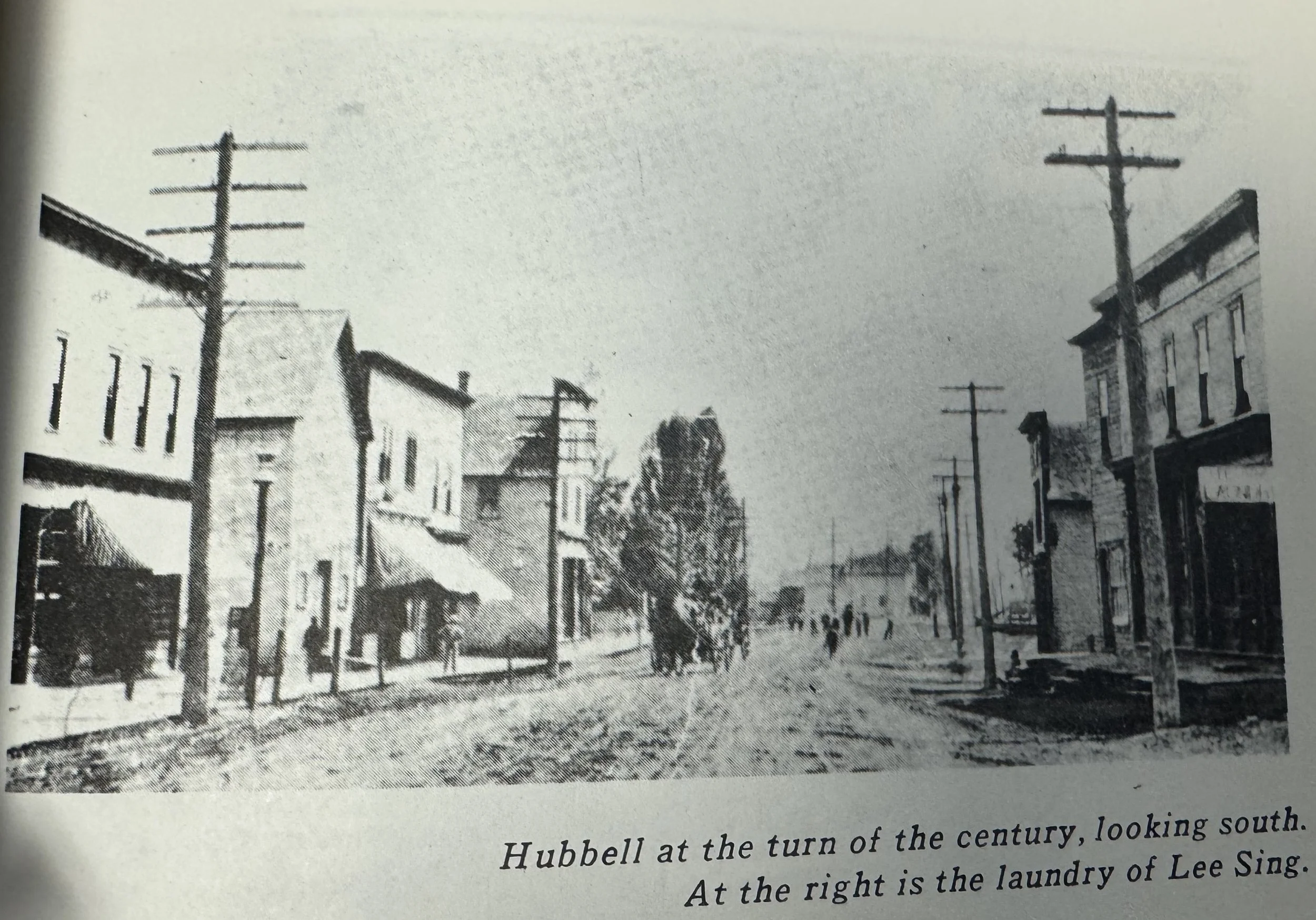
Monette, Clarence J. Lake Linden’s Yesterday: A Pictorial History. Vol. 2. Lake Linden, MI: Monette, 1977.
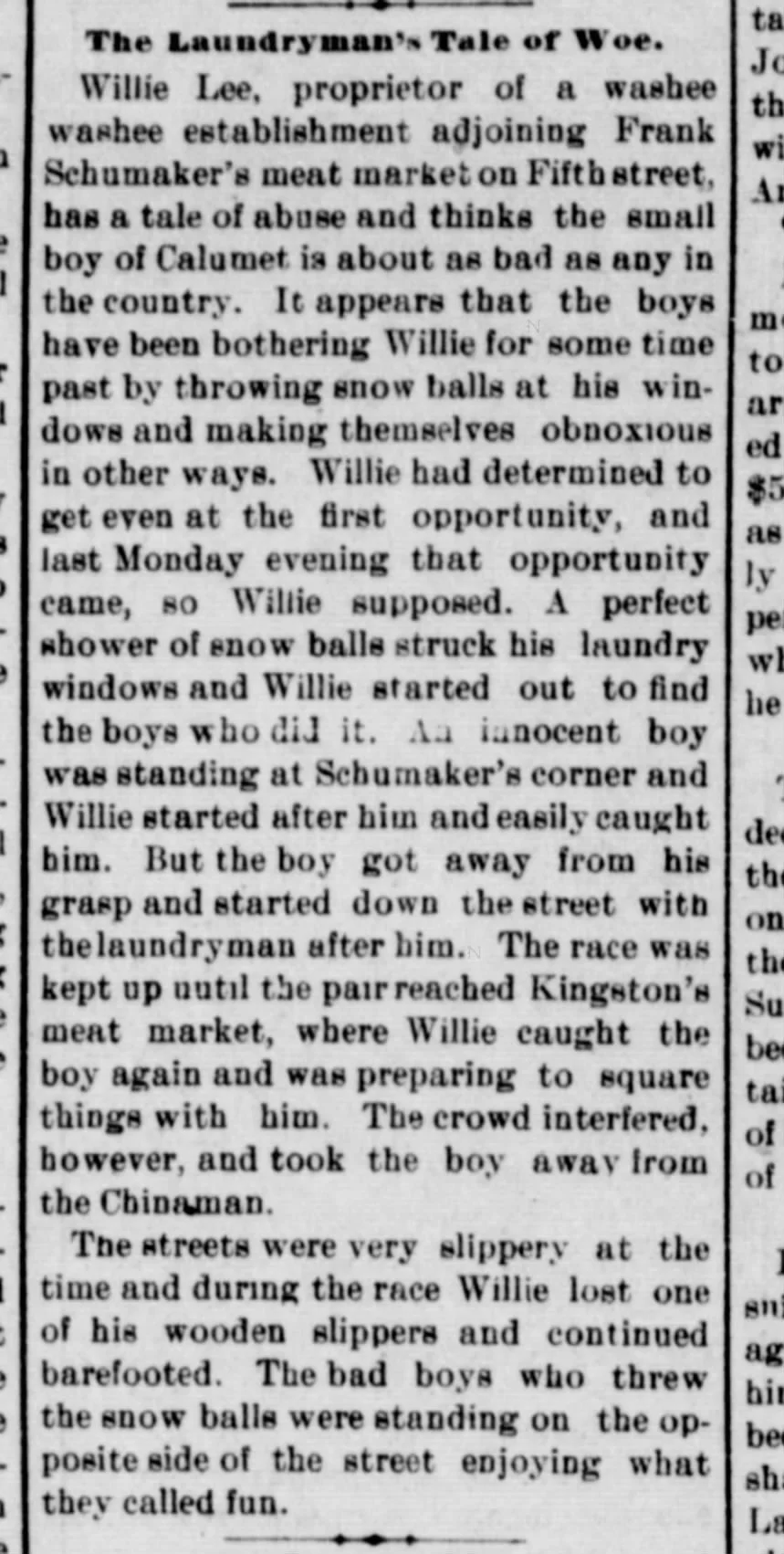
The Calumet News. April 15, 1896, pg 4. Newspapers.com. https://www.newspapers.com/article/the-calumet-news-willie-lee-calumet/187774118/
The Laundryman’s Tale of Woe.
Willie Lee, proprietor of a washee washee establishment adjoining Frank Schumaker’s meat market on Fifth street, has a tale of abuse and thinks the small boy of Calumet is about as bad as any in the country. It appears that the boys have been bothering Willie for some time past by throwing snow balls at his windows and making themselves obnoxious in other ways. Willie had determined to get even at the first opportunity, and last Monday evening that opportunity came, so Willie supposed. A perfect shower of snow balls struck his laundry windows and Willie started out to find the boys who did it. An innocent boy was standing at Schumaker’s corner and Willie started after him and easily caught him. But the boy got away from his grasp and started down the street with the laundryman after him. The race was kept up until the pair reached Kingston’s meat market, where Willie caught the boy again and was preparing to square things with him. The crowd interfered, however, and took the boy away from the Chinaman.
The streets were very slippery at the time and during the race Willie lost one of his wooden slippers and continued barefooted. The bad boys who threw the snow balls were standing on the opposite side of the street enjoying what they called fun.
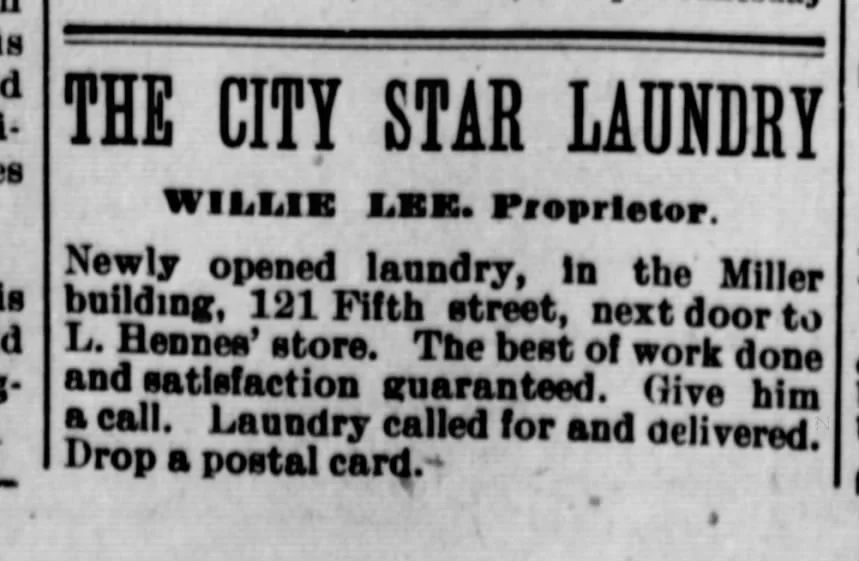
The Calumet News. October 27, 1897, pg. 2. Newspapers.com. https://www.newspapers.com/article/the-calumet-news-chinese-laundry-ad/188825915/
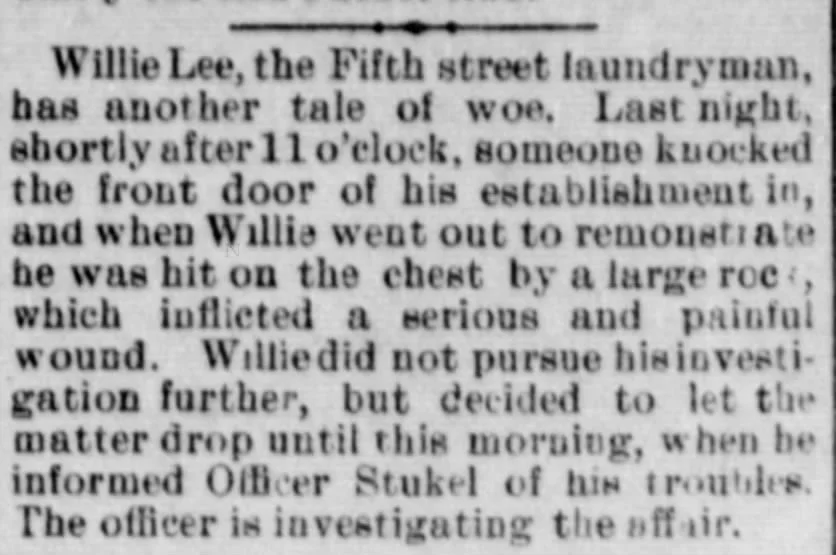
The Calumet News. May 16, 1896, pg 4. Newspapers.com https://www.newspapers.com/article/the-calumet-news-willie-lee-struck/187774189/.
Willie Lee, the Fifth street laundryman, has another tale of woe. Last night, shortly after 11 o’clock, someone knocked the front door of his establishment in, and when Willie went out to remonstrate he was hit on the chest by a large rock, which inflicted a serious and painful wound. Willie did not pursue his investigation further, but decided to let the matter drop until this morning, when he informed Officer Stukel of his troubles. The officer is investigating the affair.
In the early 1900s, Chinese residents appear regularly in Copper Country newspapers. But the way they are written about matters just as much as the fact that they are present.
One entry describes a basement gambling scene where “fifteen or twenty Chinamen” were gathered around a table covered with cash, the room described as filled with “noxious air,” and their reactions reduced to “Chinese squeals” (Copper Country Metropolis 52). The focus is not simply on gambling. It is on creating an image. The language makes the scene feel chaotic and foreign, reinforcing the idea that these men were different from the rest of the community.
A few years later, “Sam Hong, Hong Poy, Hong Sing, and Hong Din” were accused in what the paper called a gambling deal “of some magnitude” (Copper Country Metropolis 148). Instead of reporting the case plainly, the article referred to them as “slant-eyed natives of China” and mocked their speech in court (Copper Country Metropolis 148). Their race was not incidental. It shaped the entire tone of the story.
Even coverage of Lunar New Year carries this distance. The holiday is described as “the greatest holiday of the year among the natives of the land of the poppy and John Chinaman and his brothers in this country” (Copper Country Metropolis 95). Yet we know that men like Willie Lee were hosting these gatherings locally. Willie was a Fifth Street laundry owner, a businessman whose name appears again and again in the paper. He organized celebrations, ran his establishment, and lived his daily life in Calumet while the press continued to frame him as somewhat of an outsider.
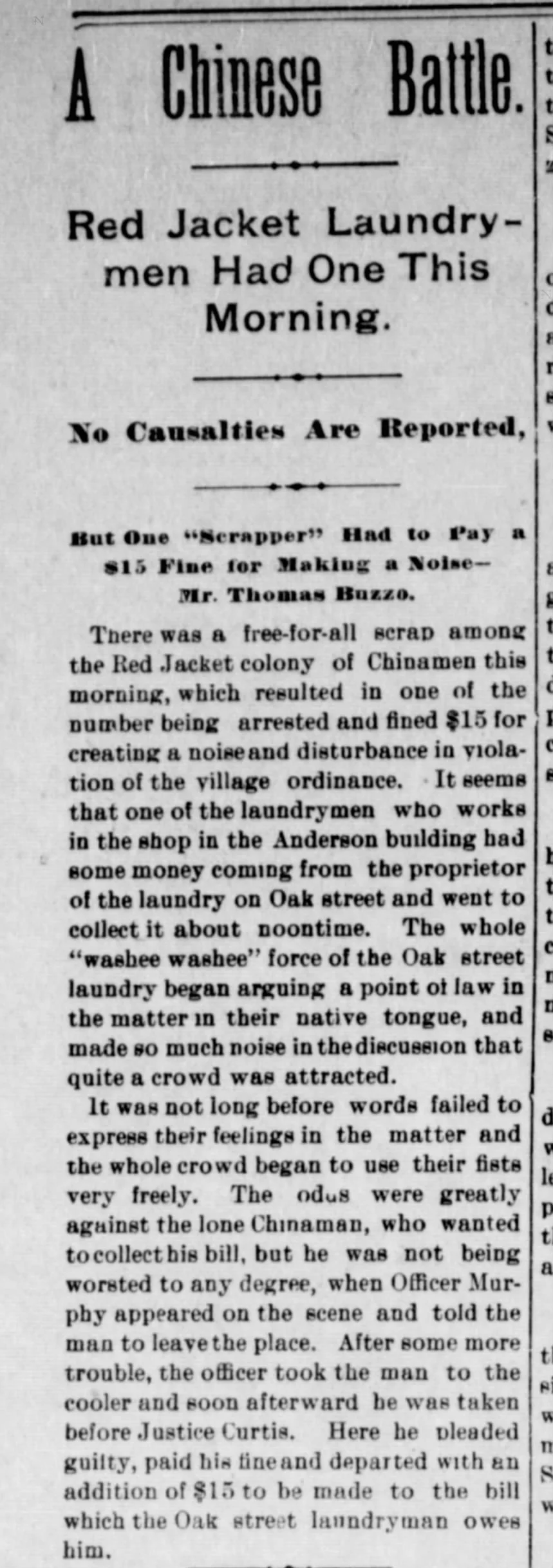
The Calumet News. December 28, 1896, pg. 4. Newspapers.com. https://www.newspapers.com/article/the-calumet-news-chinese-laundry-fight/188825566/
A Chinese Battle.
Red Jacket laundrymen had one this morning.
No casualties are reported,
But one “scrapper” had to pay a $15 fine for making a noise—Mr. Thomas Bazzo.
There was a free-for-all scrap among the Red Jacket colony of Chinamen this morning, which resulted in one of the number being arrested and fined $15 for creating a noise and disturbance in violation of the village ordinance. It seems that one of the laundrymen who works in the shop in the Anderson building had some money coming from the proprietor of the laundry on Oak street and went to collect it about noontime. The whole “washee washee” force of the Oak street laundry began arguing a point of law in the matter in their native tongue, and made so much noise in the discussion that quite a crowd was attracted.
It was not long before words failed to express their feelings in the matter and the whole crowd began to use their fists very freely. The odds were greatly against the lone Chinaman, who wanted to collect his bill, but he was not being worsted to any degree, when Officer Murphy appeared on the scene and told the man to leave the place. After some more trouble, the officer took the man to the cooler and soon afterward he was taken before Justice Curtis. Here he pleaded guilty, paid his fine and departed with an addition of $15 to be made to the bill which the Oak street laundryman owes him.
Willie Lee, who ran a laundry here for several years, but who left here last October on a visit to his old home in the land of the Celestials, got back yesterday and reports a fine time and a pleasant journey. Willie had been in the “washee washee” business in this country for many years until he had made quite a little money, so he determined to pay a visit to his parents in his native land and perhaps remain there, but he likes America and a few months’ visit at the old home was enough for him. He is willing to remain here for the remainder of his days. He has opened a laundry next to Hennes’ store.
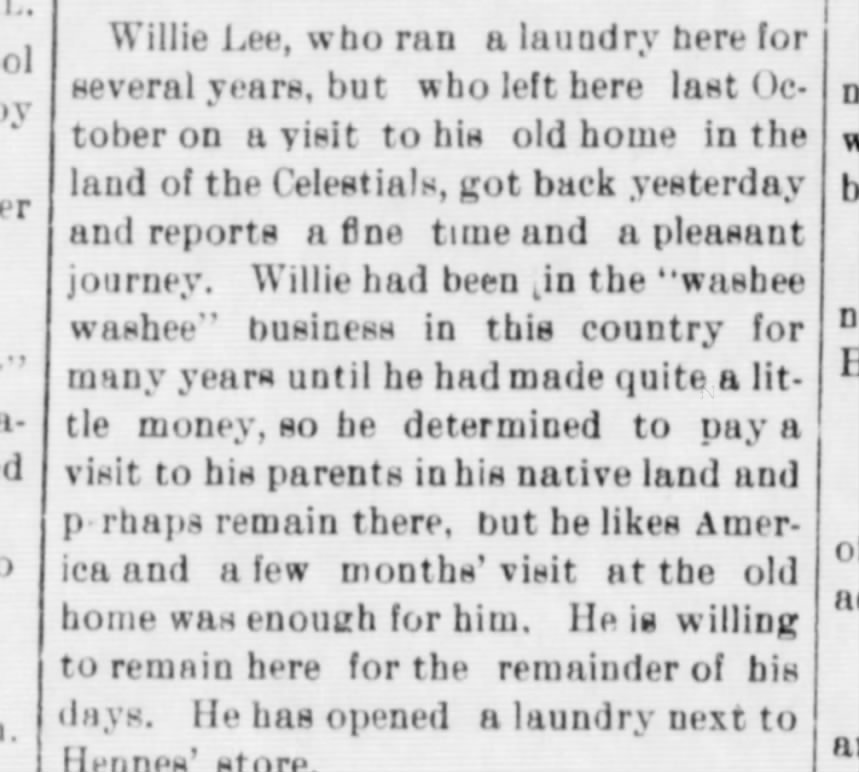
The Calumet News, September 18, 1897, pg. 4. Newspapers.com. https://www.newspapers.com/article/the-calumet-news-willie-lee-returns-from/188907267/
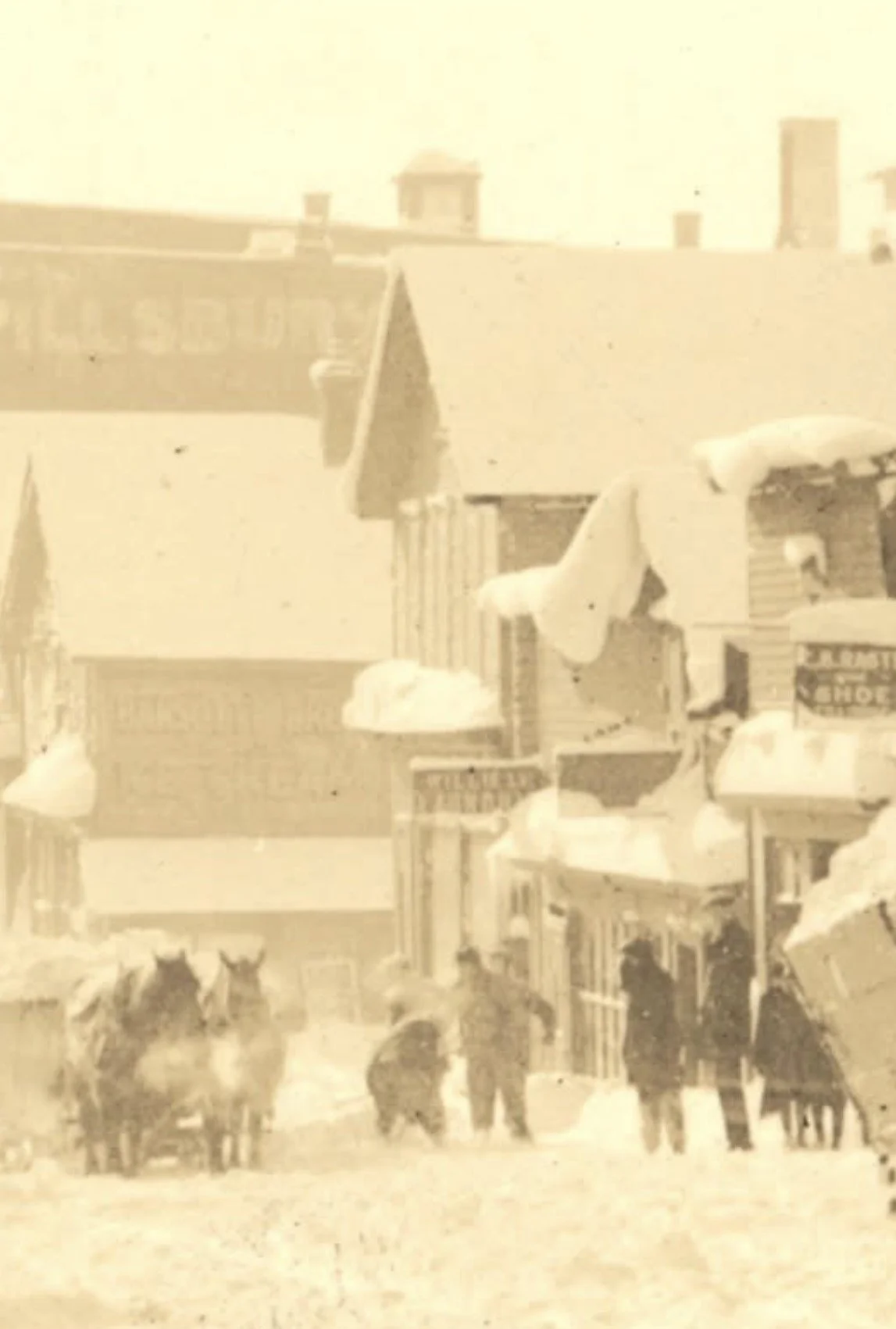
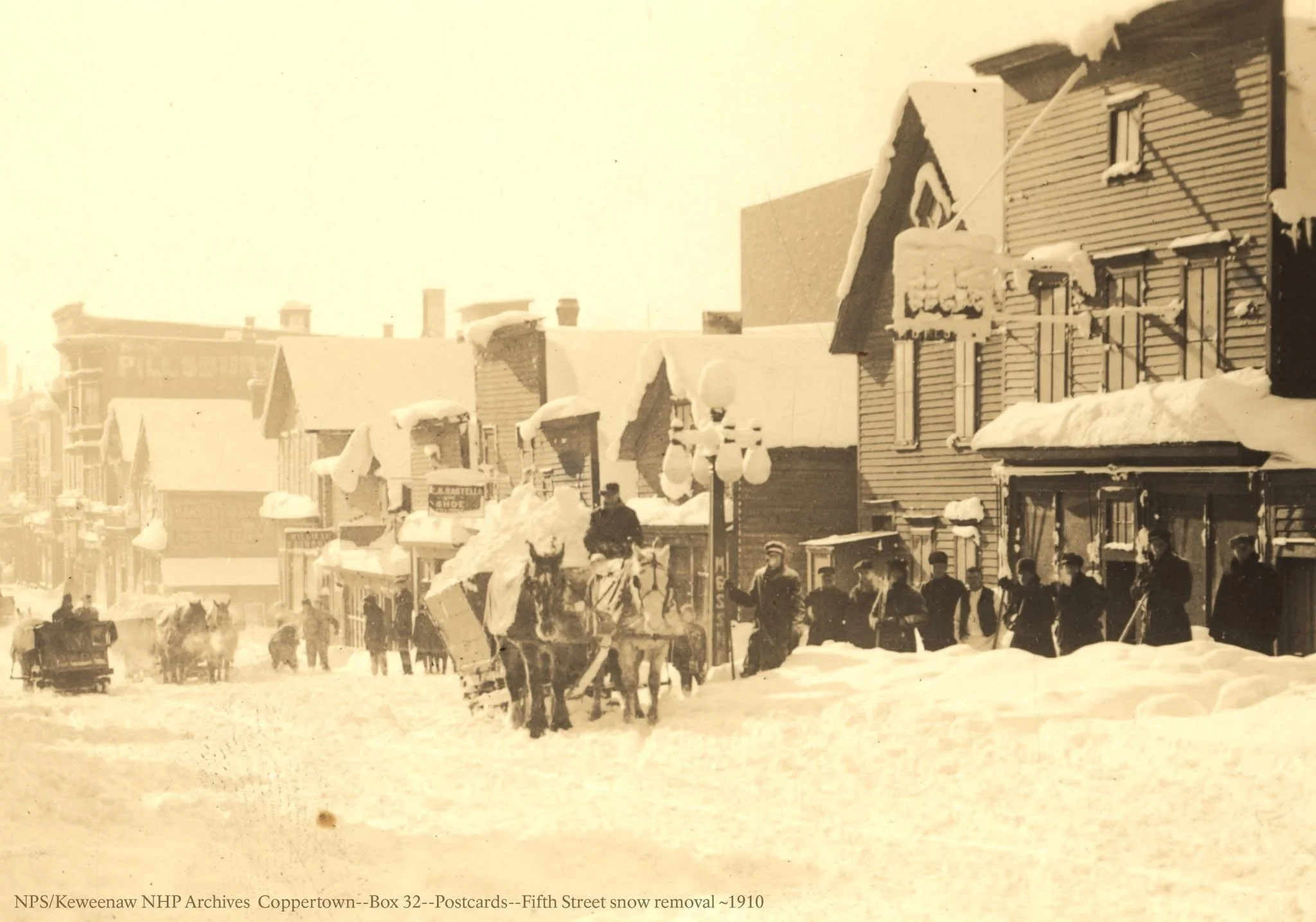
National Park Service, Keweenaw National Historical Park Archives. Fifth Street Snow Removal, Coppertown. ca. 1910. Coppertown—Box 32—Postcards.
This early photo of Fifth Street in Red Jacket (modern Calumet) shows Willie Lee’s Laundry. The sign is, admittedly, hard to make out but visible if viewed in the close-up. In the photo, the small shop has a group of boys or men playing in the snow in front of it.
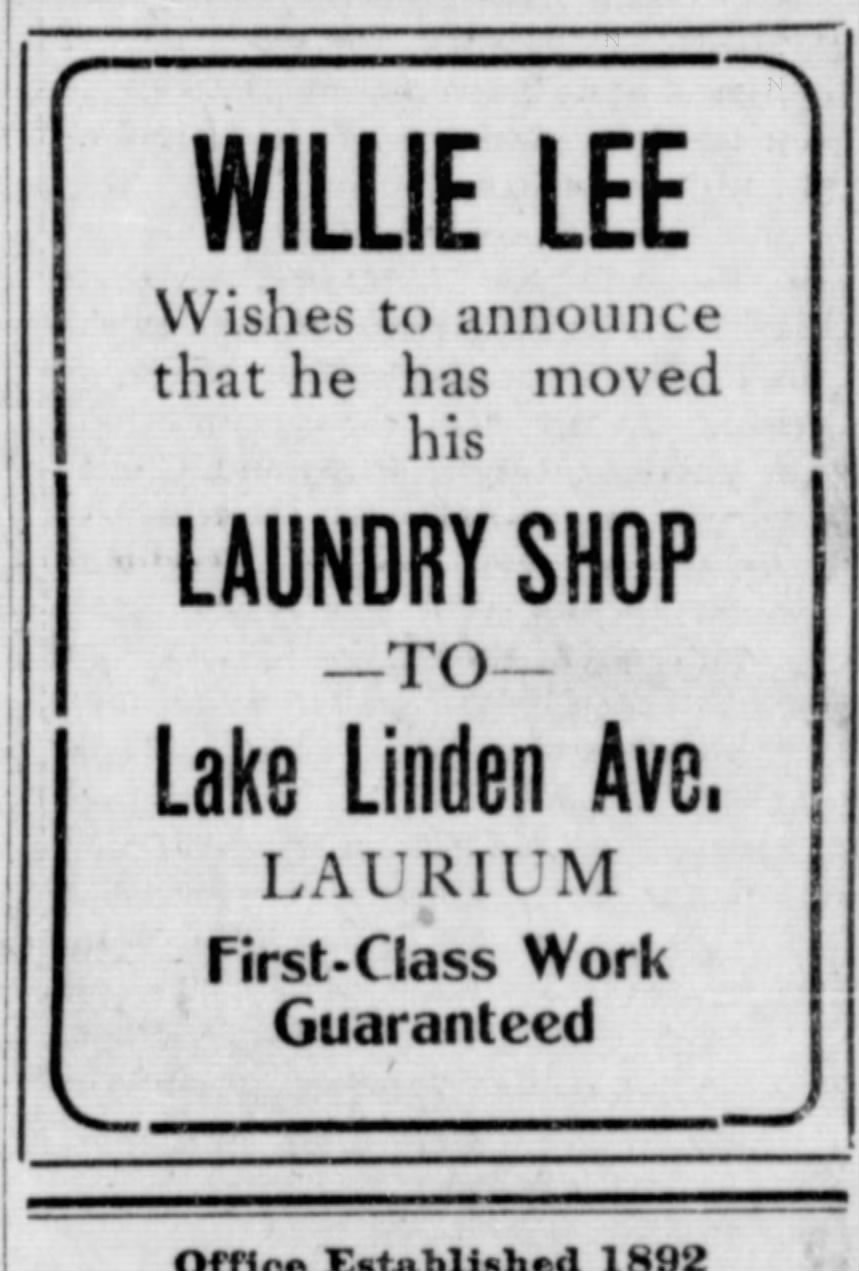
The Calumet News, Nov 1, 1910.
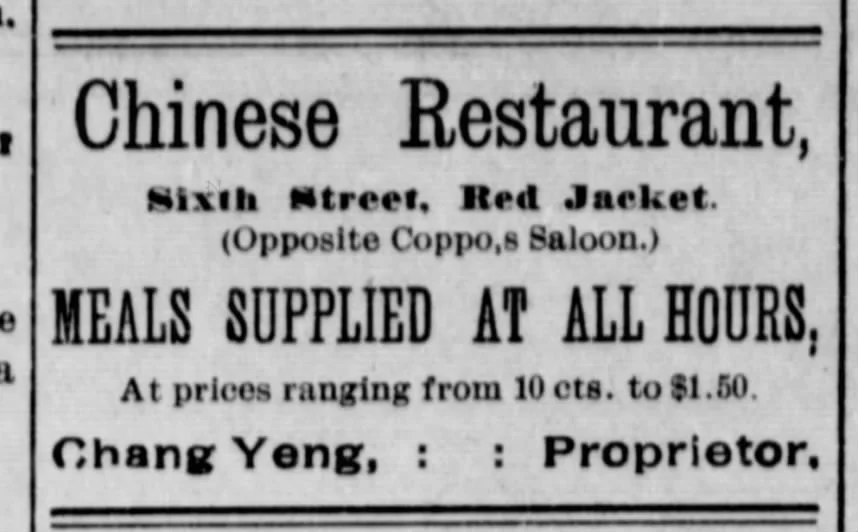
The Calumet News, October 22, 1897, pg. 2. Newspapers.com. https://www.newspapers.com/article/the-calumet-news-chinese-restaurant-in-r/188825835/
The Chinese Exclusion Act, passed in 1882, was the first major federal law to restrict immigration based on race. According to Two Faces of Exclusion, the law created a ten-year moratorium on Chinese immigration to the United States and marked the beginning of a series of increasingly restrictive policies (Kurashige, 2016). Later laws, including the Geary Act of 1892, required all Chinese immigrants already living in the country to register and carry proof of residence at all times. Those found without proper papers faced arrest and possible deportation (Sabharwal, Becerra, and Oh, 2022). Newspaper accounts from the Copper Country show how this played out locally. Federal officers arrested Chinese laundrymen in Calumet and Hancock, investigated their “certificates of residence,” and held some men in jail while their status was reviewed (Copper Country Metropolis 148). These laws focused specifically on Chinese laborers, which meant that most of the Chinese residents in Houghton County were men who had arrived earlier and were trying to maintain legal status. This is also why the mines and other large industries would not hire them.
While Chinese immigrants faced discrimination, the courts did often find in their favor, even if not always for principled reasons. Kurashige writes:
“Wong Kim Ark, a Chinese American, brought a legal case to the US Supreme Court in 1898 to challenge the denial of his birthright citizenship. Four years earlier, Wong attempted to return to the United States after visiting family in China. Although he had been born in California, he was denied entry because officials argued that he could not be a citizen if both of his parents were immigrants. The Supreme Court ruled in Wong Kim Ark’s favor, affirming birthright citizenship. The decision was influenced in part by concern that denying his claim would jeopardize the citizenship status of thousands of children born to European immigrants. This is a right that all natural-born citizens of the United States benefit from today.”
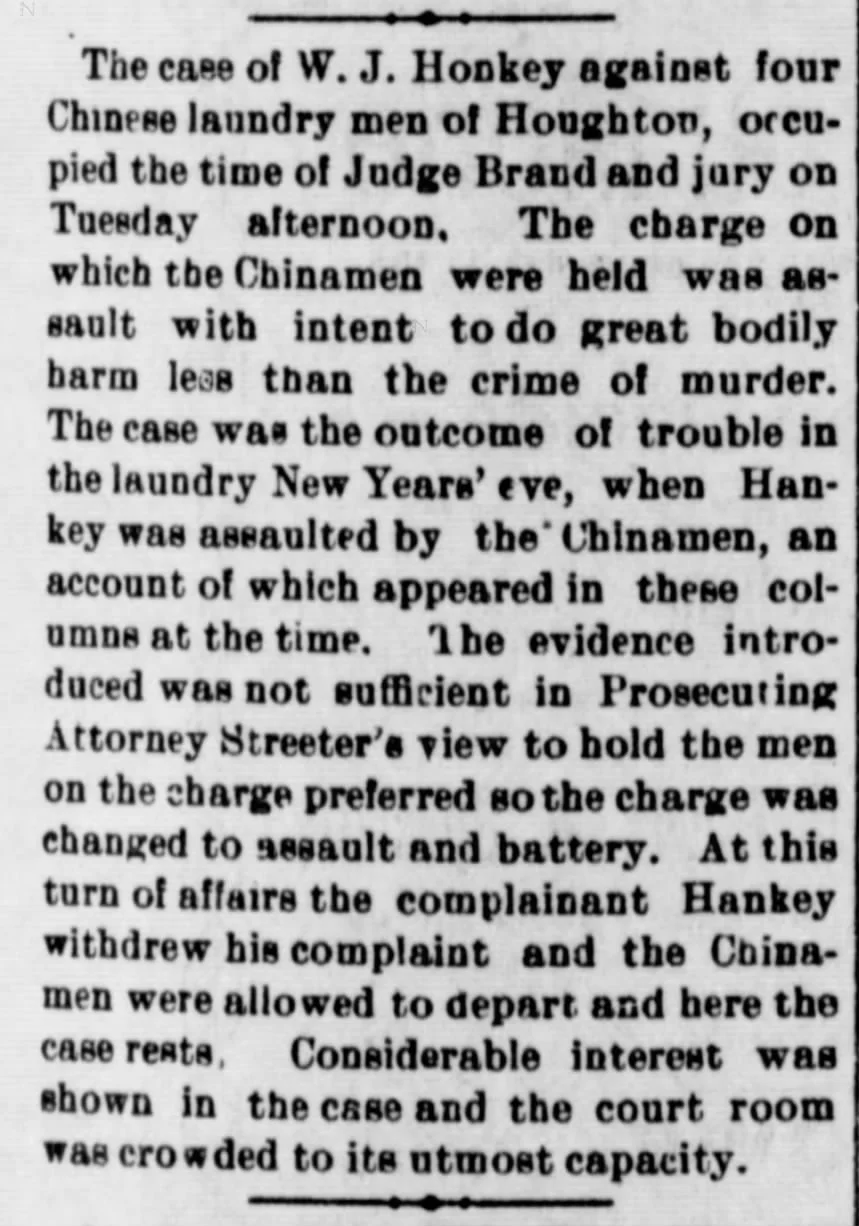
The Calumet News, January 13, 1898, pg. 3. Newspapers.com. https://www.newspapers.com/article/the-calumet-news-chinese-men-charged/188825981/.
The case of W. J. Hankey against four Chinese laundry men of Houghton, occupied the time of Judge Brand and jury on Tuesday afternoon. The charge on which the Chinamen were held was assault with intent to do great bodily harm less than the crime of murder. The case was the outcome of trouble in the laundry New Years’ eve, when Hankey was assaulted by the Chinamen, an account of which appeared in these columns at the time. The evidence introduced was not sufficient in Prosecuting Attorney Streeter’s view to hold the men on the charge preferred so the charge was changed to assault and battery. At this turn of affairs the complainant Hankey withdrew his complaint and the Chinamen were allowed to depart and here the case rests. Considerable interest was shown in the case and the court room was crowded to its utmost capacity.
THREE CHINAMEN ARRESTED:
VIOLATION EXCLUSION ACT
U. S. Officers Take Local Orientals in Custody and it is Believed Chinamen are Guilty of Illegal Residence.
United States immigration officers were in Calumet last evening and effected the arrests of three Chinamen, who are believed to have been brought into the upper peninsula since the passage of the Chinese exclusion act.
The Chinamen were taken from the Willie Lee laundry, near the Mineral Range depot. Each asserted that he has his “choc tee” which is a certificate of residence, and in effect previous to the Chinese exclusion act. These “choc tees,” according to the Chinamen are in Minneapolis, deposited with friends.
The Chinese statements are to be investigated and in the meantime they are held in the Houghton county jail. Under Sheriff Phil Sheridan and Marshal Trudell of Red Jacket were present at the arrest of the Calumet Chinamen.
The local arrests, it is believed, are the result of the arrest last week of Felix Wagner of the Soo. It is believed that Wagner has been responsible for the smuggling into the U. P. of many Chinamen since the exclusion act went into effect.
The arrest of the Chinamen in Red Jacket last evening caused quite little consternation in Calumet’s Chinatown, and has placed the local Orientals on the alert. It is likely that while in the copper country other cases will be investigated by the U. S. officers.
One of the three men arrested last evening has a wife in Calumet, the only Chinese woman, it is believed, in the copper country.
The three Orientals placed under arrest here can all talk a little English. They were dressed in American fashion and all being minus their queues. Provided the charges of smuggling can be proved, the Orientals will have to go back to the land of “chop suey and rice.”
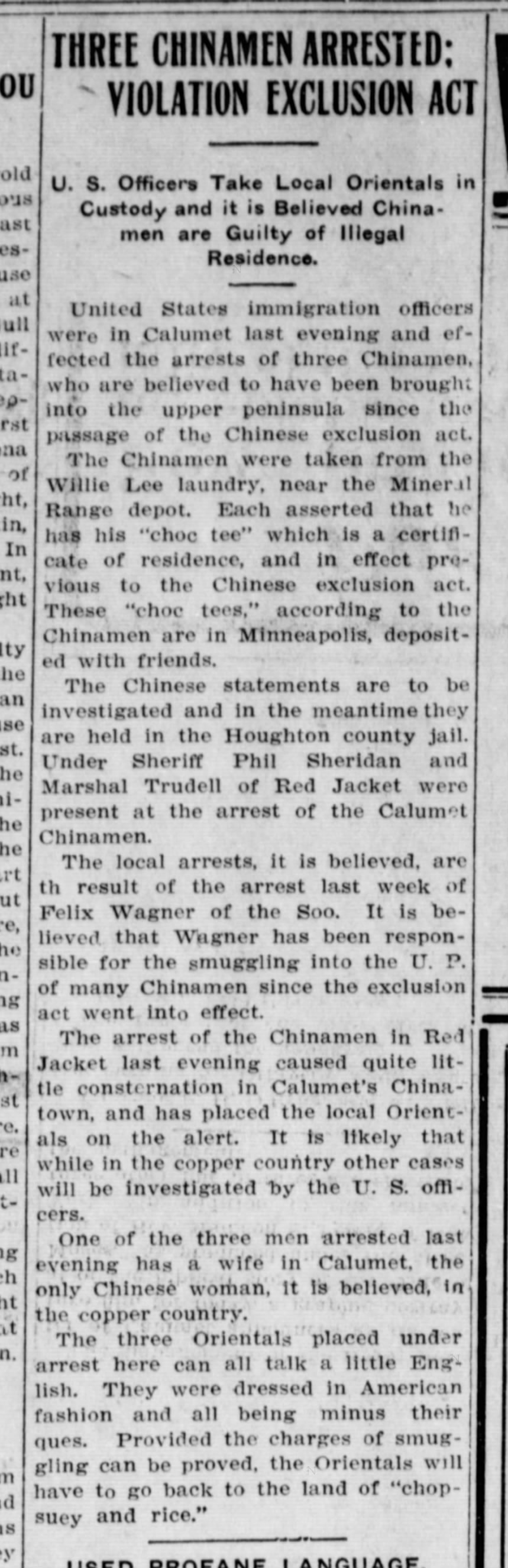
The Calumet News, December 20, 1909, pg. 8. Newspapers.com. https://www.newspapers.com/article/the-calumet-news-chinese-exclusion-act/188826404/
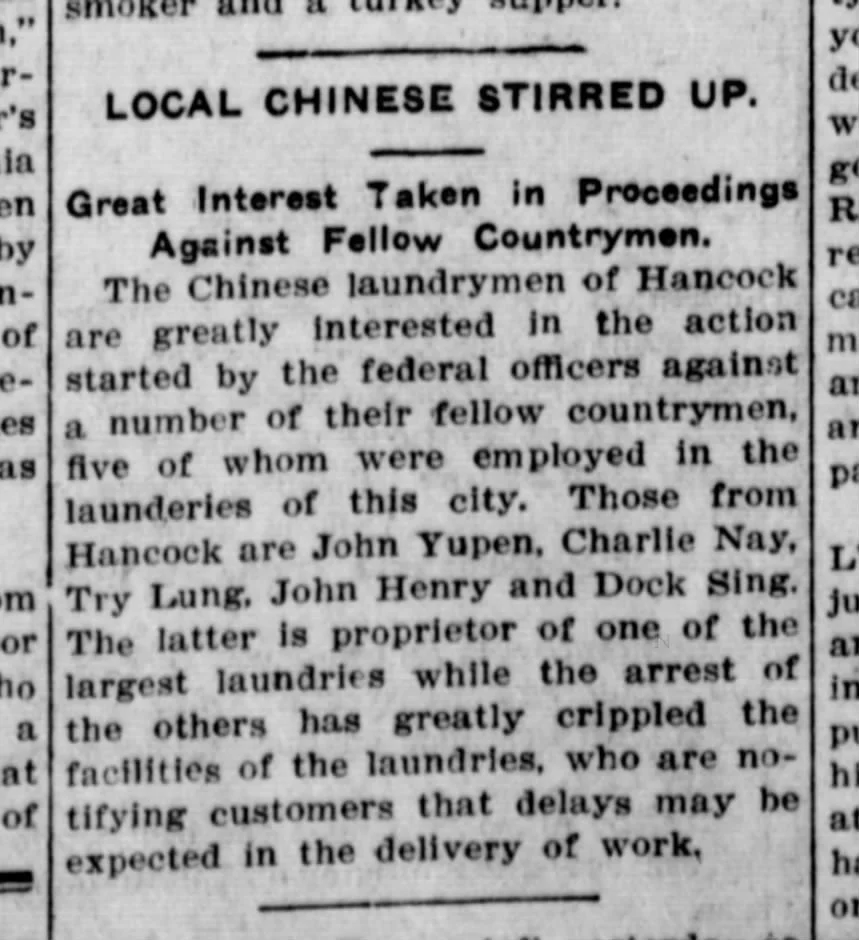
The Calumet News, December 21, 1909, pg. 3. Newspapers.com. https://www.newspapers.com/article/the-calumet-news-arrest-of-chinese-laund/188826437/.
LOCAL CHINESE STIRRED UP.
Great Interest Taken in Proceedings Against Fellow Countrymen.
The Chinese laundrymen of Hancock are greatly interested in the action started by the federal officers against a number of their fellow countrymen, five of whom were employed in the laundries of this city. Those from Hancock are John Yupen, Charlie Nay, Try Lung, John Henry and Dock Sing. The latter is proprietor of one of the largest laundries while the arrest of the others has greatly crippled the facilities of the laundries, who are notifying customers that delays may be expected in the delivery of work.
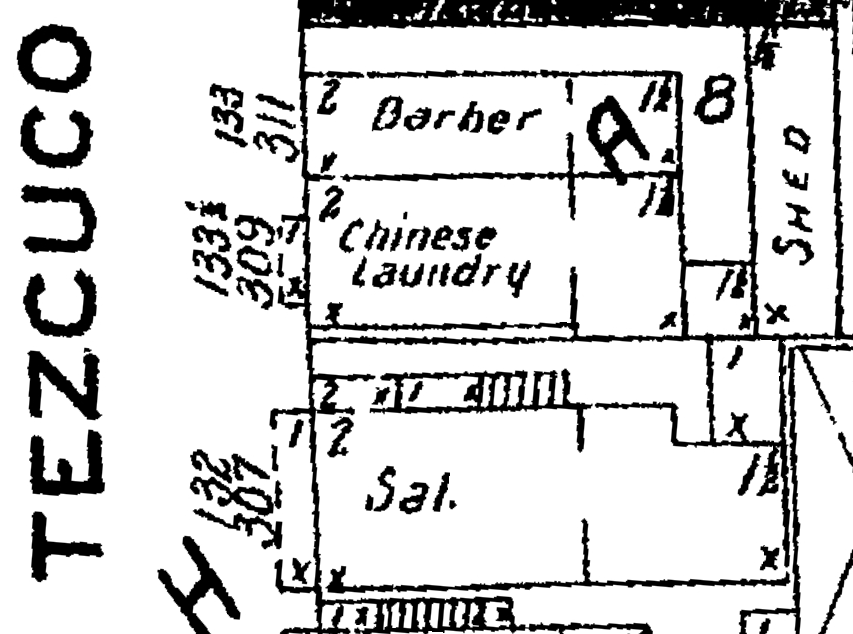
Sanborn Map Company. Tezcuco Street, Hancock, Michigan. 1908. Keweenaw History.
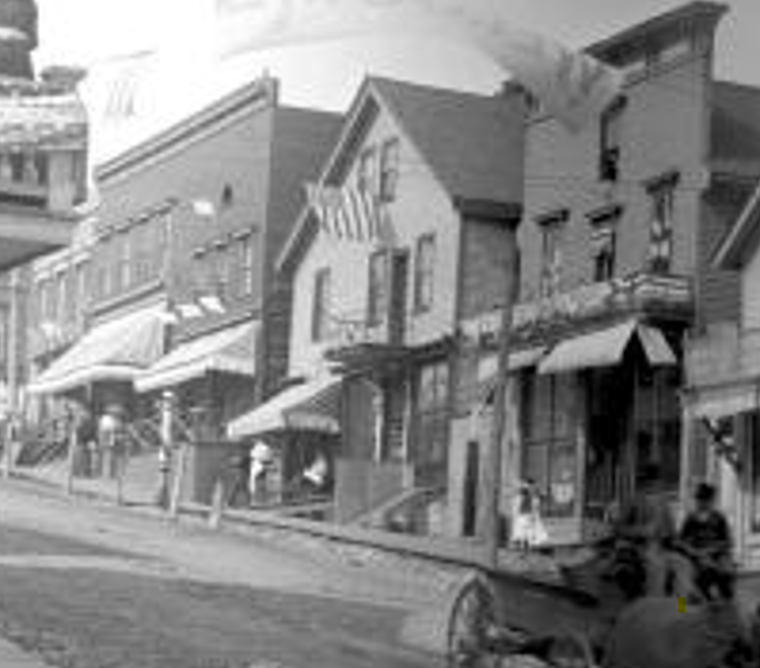
See full image and citation at bottom of page.
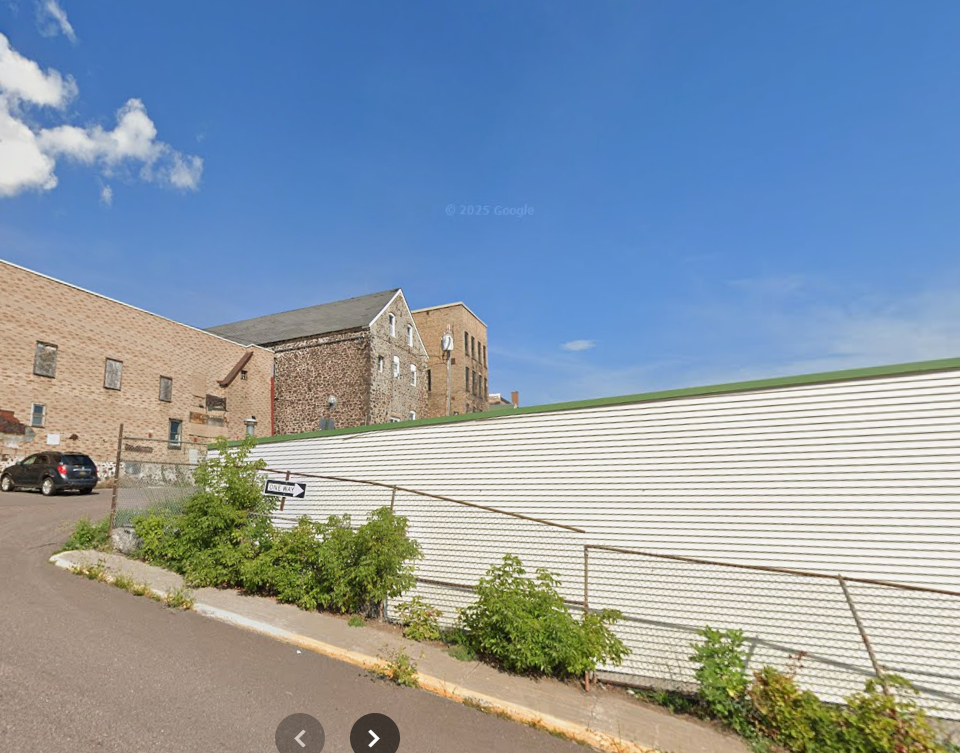
Google Maps, 2024.
The images above shows where one Chinese laundry stood in 1908. Tezcuco Street in Hancock was a main, and busy, road. It had a few different Chinese laundries from 1880s until about the 1920s. This building stood near the alley behind where the art center has been for many years.
NINE CHINAMEN RELEASED.
Two Others File No Bonds and Will Be Deported to China.
Nine of the copper country Chinamen recently arrested by Inspectors Edsall and Pearce, were this morning ordered released by United States Commissioner Olivier of Hancock, the bonds recently filed by them having been formally approved. Those released are John Henry, Charlie Joe, Hong Sit, Chin Mow Yuen, Lee Wee, John Lum, Charlie Nay, Dock Sing, and Ngan Ywe Duck, the latter being the Ontonagon boy, who claims to have been born in this country. Siu Sai You, the Chinaman captured in Duluth and brought back to Houghton county by the federal inspectors, and Lee Loy, who was found hiding in the laundry tub of a chinese laundry, will both be deported to China not having made any attempt to secure bonds. One other Fay Long, will, it is expected be released tomorrow, his bond having been given and the approval of which will probably be received today or tomorrow from Grand Rapids.
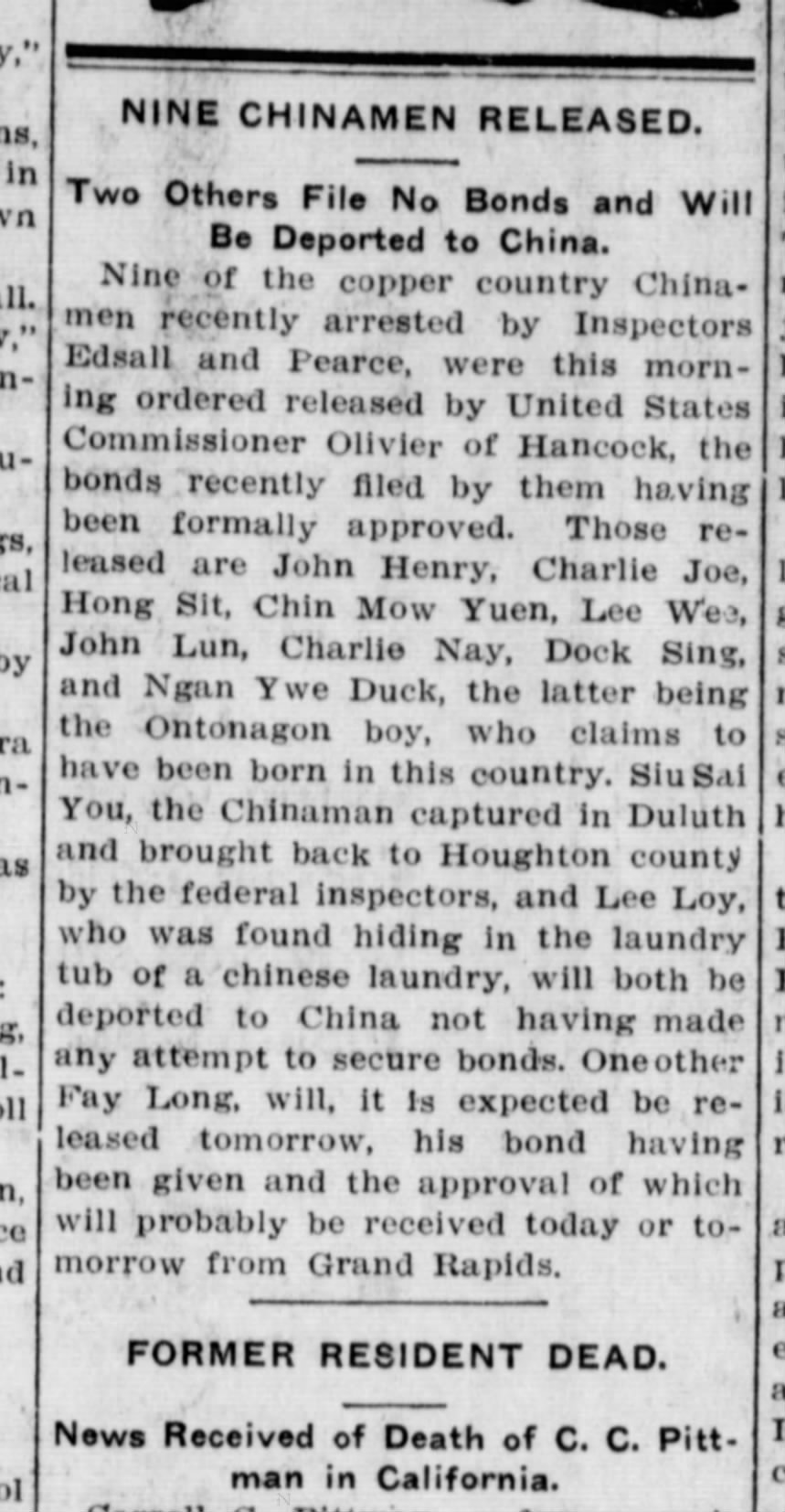
The Calumet News, January 24, 1910, pg. 3. Newspapers.com. https://www.newspapers.com/article/the-calumet-news-chinese-laundrymen-rele/188826526/.
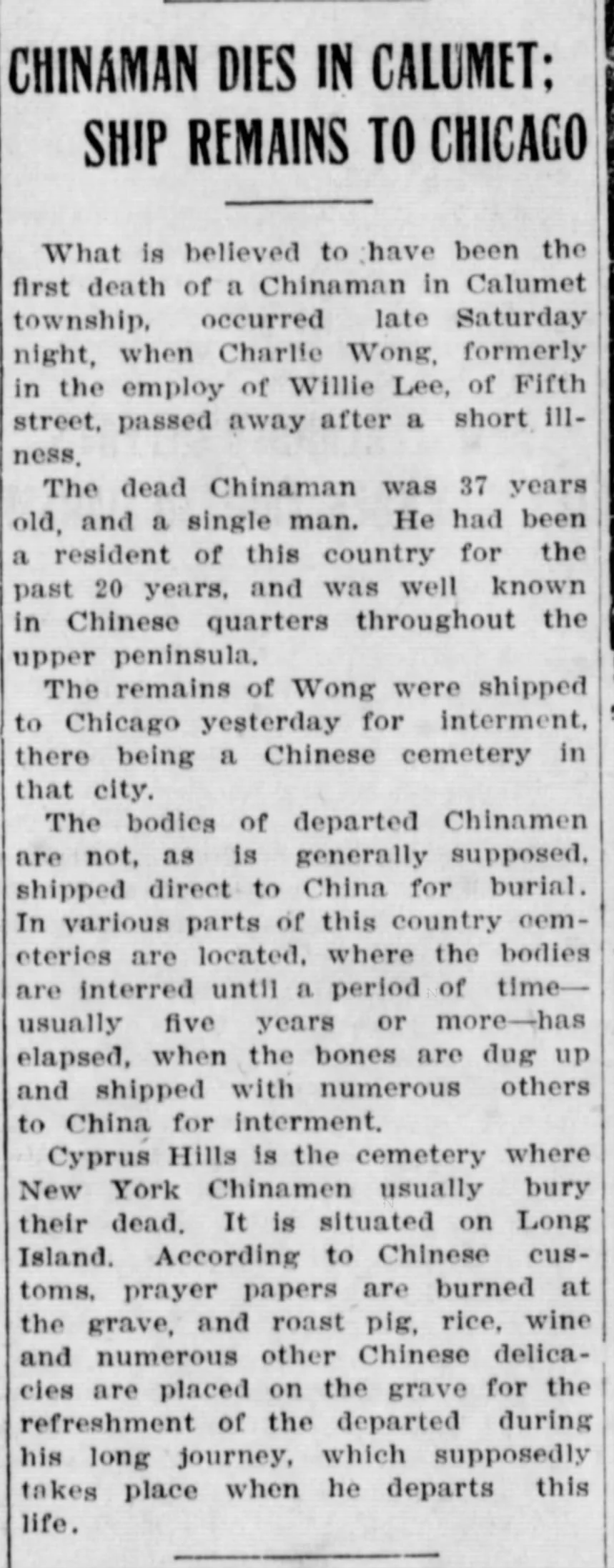
The Calumet News, August 22, 1910, pg. 8. https://www.newspapers.com/article/the-calumet-news-obituary-for-charlie-wo/188906934/.
CHINAMAN DIES IN CALUMET;
SHIP REMAINS TO CHICAGO
What is believed to have been the first death of a Chinaman in Calumet township, occurred late Saturday night, when Charlie Wong, formerly in the employ of Willie Lee, of Fifth street, passed away after a short illness.
The dead Chinaman was 37 years old, and a single man. He had been a resident of this country for the past 20 years, and was well known in Chinese quarters throughout the upper peninsula.
The remains of Wong were shipped to Chicago yesterday for interment, there being a Chinese cemetery in that city.
The bodies of departed Chinamen are not, as is generally supposed, shipped direct to China for burial. In various parts of this country cemeteries are located, where the bodies are interred until a period of time—usually five years or more—has elapsed, when the bones are dug up and shipped with numerous others to China for interment.
Cyprus Hills is the cemetery where New York Chinamen usually bury their dead. It is situated on Long Island. According to Chinese customs, prayer papers are burned at the grave, and roast pig, rice, wine and numerous other Chinese delicacies are placed on the grave for the refreshment of the departed during his long journey, which supposedly takes place when he departs this life.
CHINESE WILL CELEBRATE
NEW YEAR’S NEXT SUNDAY
Chinamen are laying in all sorts of delicacies from the land across the sea, settling their bills and putting their laundries in order for the gala day of the Chinese calendar New Year’s, Sunday, Jan. 29.
The reform wave that struck China has wrought many changes in the ancient ceremonies. When the emperor told his subjects that pigtails were out of style he also gave them the tip to abolish some of their peculiar practices. So this year’s holiday will be celebrated on more modern lines than usual.
Roast duck and chop suey in many styles and candied fruits will be drenched down local Chinese throats by tea and wine to the strains of oriental ditties squeaked out on imported instruments.
The Chinaman believes in starting out the New Year with a clean record. Every Chinaman pays up all bills before New Year’s.
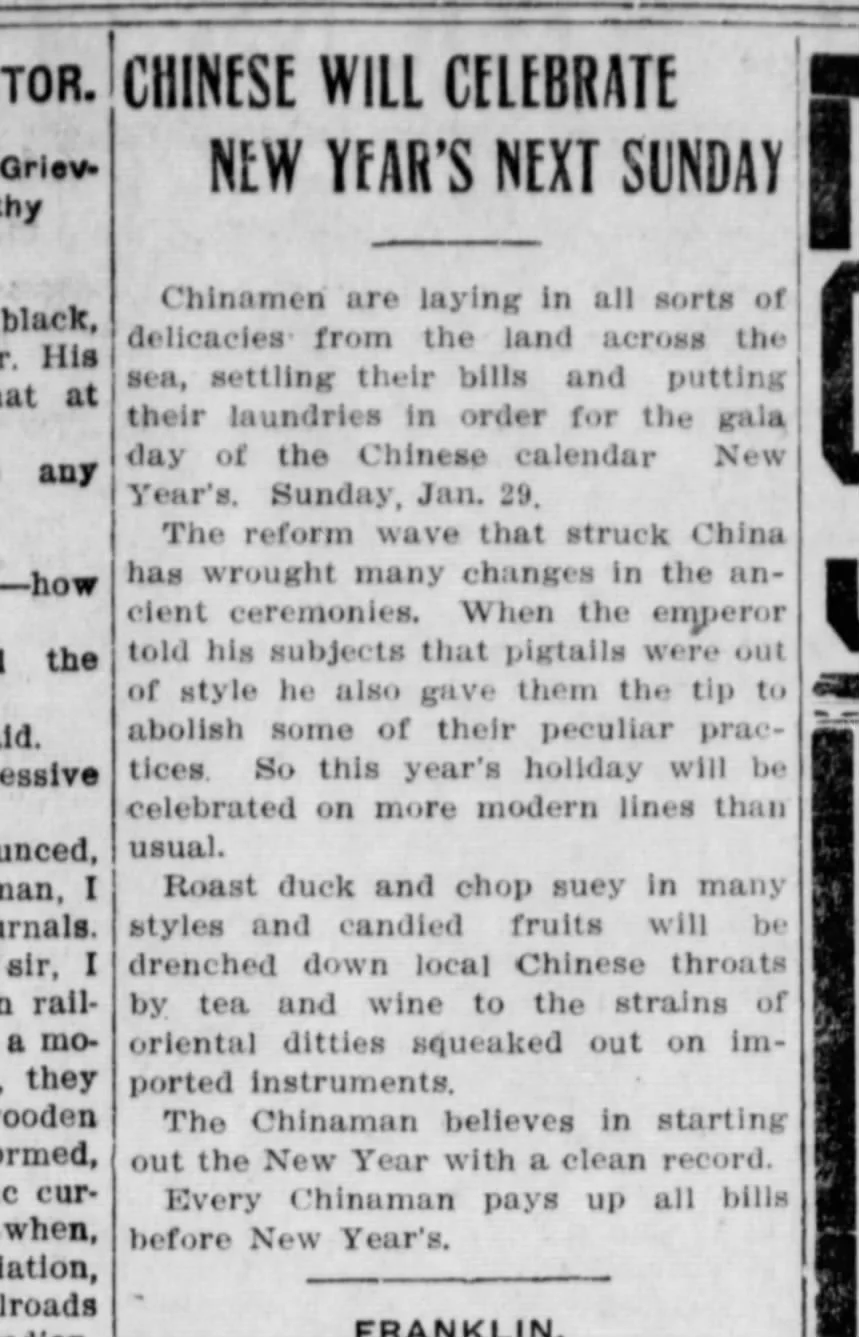
The Calumet News, January 24, 1911, pg. 5. Newspapers.com. https://www.newspapers.com/article/the-calumet-news-chinese-new-years/188826639/

One Chinese restaurant, which likely sold the popular chop suey dish, was near the bridge on Shelden Street in Houghton. It is the second building from the left in the photo below. The building’s structure is still used today as part of the Downtowner Restaurant.
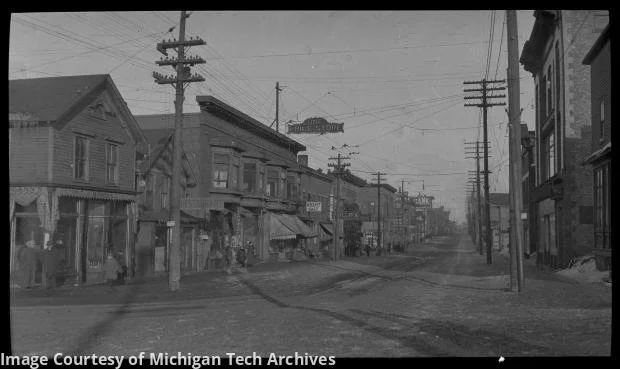
Reeder, J. T. Houghton – Street Scene Main Street. Undated. Photographic strip negative. MS042-064-999-Z724-03. Reeder Photograph Collection. Michigan Technological University Archives and Copper Country Historical Collections.
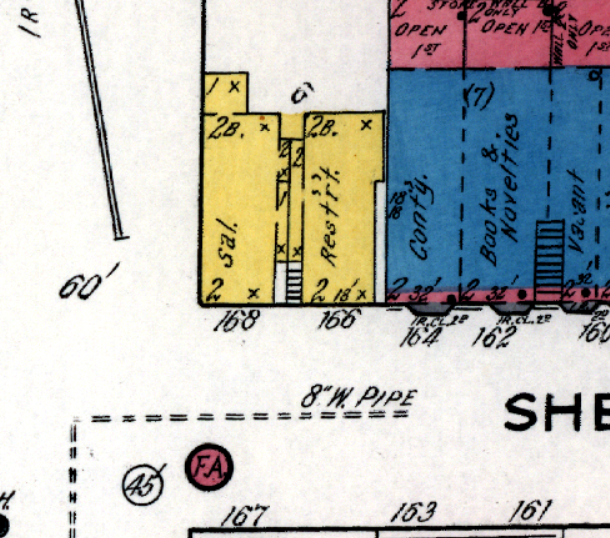
Sanborn Map Company. Shelden Street, Houghton, Michigan. 1917. Keweenaw History.
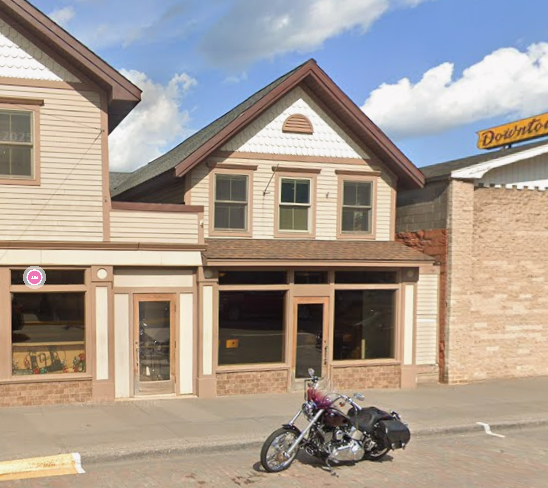
Google Maps, 2024.

Dock Won. 1900 U.S. census. Portage Township, Houghton County, Michigan. Roll 715, page 3, Enumeration District 0192. National Archives and Records Administration. Ancestry.com.
Newspapers in the Copper Country reported on marriages between Chinese men and white immigrant women, often giving detailed descriptions of the ceremonies and the backgrounds of the couples. Headlines about these wedding usually placed race at the forefront of the story. The attention these marriages received suggests that editors understood they would attract readers. Chinese residents were already treated as outsiders in the press, and a marriage that crossed racial lines challenged social expectations in a way that editors knew would draw curiosity and commentary from readers. The marriages were met with speculation with one author even asking the bride why she’d marry the groom. Her reply? Because she loved him.
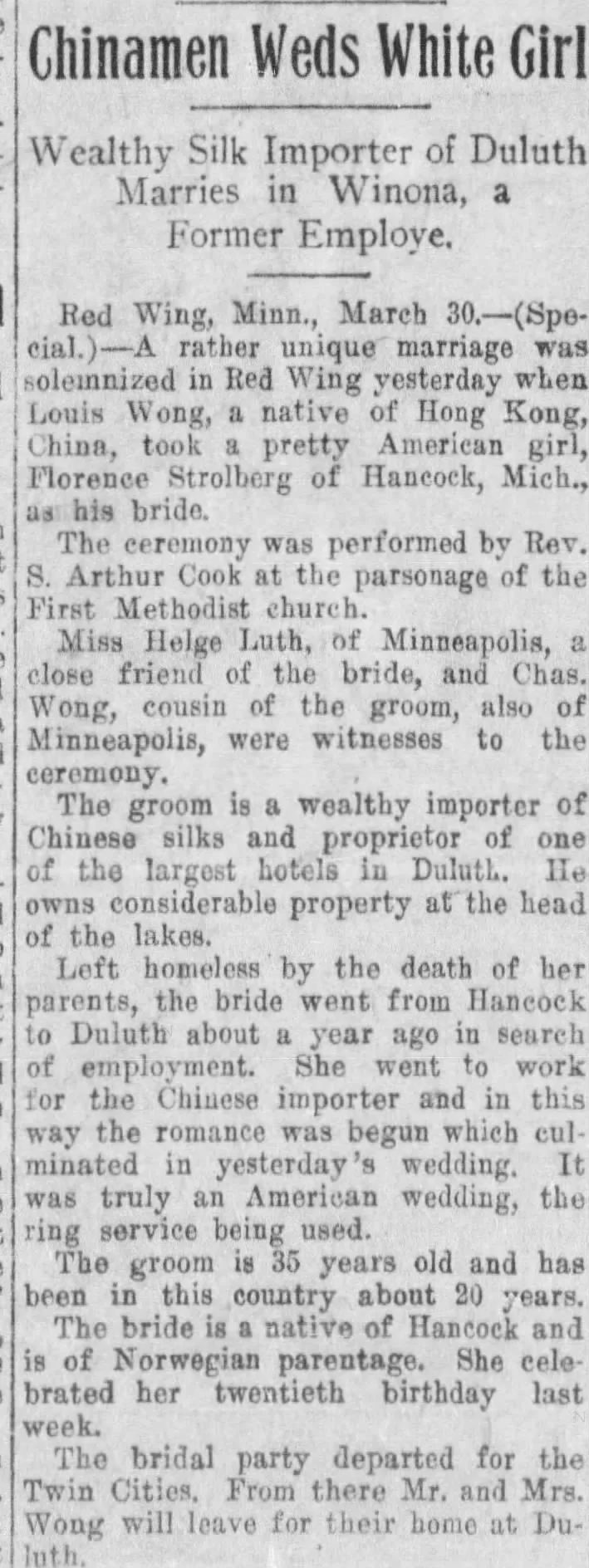
Star Tribune (Minneapolis). March 30, 1911, pg. 1. Newspapers.com. https://www.newspapers.com/article/star-tribune-chinese-importer-weds-norwe/189029045/
Chinamen Weds White Girl
Wealthy Silk Importer of Duluth Marries in Winona, a Former Employe.
Red Wing, Minn., March 30.—(Special.)—A rather unique marriage was solemnized in Red Wing yesterday when Louis Wong, a native of Hong Kong, China, took a pretty American girl, Florence Strolberg of Hancock, Mich., as his bride.
The ceremony was performed by Rev. S. Arthur Cook at the parsonage of the First Methodist church.
Miss Helge Luth, of Minneapolis, a close friend of the bride, and Chas. Wong, cousin of the groom, also of Minneapolis, were witnesses to the ceremony.
The groom is a wealthy importer of Chinese silks and proprietor of one of the largest hotels in Duluth. He owns considerable property at the head of the lakes.
Left homeless by the death of her parents, the bride went from Hancock to Duluth about a year ago in search of employment. She went to work for the Chinese importer and in this way the romance was begun which culminated in yesterday’s wedding. It was truly an American wedding, the ring service being used.
The groom is 35 years old and has been in this country about 20 years.
The bride is a native of Hancock and is of Norwegian parentage. She celebrated her twentieth birthday last week.
The bridal party departed for the Twin Cities. From there Mr. and Mrs. Wong will leave for their home at Duluth.
HANCOCK GIRL WEDS CHINAMAN
MISS FLORENCE STROLBERG FORMERLY OF HANCOCK BECOMES BRIDE OF LOUIS WONG OF DULUTH.
According to dispatches received from Red Wing, Minn., the wedding was solemnized in that city on Wednesday of Miss Florence Strolberg, formerly of Hancock, and Louis Wong, of Duluth, an Americanized Chinese. The ceremony was performed by Rev. S. Arthur Cook, pastor of the First Methodist church of that city. The American ring service was used and the ceremony was an elaborate one.
The groom is a native of Hong Kong, China, and is thirty-five years of age, having been in America for twenty years. He is an importer of Chinese silks, with headquarters at Duluth and proprietor of one of the largest hotels of that city, where he also owns considerable other property.
The bride was born in Hancock of Norwegian parents, just twenty years ago, she having celebrated her birthday anniversary last week. Left homeless by the death of her parents about one year ago, Miss Strolberg went to Duluth where she found employment with the Chinese importer and where the romance began which culminated in their wedding this week.
Mr. and Mrs. Wong will spend their honeymoon at St. Paul and Minneapolis and later will take up their residence at Duluth.
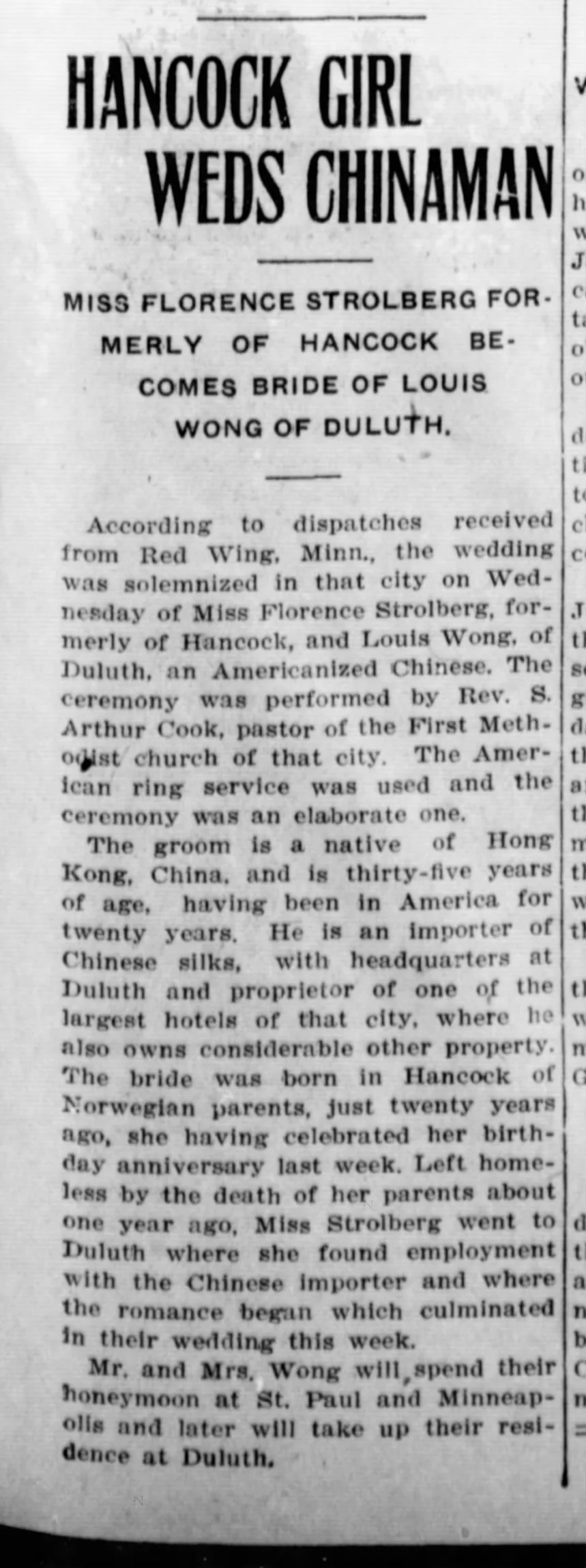
The Calumet News. January 14, 1911, pg. 1. Newspapers.com. https://www.newspapers.com/article/the-calumet-news-hancock-girl-weds-chin/188907871/.
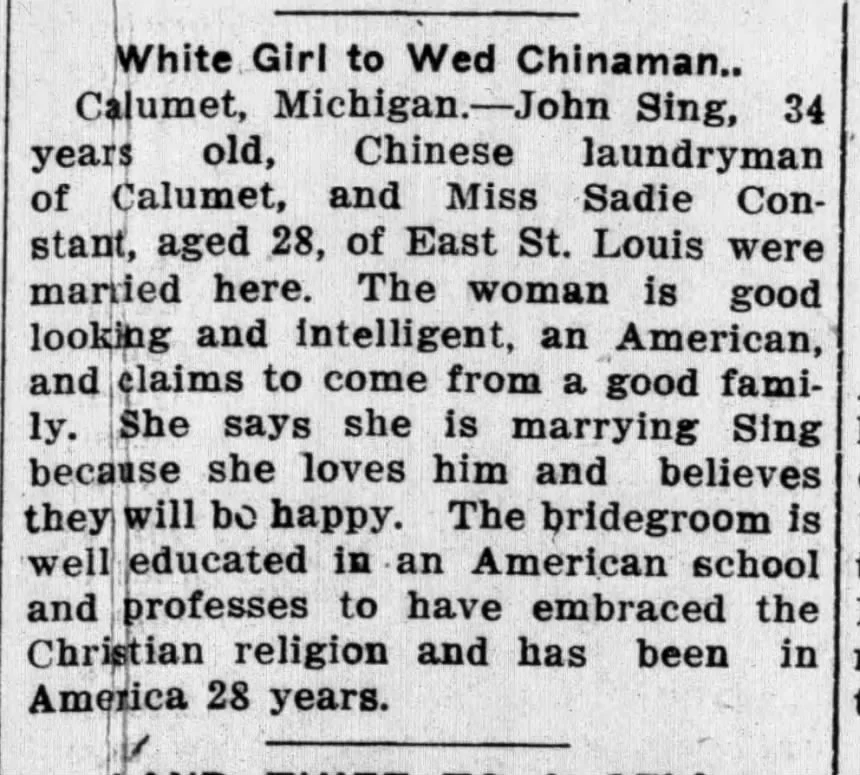
Dodge Center Record. (Dodge Center, MN), April 27, 1911, pg. 1. Newspapers.com. https://www.newspapers.com/article/dodge-center-record-white-girl-to-wed-ch/191180139/
White Girl to Wed Chinaman.
Calumet, Michigan - John Sing, 34 years old, Chinese laundryman of Calumet, and Miss Sadie Constant, aged 28, of East St. Louis were married here. The woman is good looking and intelligent, an American, and claims to come from a good family. She says she is marrying Sing because she loves him and believes they will be happy. The bridegroom is well educated in an American school and professes to have embraced the Christian religion and has been in American for 28 years.
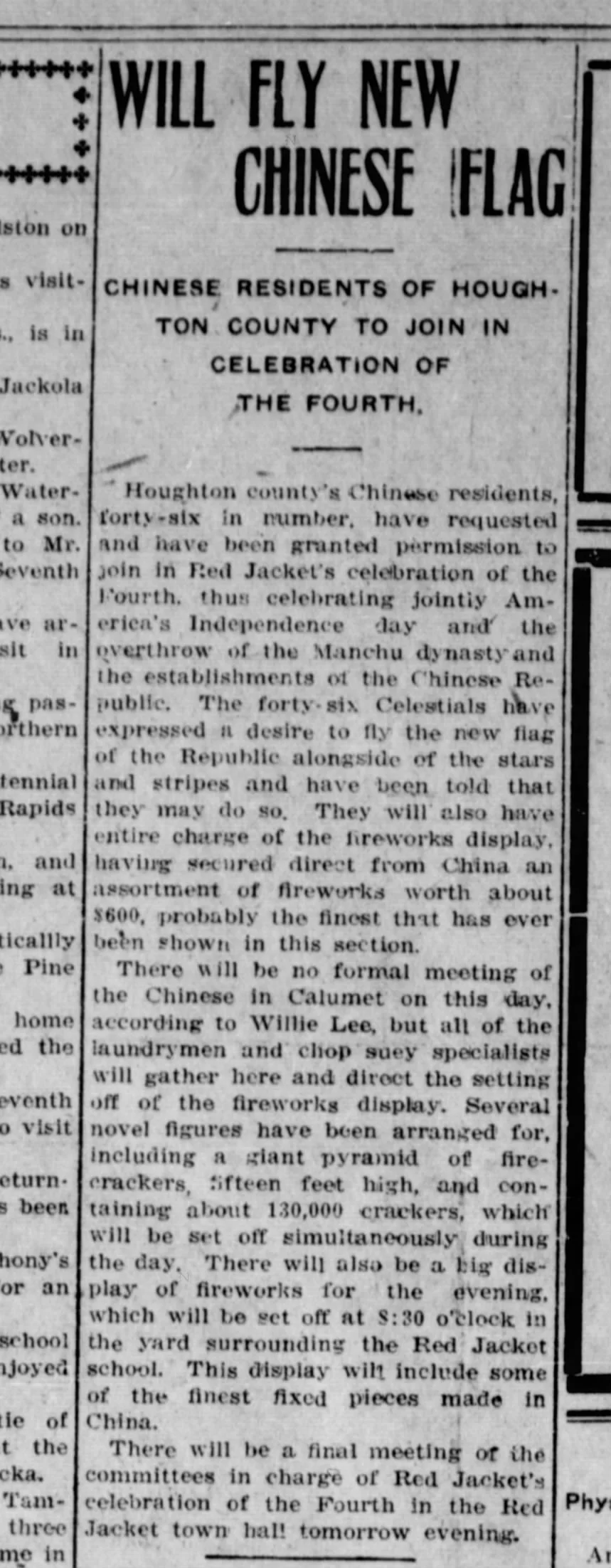
The Calumet News. June 25, 1912, pg. 8. Newspapers.com. https://www.newspapers.com/article/the-calumet-news-chinese-citizens-celebr/187774295/.
WILL FLY NEW CHINESE FLAG
CHINESE RESIDENTS OF HOUGHTON COUNTY TO JOIN IN CELEBRATION OF THE FOURTH.
Houghton county’s Chinese residents, forty-six in number, have requested and have been granted permission to join in Red Jacket’s celebration of the Fourth, thus celebrating jointly America’s Independence day and the overthrow of the Manchu dynasty and the establishments of the Chinese Republic. The forty-six Celestials have expressed a desire to fly the new flag of the Republic alongside of the stars and stripes and have been told that they may do so. They will also have entire charge of the fireworks display, having secured direct from China an assortment of fireworks worth about $600, probably the finest that has ever been shown in this section.
There will be no formal meeting of the Chinese in Calumet on this day, according to Willie Lee, but all of the laundrymen and chop suey specialists will gather here and direct the setting off of the fireworks display. Several novel figures have been arranged for, including a giant pyramid of firecrackers, fifteen feet high, and containing about 130,000 crackers, which will be set off simultaneously during the day. There will also be a big display of fireworks for the evening, which will be set off at 8:30 o’clock in the yard surrounding the Red Jacket school. This display will include some of the finest fixed pieces made in China.
There will be a final meeting of the committees in charge of Red Jacket’s celebration of the Fourth in the Red Jacket town hall tomorrow evening.
CHINESE TO MARK DAY.
Big Celebration of New Year’s Planned for Calumet Wednesday.
Houghton county’s Chinese residents are abreast of the times. Since the overthrow of the Manchu dynasty, the Gregorian calendar has been recognized in their native land, and the forty-five Celestials located in the copper country have determined to celebrate with the rest of the world, the first day of the new year. Likewise they have adopted July 4 as their own independence day and will celebrate with the Americans as they did last summer.
Willie Lee of Calumet has the honor of being host at this, the first New Year’s celebration of Houghton county’s laundrymen and all of them will gather with him on Wednesday morning. There will be a big banquet at which Chinese dishes, wines imported from China and other concoctions to tickle the Christian Chinese appetite will abound. Practically all of the copper country Chinese have adopted the Christian faith, but even those who have not will celebrate, for January 1 will supersede the old China New Year even in China.
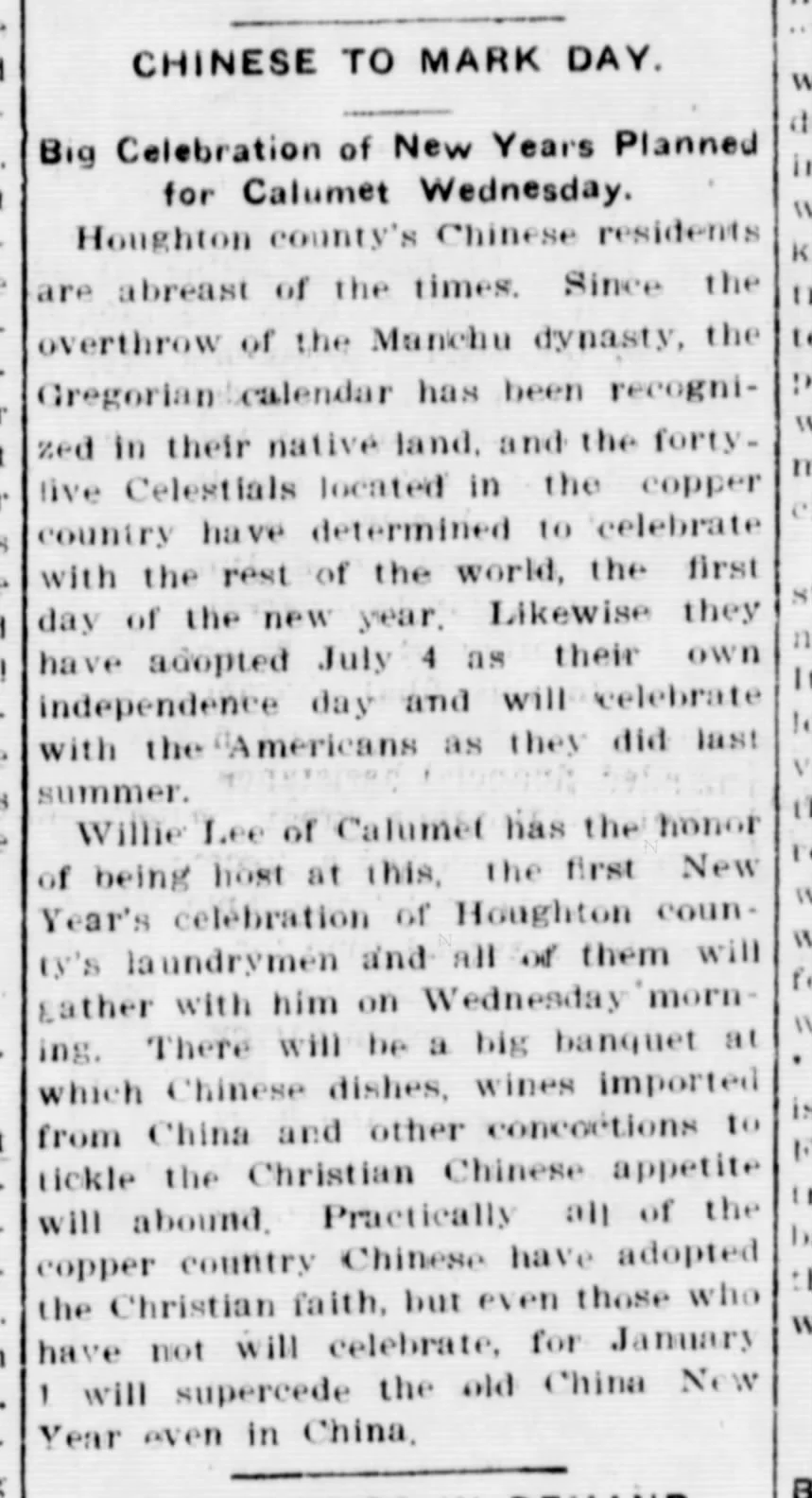
The Calumet News, December 30, 1912, pg. 5. Newspapers.com. https://www.newspapers.com/article/the-calumet-news-chinese-citizens-celebr/187774376/
For Lunar New Year celebrations, local Chinese residents marked their cultural heritage just as Finns did on Juhannus or the Cornish on St. Piran’s Day. Newspapers describe preparations that included imported delicacies and organized gatherings held within the mining towns themselves. In 1912, forty-six Chinese residents formally requested permission to join the Red Jacket Fourth of July celebrations and were granted it. They flew the new flag of the Chinese Republic alongside the stars and stripes and secured nearly $600 worth of fireworks imported directly from China (Copper Country Metropolis, 306). The display included a fifteen-foot pyramid of firecrackers and a large evening exhibition set off near the Red Jacket school yard.
The Chinese population of Houghton County was small, but it was organized, visible, and active in the life of the mining towns. They worked, celebrated, married, paid taxes, hosted gatherings, and marked the passing of each year. As Lunar New Year begins again next week, their presence remains part of the documented history of the Copper Country.
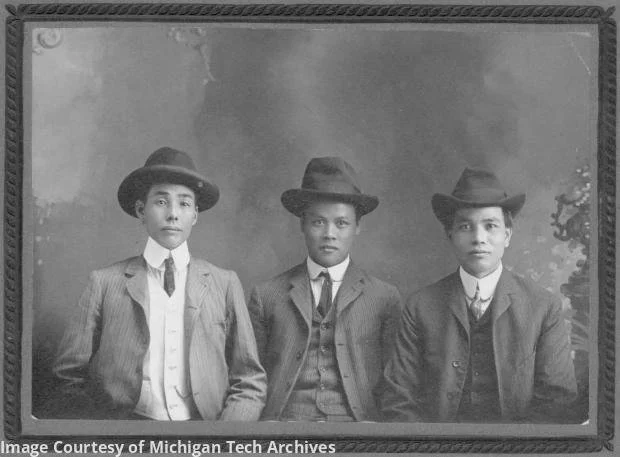
Nara, J. W. Oriental Laundry Men. Undated. Photographic print. Nara 42-173. William Nara Photograph Collection. Michigan Technological University Archives and Copper Country Historical Collections.
Thanks for making it to the end! Please consider contributing to our research with a one-time donation. Let’s keep Copper Country history alive together.
Contribute to Copper Country history
Sources:
Engel, Dave, and Gerry Mantel. Calumet: Copper Country Metropolis. River City Memoirs–Maki, 2002.
Kurashige, Lon. Two Faces of Exclusion: The Untold History of Anti-Asian Racism in the United States. Chapel Hill: University of North Carolina Press, 2016.
Sabharwal, Meghna, Aurora Becerra, and Seongdeok Oh. “From the Chinese Exclusion Act to the COVID-19 Pandemic: A Historical Analysis of ‘Otherness’ Experienced by Asian Americans in the United States.” Public Integrity 24, no. 6 (2022): 535–549. https://doi.org/10.1080/10999922.2022.2120292
Thurner, Arthur W. Calumet Copper and People. S.N. 1974.
Carousel:
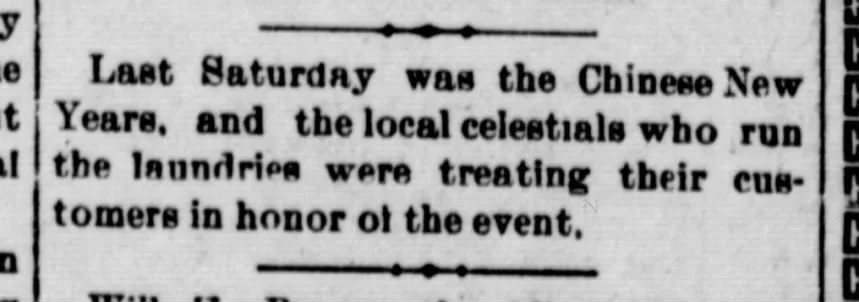
Chinese New Year, January 24, 1898, pg. 8. https://www.newspapers.com/article/the-calumet-news-chinese-new-year/188826022/
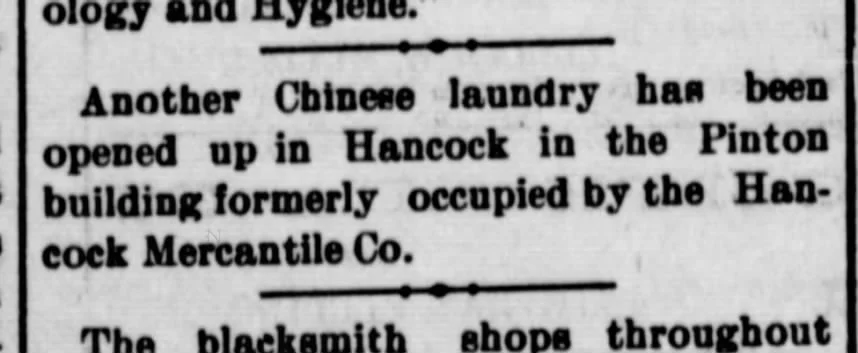
Chinese Laundry in Hancock, March 7, 1898, pg. 3. https://www.newspapers.com/article/the-calumet-news-chinese-laundry/188826065/
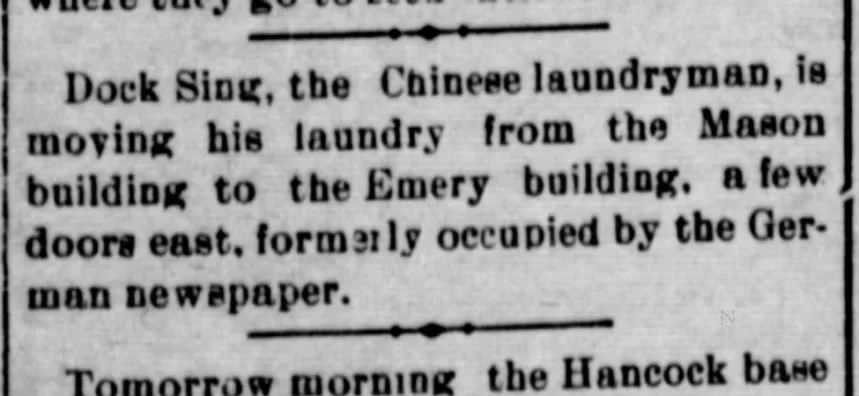
Dock Sing moves business. July 6, 1898. pg. 5. https://www.newspapers.com/article/the-calumet-news-miswald/190046237/
Map Gallery:
Sanborn Map Company. Fifth Street, Red Jacket (Calumet), Michigan. 1908. Keweenaw History.
Sanborn Map Company. Elm Street, Red Jacket (Calumet), Michigan. 1907. Keweenaw History.
Sanborn Map Company. Pine Street, Red Jacket (Calumet), Michigan. 1888. Keweenaw History.
Sanborn Map Company. Tezcuco Street, Hancock, Michigan. 1888. Keweenaw History.
Sanborn Map Company. Tezcuco Street, Hancock, Michigan. 1900. Keweenaw History.
Sanborn Map Company. Shelden Street, Houghton, Michigan. 1908. Keweenaw History.
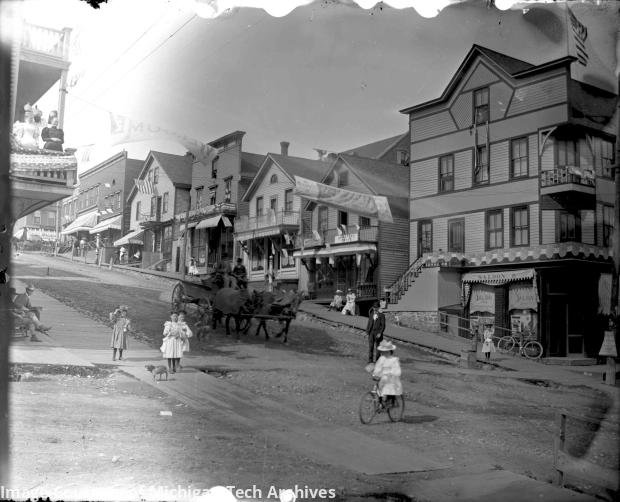
Unknown photographer. Hancock Tezcuco Street. 1911. Glass plate negative. MTU Neg 00252. Roy Drier Photograph Collection. Michigan Technological University Archives and Copper Country Historical Collections.
