
“Big” Annie Klobuchar Clemenc Shaws
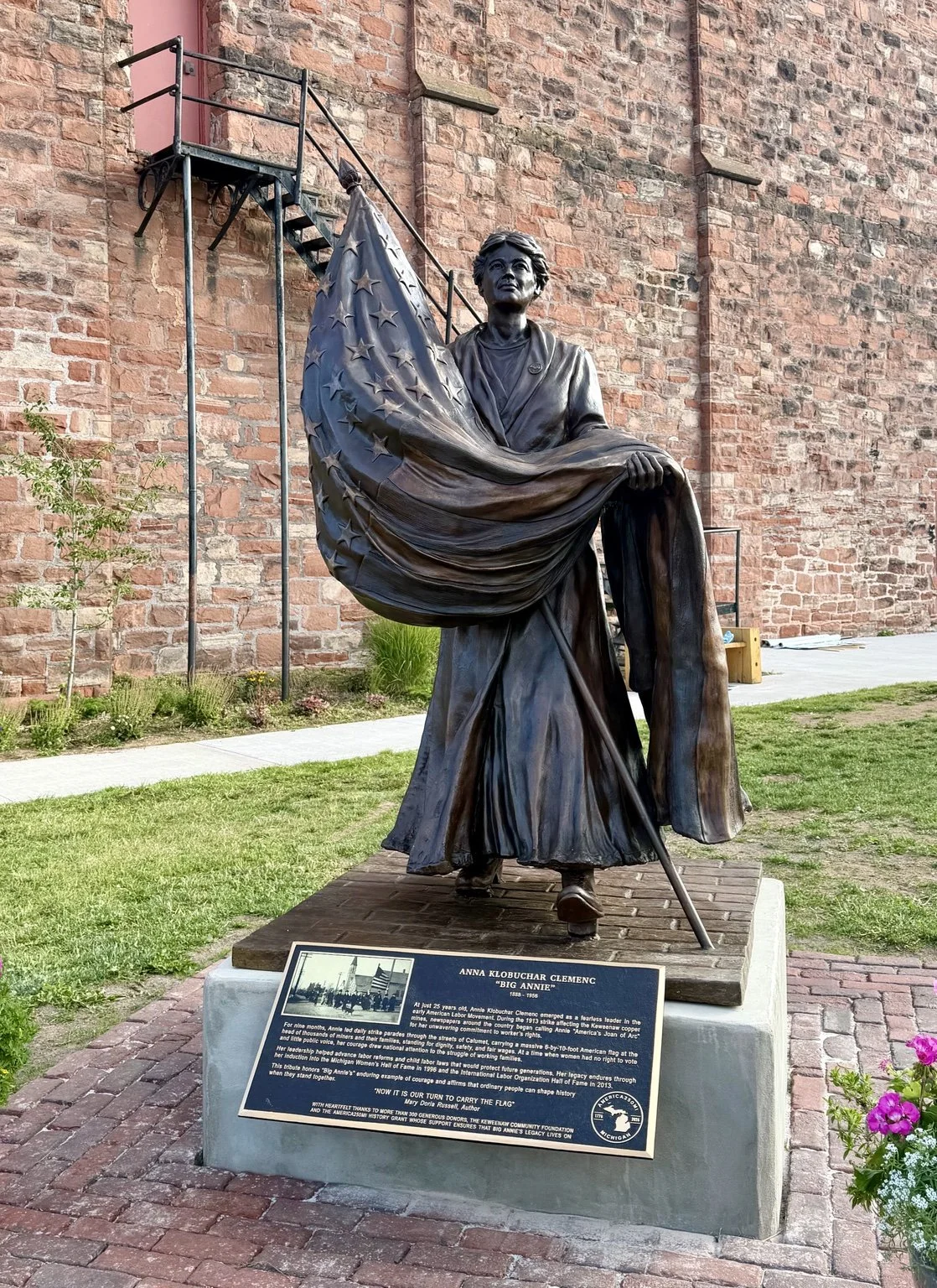
The new statue of Annie was unveiled on August 22, 2026. Photo taken by author.
With much fanfare, a new statue was unveiled in Calumet, MI, recently. A tall and stoic woman holds an American flag and gazes toward the future with hope. Anyone studying the history of the mining companies in the Western Upper Peninsula has read the name “Big Annie.” Most even know her story: leading strikers and the women supporting them during the 1913 mining strike. However, not many know the details of her life and who she was beyond the years 1913-1914.
Anna Klobuchar was born in Calumet to Slovenian-immigrant parents George and Mary on March 2, 1888. According to her Find a Grave entry, she was “at least six feet in height, [and] was a striking figure as she carried a huge American flag at the head of the marches. Sometimes called the ‘Joan of Arc of Calumet,’ she is probably the best known person today from the Copper Country during its boom period.”
Annie was born in the Copper Country but spent some time in Slovenia as a child. According to Slovenian writer Dominik Janez Herle, “[Annie’s] mother, Marija Adams, was born in 1868 in the village of Doljna Paka in the parish of Črnomelj and came to the United States in 1886. Her father, Jurij Klobuchar, was born in 1863, also in the parish of Črnomelj, probably in the village of Dobliče, and came to the United States in 1883. The couple married at Sacred Heart Church in Calumet on July 7, 1887.
Soon after her birth, Ana returned to Slovenia with her parents, where she spent the first six or seven years of her life in the Črnomelj area. Ana therefore began attending elementary school in Slovenia. At the beginning of 1892, Ana’s sister Marija was born. In July 1895, her father Jurij returned alone to Calumet, and in June 1897 his wife Marija returned to Calumet with the two children. After their arrival in the United States, three more children were born to Jurij and Marija: Jurij, Jože, and Franci.” (Zvon, 2022, no. 6., translated from Slovenian).

1900 U.S. Census, Osceola Township, Houghton County, MI. Enumeration district 0189, roll 715, pg. 4.
On the 1900 Census, her family lived on an “unknown”-named road near Calumet. Her father worked as a trammer in the mine. They also had several other trammers staying in their home as boarders. Clearly, Annie was surrounded by miners and their struggles from a young age. She also certainly felt a tremendous sense of community with her neighbors. Herle wrote: “Ana’s family was not the only Slovenian family in the area. Many other immigrants and their relatives from Črnomelj also lived there. They were able to attend a Slovenian Catholic parish, shop at Slovenian stores, visit Slovenian taverns and social clubs, and read a Slovenian newspaper.” (translated from Slovenian)

Michigan, U.S., Marriage Records 1867-1952, Film 88, 1906 Genesee-Mackinac
In the spring of 1906, 18-year-old Annie married 30-year-old laborer and Slovenian immigrant Joseph Klemenc (also variously spelled Clemenc, Clement, and Clements) at St. Joseph’s Church in Calumet.

“Annie Clemenc (Big Annie).” NPS, Keweenaw NHP, CHMC Strike Album #002, Ana Clemenc & Ben Goggio, 1913

1910 U.S. Census, Osceola Township, Houghton County, MI. Enumeration District 0127, roll T624_647, pg. 19a.
Four years later, Annie and Joseph lived on Oak Street in Calumet. According to the 1910 census, Joseph worked as a miner. Their neighbors were Germans, English, Irish, as well as fellow Slovenes. Besides one cop, one brewer, and one teacher, every other man living in the homes around them worked for the copper mines.
Annie had a progressive attitude toward workers’ and women’s rights from a young age. “Clemenc… was devoted to the active participation of women outside the traditional confines of the home. Having graduated from eighth grade, she was a relatively well-educated woman at that time. Clemenc was an avid follower of Eugene Debs, Mother Mary Harris Jones, and the tenets of socialism. It was her independent nature and strong-willed character that inspired many men and women to take a stand for justice.” (Michigan Women’s Hall of Fame).
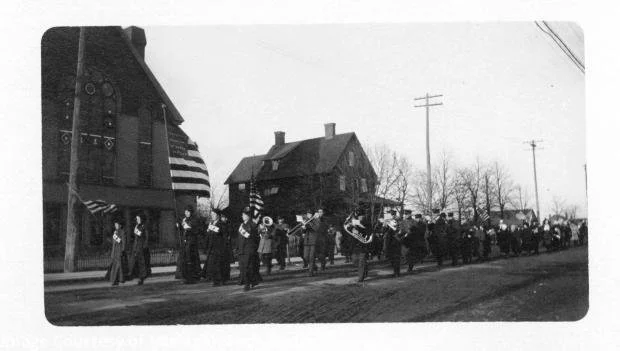
“Big Annie" Clemenc carrying flag at strikers parade Calumet Ave. near C and H hospital." Acc-400-12-13-1988-01-08-19. Louise Koepel. Quincy Mining Company Collection. MTU Archives and Copper Country Historical Collections.
The mining workers called a strike on July 23, 1913 because “…miners on Michigan’s Keweenaw Peninsula (U.P.) were subjected to hazardous working conditions and extremely low wages. Members of the Western Federation of Miners, many of whom were immigrants, held a massive labor strike in hopes of improving their impoverished conditions. Clemenc… helped organize the Woman’s Alliance in support of the miners’ cause.” (Michigan Women’s Hall of Fame).
Daily parades were organized to support the miners. According to Herle, on the third day of these parades, Annie stepped to the front of the group for the first time and continued this tradition whenever parades were held; “she always carried with her a three-meter-long pole from which an American flag was hung. Every morning at six o’clock, 2,000 people gathered and followed Ana on the march. The march was usually ten kilometers long,” (translated from Slovenian).

The Calumet News, 30 Sept 1913, pg. 8.
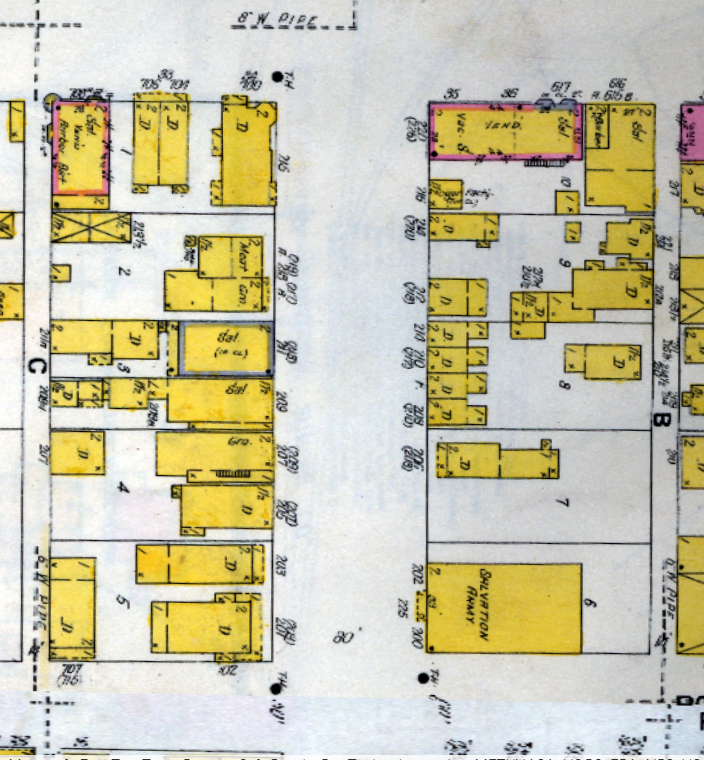
Seventh Street, between Oak and Portland, where the incident occurred, as seen in 1908. 1908 Sanborn Map, Keweenaw Time Traveler.
WILD SCENES
ARE ENACTED
EARLY TODAY
Picketing of Violent Nature Resorted to by Strikers and Women Sympathizers
MINE GUARDS ARE FIRED ON
Party Going to the Ahmeek Property Are Attacked and Many Shots Are Fired
NUMBER OF ARRESTS ARE MADE
Disturbance of a violent character was rife in the north end of the county this morning, the strikers apparently giving vent to their satisfaction over the dissolution of the injunction by Judge O’Brien yesterday.
Picketing prevailed in Red Jacket, Swedetown and other Calumet locations and rough tactics were employed by strikers and women sympathizers in their effort to prevent men from going to work.
Dinner pails were jerked from the hands of men by the women and the contents strewn about the pavements, while the strikers who stood in the rear jeered and shouted at the workmen. The arrest of two women and a was the result of the fracas in Red Jacket.
Trouble on Seventh Street.
About 5 o’clock, women and strikers congregated on Seventh street, between Oak and Portland, and the disturbance was centered in that block. A workman hove into view, and a woman approached him and jerked his pail from his hands, pounding it on the pavement. He retaliated with a blow from a club and despite howls and hisses, he continued on his way.
Later two men, carrying dinner pails approached Seventh street from Portland and they were immediately surrounded by women and strikers. The pails were pulled from their hands, the irate women beating the receptacles on the walks. Amid the shouting, Officer Spehar of the Red Jacket force attempted to induce the men to return to their homes. This action aroused spectators to an ugly mood. Deputies and members of the Waddell force accompanied the two men through the crowd to work.
Jeer at Military Officers.
General P. L. Abbey and staff officers arrived on the scene and Annie Clemenc, one of the leaders, was arrested. As she was being taken to the Red Jacket jail in an automobile, strikers hurled jeers and hisses at the military officers. She was arraigned before Justice William Fisher, charged with intimidation. It is alleged she incited women and strikers to attack a man on his way to work on Seventh street this morning and that the man was badly beaten and his dinner pail smashed. She demanded an examination which was set for Monday, and was released on bonds of $300. She protested her innocence of any crime and stated she would be on the picket line again tomorrow morning, starting at 4 o’clock.
Others Also Arraigned.
Gustav Ignatz, charged with intimidation, also demanded an examination when arraigned before Justice Fisher this morning, his hearing being set for Monday.
Meesha Raukar-Kervat was arrested on the charge of creating a noise and disturbance, under the village ordinance. Her hearing was set for Friday before Justice Fisher.
A workman was struck in the face by a striker at Sixth and Oak streets and a deputy who happened to be near, arrested the assailant. As the man was being taken to jail, a crowd of a hundred or more strikers followed. The women continued their noisy demonstration near the jail and officers ordered the streets cleared.
Announcement of the dissolution of the injunction resulted in a wild demonstration at Ahmeek last night. Two arrests were made.
Mine Guards’ Car Attacked.
While the strikers were carrying on this orgy, word was received at Ahmeek that a coach load of mine guards was en route to that location and the strikers became active instantly. The coach, containing thirty men, was detached from the regular train near Calumet and was taken by a locomotive to Ahmeek, arriving about 9:30. The train proceeded as far as a switch in the north end of Ahmeek village, from where it was to be taken to the mine location. The tracks had been barricaded and the train could proceed no farther. At this juncture, a fusilade of shots was fired, supposedly by strikers, at the coach and a…
RIOTOUS SCENES FOLLOW
REMOVAL OF RESTRAINT
Continued From First Page.
shower of rocks followed. Windows in the Pullman were smashed and the train was forced to return to Calumet.
Attacked a Second Time.
The guards left the train, and at 9 o’clock this morning proceeded to Ahmeek in automobiles, running a gauntlet of revolver shots from Wolverine to Ahmeek. The shots were returned and in all several hundred bullets are said to have sailed over the heads of both strikers and guards. One automobile was struck, but so far as is known no one was injured. Major Gausser and a squad of cavalrymen were on the alert during a greater part of the night and this morning.
Picketing was resorted to at Ahmeek, Mohawk, Allouez, Wolverine and Centennial. A striker stoned a horse ridden by a cavalryman at Ahmeek and he was arrested.
Work Stopped at Mohawk.
Strikers visited the homes of workmen at Mohawk last night and demanded that the men refrain from work. The order was effective and today not a fire is burning in the boilers of the Mohawk Mining company. The location is without fire protection or water as a result. The boilers were fired at Ahmeek and Allouez No. 1, however.
The situation is now is grave as at any time during the strike and General Abbey asserts that the outlook is serious. At Mohawk, preparations for resumption of operations were progressing favorably and many men asked for their old positions. Today the situation is changed and not a man is at work at Mohawk.
Escorted to Centennial.
A squad of cavalrymen were called out today to escort a body of mine guards to Centennial.
Strikers surrounded the home of a workman at Centennial Heights last evening and prevented him from leaving the premises.
Another party of strike breakers began work at the Quincy yesterday, bringing the number of outside workmen above the 100 mark. Quarters for the newcomers were arranged in No. 3 dry at Mesnard. Repairs are being made to No. 8 shaft, Mesnard, where hoisting likely will be resumed this week.
Mary Saari, a Quincy girl, who has given the authorities considerable trouble, was arrested Sunday evening, charged with stoning one of the militiamen. This girl was arrested several weeks ago and the authorities believed her to be deranged. She wrestled with the officers and only after strenuous efforts were used was she subdued. She has been taken to the county jail.
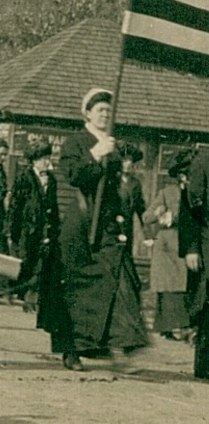
Annie carrying her flag in a parade. Photo from Daily Mining Gazette via Pasty.com.
In 1913, Annie was elected President of the Women’s Auxiliary No. 15 of the Western Federation of Miners. In September of that year, Annie was leading the women picketing in various Calumet-area locations. When mining workers who attempted to cross the picket lines (scabs) tried to go to work, Annie and other women took the men’s lunch pails and tossed them. They used various tactics to try to stop them from going into work. The striking men stood by, jeering at the scabs and supporting the women. Annie was arrested for “intimidation,” as the police claimed she encouraged and incited the rioters. Annie posted a large $300 bond and told the judge she would be on the picket line again the next morning.


The Calumet News, 23 Oct 1913
DEPUTIES ARE ATTACKED IN STRIKE RIOTS
Serious Disturbances in Calumet District This Morning; Officers Injured
THIRTEEN ARRESTS ARE MADE
Knives, Billies, Stones and Other Weapons Used; Two Men Sent to Hospital
ATTACK NORTHWESTERN TRAIN
Rioting of a serious character and a general inclination to disregard law and order marked the activities of strikers in the north end of the copper district today.
A number of deputies were beaten in hand-to-hand fights and two of the officers were taken to the Calumet & Hecla hospital for treatment. Thirteen strikers were arrested on various charges for Red Jacket and Blue Jacket disturbances, and warrants likely will be issued for others.
The violence is believed to have had its inception with the formation of a parade of about sixty strikers at 5 o’clock, the line of march extending through the residence and mining sections and then to Red Jacket.
Deputies who were escorting men to work on Portland street encountered the parade and a tirade of abuse was heaped upon them. One of the strikers is said to have hurled epithets at the deputies and an attempt was made to arrest him. A riot followed, men and women marchers surrounding the officers and attacking them with knives, billies, blackjacks and stones.
In the fight, Edward Beaudoin, a deputy, was stabbed in the shoulder and clouted over the head, the effects of which may be serious. The officer was cut with a rusty dagger. Beaudoin was taken to the hospital.
Riot in Blue Jacket.
In the Blue Jacket riot, Deputy Sheriffs Lawrence Cane and Joseph Hirsch were injured and the wounds of Hirsch are believed to be serious. A parade, headed by “Big” Annie Clemenc, traversed in this section and two of the strikers are said to have left the ranks to pummel the officers. Hirsch was pounded over the head with a club and was taken to the hospital.
The attack was precipitated, it is claimed, by the strikers, the deputies making no attempt to interfere with the parade.
As the parade reached Tenth and Pine streets, deputies were showered with ice and other missiles. A number of deputies came to the scene and rioting was prevented.
Thirteen Arrests Made.
Arrests growing out of the disturbances were as follows:
John Steinmetz, charged with attacking officers with a club.
Peter Spehar, charged with stabbing Deputy Benudoin.
Margaret Brula, the bearer of an American flag in the parade, charged with beating Deputies Moore, Oliver and Blum.
John King the agitator who figured prominently in the flag incident on Eighth street a few weeks ago, charged with carrying concealed weapons.
Ignatz Kozovich, charged with carrying concealed weapons.
John Mosich, Amelia Varich and Peter Mikko, charged with attacking deputies and obstructing officers while in the performance of duty.
John Scolia, charged with attacking a deputy with a blackjack. The weapon taken from Scolia was a metal ball attached to a leather cord. A revolver, loaded and five additional shells were found on Scolia when he was arrested. Scolia is said to have shouted “Come on and kill the deputies” during the riot.
Sam Berlich, charged with attacking Deputy St. Antoine.
Tom Masich, charged with carrying concealed weapons.
John Burbanico, charged with attacking and interfering with an officer.
A striker named Anderson, charged with attacking deputies.
Evidence that many of the strikers were armed was produced at the jail where three billies, three knives, one dagger and a loaded revolver were taken from the prisoners.
Agitators Held Responsible.
It is believed that this morning’s disturbances are the result of speeches of agitators who are said to have counselled greater activity among the strikers. The mood of the federation men has been more defiant this week and hostile crowds of strikers have…
DEPUTIES HURT IN STRIKE RIOTS
Serious Disturbances in the Calumet District This Morning
…gathered in almost every location. Parades were held at Quincy, South Range towns and in Keweenaw while strikers maintained pickets at Mohawk, Centennial and Wolverine, where they jeered deputies and workmen.
Arrests at Allouez.
A band of strikers congregated at the Allouez street car station where workmen alight each morning on their way to work and serious trouble was imminent when the car arrived. General Abbey and staff officers were present and ordered the arrest of Mike Dagan and Steve Dalzariur on a charge of intimidation.
The men were arraigned before Justice Medlyn at Ahmeek who set the date of examination for Nov. 3. Bonds in the sum of $200 were furnished.
Four boys, ranging between 16 and 20 years of age, were arrested at Allouez last night by Capt. McCormack of the artillery corps, on a charge of disorderly conduct. A crowd of boys congregated in the vicinity of the home of Victor Abramson, a workman, and fired a volley of revolver shots in the air, yelling, shouting and asking Abramson to come outside. Two of the boys were discharged and the other two, Edwin Nordstrom and John Forster, were detained. Their hearing will be held before Justice Medlyn November 1. Bonds in the sum of $200 were furnished.
Mike Zamotti of Wolverine, was arrested by Undersheriff Heikkala at South Kearsarge last night for the alleged shooting into the open door at the residence of Sam Uren. The bullet shattered a mirror and imbedded itself in the wall. Deputies who saw the act, state that the man ran away immediately after the shot was fired and they gave chase. The man, in his flight, threw the revolver away and it was picked up by his pursuers. The arrest was made about 9:45 o’clock. Zamotti will be given an examination before Justice Armit Saturday for careless use of firearms, under a township ordinance. It is stated that an application for a bench warrant, charging Zamotti with violating the injunction, will be made.
Strikers Break Train Windows.
When the Northwestern train arrived in Houghton this morning at 10:20 with a car of laborers for one of the mines at Calumet, a small crowd of strikers, presumably Italians, waited at the Houghton station and when the train pulled in attempted to get into the car. It was a vestibuled car with locked doors. The strikers failed to make an entrance and when the train pulled out several of them remained on board and rode over to Hancock.
At Hancock a larger crowd of strikers, estimated at 100, congregated at the station. They attempted to board the laborers’ car, which was attached to the baggage car. Failing in this they tried to disconnect the car from the baggage car. This also was not successful and when the train began to back away from the station to make room for a south-bound train.
The strikers began to hurl snowballs and rocks at the cars and with these missiles they wrecked every window in the laborers’ car. Then they turned their attention to the first-class day coach and the Pullman and broke windows in these cars. The train had to remain in the yard for a few minutes while the south-bound North Shore train passed and the strikers continued a fusilade of rocks. The train was a pretty badly battered conveyance when it finally pulled out of the yards for Calumet. In the melee one of the strikers fired a revolver but it hurt no one as far as can be learned. Sixty-eight windows in the train were broken.
There were no officers at the station. Inquiry at the sheriff’s office brought out the fact that the office had not been notified of the prospective arrival of this particular car of laborers.
A crowd of strikers gathered at the Mineral Range depot, anticipating the arrival of the train. The coach bearing the workmen, however, as switched to the C. & H. tracks at Swedetown and taken to the mining company’s property. This move frustrated any intention the strikers may have had to interfere with the imported men.
The attack on the train has been reported to the Northwestern railroad company and it is likely that the company will assist in the prosecution. This will involve a new phase of the strike situation. Deputies have been detailed on the case and arrests are expected this afternoon.
“Big Annie” is Convicted.
“Big Annie” Clemenc, female agitator and a leader of a majority of the strikers’ parades, was found guilty by a jury in Justice Fisher’s court yesterday afternoon on a charge of assaulting a workman. A fine of $10 and costs or an alternative of 30 days in the county jail, was meted out. The case will be appealed.
John Kuchinich and Veronica Beljan, were bound over to circuit court on a charge of intimidation by Justice Fisher yesterday.
John Budich, charged with felonious assault, was bound over to circuit court yesterday afternoon by Justice Armit. Budich is held for attacking Deputy Walter Rost with a shoemaker’s awl and plunging it into his head, a few weeks ago.
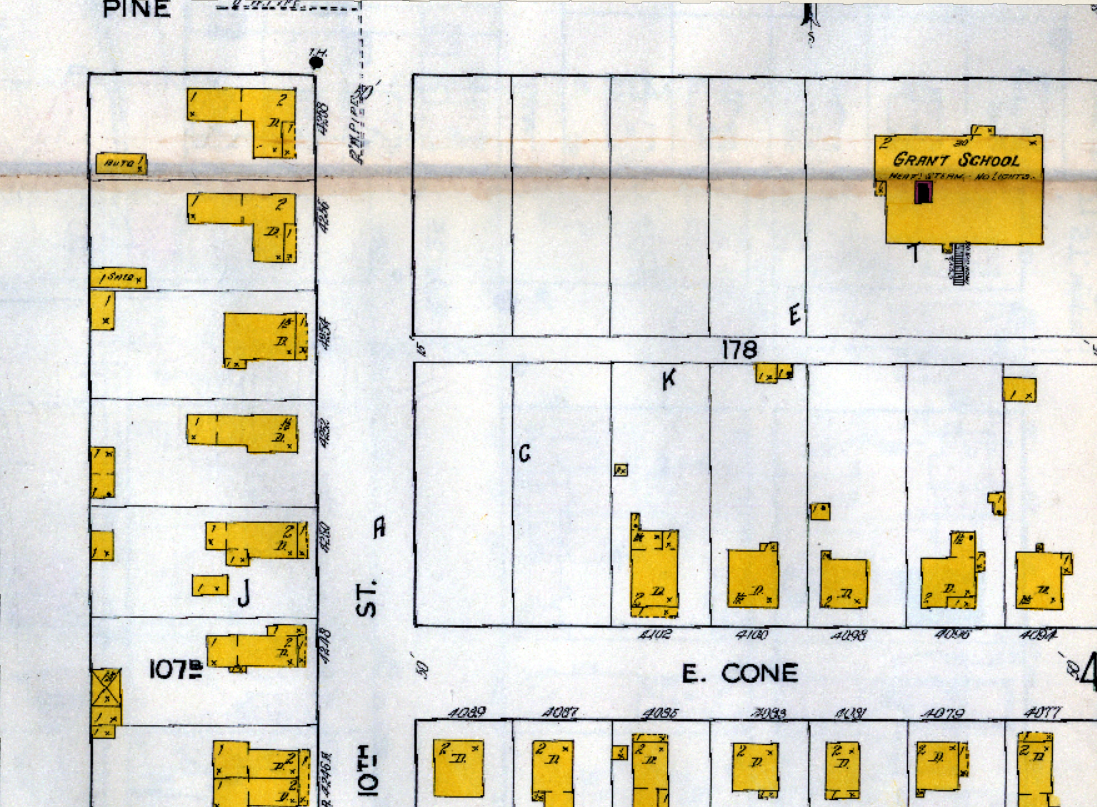
The area of 10th and Pine Streets in Calumet in 1908, a few years before the strike. 1908 Sanborn Map, Keweenaw Time Traveler.
On October 7, 1913, Proletarec, a Slovenian-language newspaper based in Chicago and edited by Frank Shaws, wrote: “On Tuesday, a military officer arrested the well-known Comrade Ana Klemenc when she addressed a group of Slovenian “scabs” on Seventh Street. Mrs. Klemenc calmly told them that they should go home and join the strikers; meanwhile the deputies ran up and shouted at the scab, who was hesitating somewhat: ‘You coward, are you afraid of a woman and won’t go to work?’ Then the deputies, eight or nine of them, forcibly dragged the scab forward. The soldier who had watched the scene then arrested Comrade Klemenc, saying that she belonged at home rather than out on the street harassing scabs. She was in jail for five hours, after which she was released on bail.”
The next day, Annie was also featured in The Day Book, an “experimental, advertising-free daily newspaper published in Chicago.” (Wikipedia). The paper frequently championed labor rights and its article on Annie was no different. See the article below.
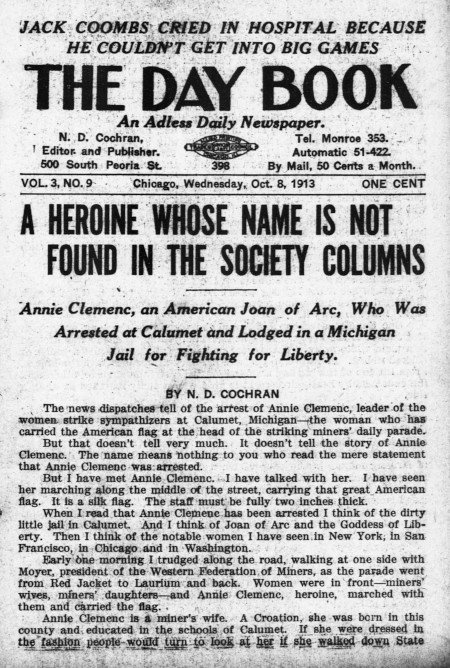
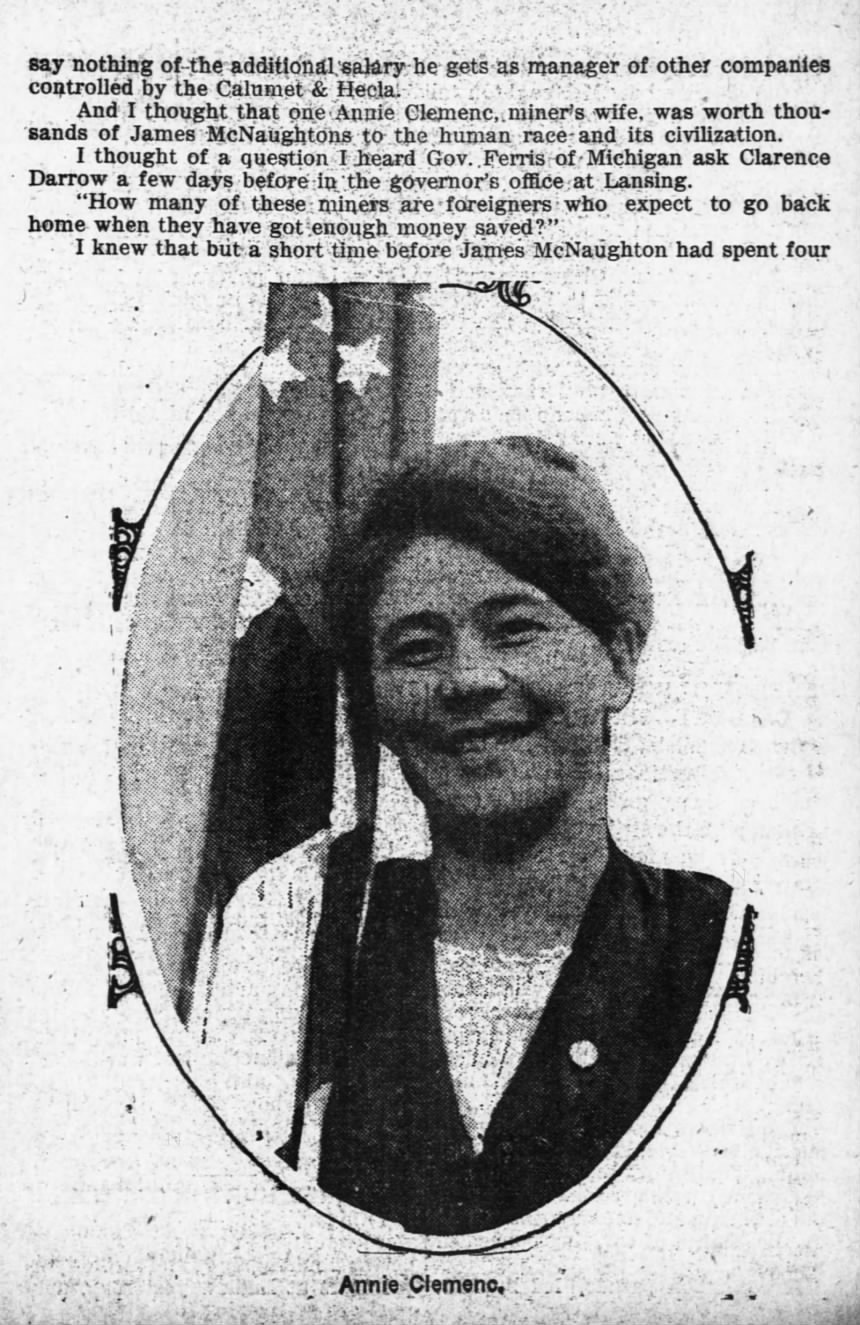
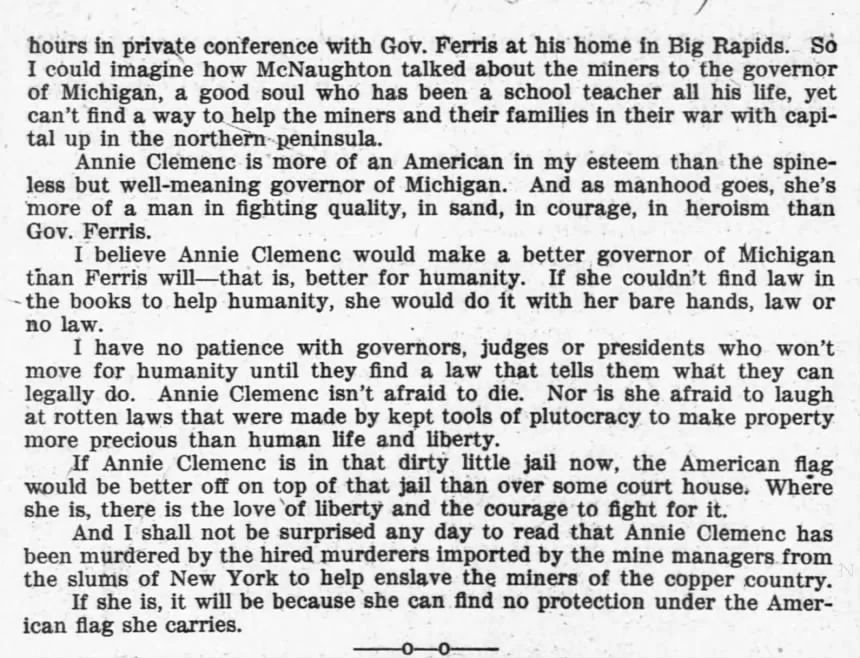
A HEROINE WHOSE NAME IS NOT FOUND IN THE SOCIETY COLUMNS
Annie Clemenc, an American Joan of Arc, Who Was Arrested at Calumet and Lodged in a Michigan Jail for Fighting for Liberty.
BY N. D. COCHRAN
The news dispatches tell of the arrest of Annie Clemenc, leader of the women strike sympathizers at Calumet, Michigan—the woman who has carried the American flag at the head of the striking miners’ daily parade.
But that doesn’t tell very much. It doesn’t tell the story of Annie Clemenc. The name means nothing to you who read the mere statement that Annie Clemenc was arrested.
But I have met Annie Clemenc. I have talked with her. I have seen her marching along the middle of the street, carrying that great American flag. It is a silk flag. The staff must be fully two inches thick.
When I read that Annie Clemenc has been arrested I think of the dirty little jail in Calumet. And I think of Joan of Arc and the Goddess of Liberty. Then I think of the notable women I have seen in New York, in San Francisco, in Chicago and in Washington.
Early one morning I trudged along the road, walking at one side with Moyer, president of the Western Federation of Miners, as the parade went from Red Jacket to Laurium and back. Women were in front—miners’ wives, miners’ daughters—and Annie Clemenc, heroine, marched with them and carried the flag.
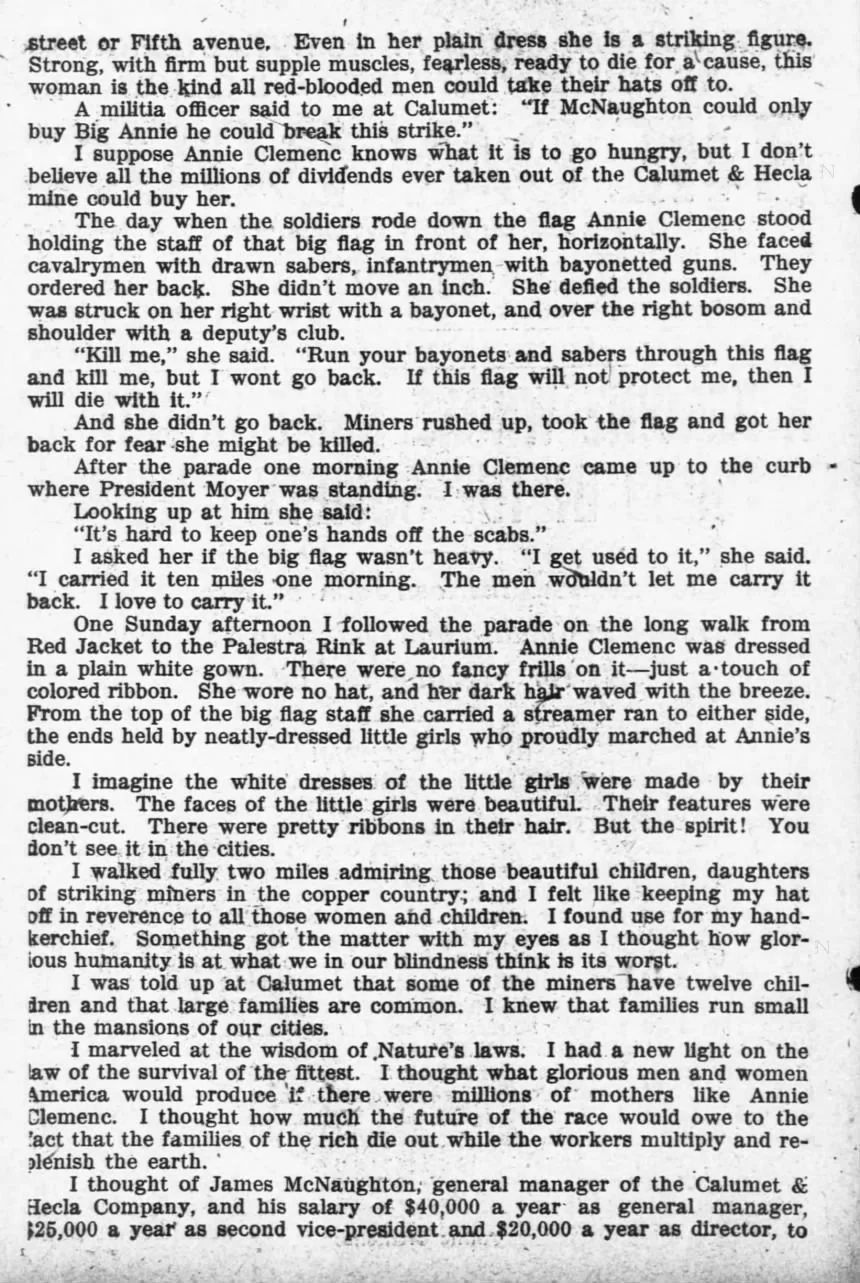
Annie Clemenc is a miner’s wife. A Croatian, she was born in this country and educated in the schools of Calumet. If she were dressed in the fashion people would turn to look at her if she walked down Statestreet or Fifth avenue. Even in her plain dress she is a striking figure. Strong, with firm but supple muscles, fearless, ready to die for a cause, this woman is the kind all red-blooded men could take their hats off to.
A militia officer said to me at Calumet: “If McNaughton could only buy Big Annie he could break this strike.”
I suppose Annie Clemenc knows what it is to go hungry, but I don’t believe all the millions of dividends ever taken out of the Calumet & Hecla mine could buy her.
The day when the soldiers rode down the flag Annie Clemenc stood holding the staff of that big flag in front of her, horizontally. She faced cavalrymen with drawn sabers, infantrymen with bayonetted guns. They ordered her back. She didn’t move an inch. She defied the soldiers. She was struck on her right wrist with a bayonet, and over the right bosom and shoulder with a deputy’s club.
“Kill me,” she said. “Run your bayonets and sabers through this flag and kill me, but I wont go back. If this flag will not protect me, then I will die with it.”
And she didn’t go back. Miners rushed up, took the flag and got her back for fear she might be killed.
After the parade one morning Annie Clemenc came up to the curb where President Moyer was standing. I was there.
Looking up at him she said:
“It’s hard to keep one’s hands off the scabs.”
I asked her if the big flag wasn’t heavy. “I get used to it,” she said. “I carried it ten miles one morning. The men wouldn’t let me carry it back. I love to carry it.”
One Sunday afternoon I followed the parade on the long walk from Red Jacket to the Palestra Rink at Laurium. Annie Clemenc was dressed in a plain white gown. There were no fancy frills on it—just a touch of colored ribbon. She wore no hat, and her dark hair waved with the breeze. From the top of the big flag staff she carried a streamer ran to either side, the ends held by neatly-dressed little girls who proudly marched at Annie’s side.
I imagine the white dresses of the little girls were made by their mothers. The faces of the little girls were beautiful. Their features were clean-cut. There were pretty ribbons in their hair. But the spirit! You don’t see it in the cities.
I walked fully two miles admiring those beautiful children, daughters of striking miners in the copper country; and I felt like keeping my hat off in reverence to all those women and children. I found use for my handkerchief. Something got the matter with my eyes as I thought how glorious humanity is at what we in our blindness think is its worst.
I was told up at Calumet that some of the miners have twelve children and that large families are common. I knew that families run small in the mansions of our cities.
I marveled at the wisdom of Nature’s laws. I had a new light on the law of the survival of the fittest. I thought what glorious men and women America would produce if there were millions of mothers like Annie Clemenc. I thought how much the future of the race would owe to the fact that the families of the rich die out while the workers multiply and replenish the earth.
I thought of James McNaughton, general manager of the Calumet & Hecla Company, and his salary of $40,000 a year as general manager, $25,000 a year as second vice-president and $20,000 a year as director, tosay nothing of the additional salary he gets as manager of other companies controlled by the Calumet & Hecla.
And I thought that one Annie Clemenc, miner’s wife, was worth thousands of James McNaughtons to the human race and its civilization.
I thought of a question I heard Gov. Ferris of Michigan ask Clarence Darrow a few days before in the governor’s office at Lansing.
“How many of these miners are foreigners who expect to go back home when they have got enough money saved?”
I knew that but a short time before James McNaughton had spent fourhours in private conference with Gov. Ferris at his home in Big Rapids. So I could imagine how McNaughton talked about the miners to the governor of Michigan, a good soul who has been a school teacher all his life, yet can’t find a way to help the miners and their families in their war with capital up in the northern peninsula.
Annie Clemenc is more of an American in my esteem than the spineless but well-meaning governor of Michigan. And as manhood goes, she’s more of a man in fighting quality, in sand, in courage, in heroism than Gov. Ferris.
I believe Annie Clemenc would make a better governor of Michigan than Ferris will—that is, better for humanity. If she couldn’t find law in the books to help humanity, she would do it with her bare hands, law or no law.
I have no patience with governors, judges or presidents who won’t move for humanity until they find a law that tells them what they can legally do. Annie Clemenc isn’t afraid to die. Nor is she afraid to laugh at rotten laws that were made by kept tools of plutocracy to make property more precious than human life and liberty.
If Annie Clemenc is in that dirty little jail now, the American flag would be better off on top of that jail than over some court house. Where she is, there is the love of liberty and the courage to fight for it.
And I shall not be surprised any day to read that Annie Clemenc has been murdered by the hired murderers imported by the mine managers from the slums of New York to help enslave the miners of the copper country.
If she is, it will be because she can find no protection under the American flag she carries.
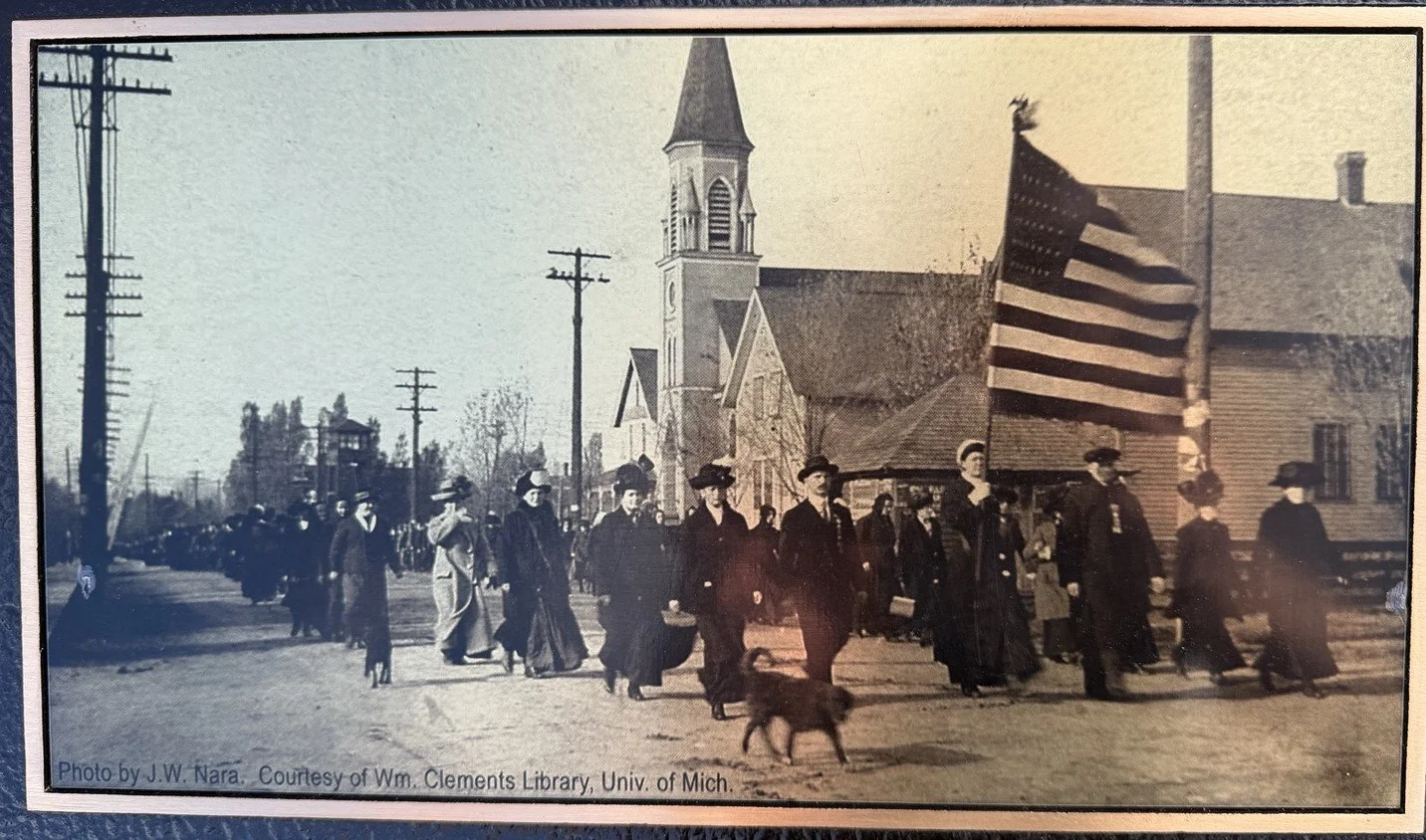
Annie carrying her flag through Calumet. J.W. Nara. William Clements Library, University of Michigan.
In November, Annie’s trial began in the Calumet Justice court.
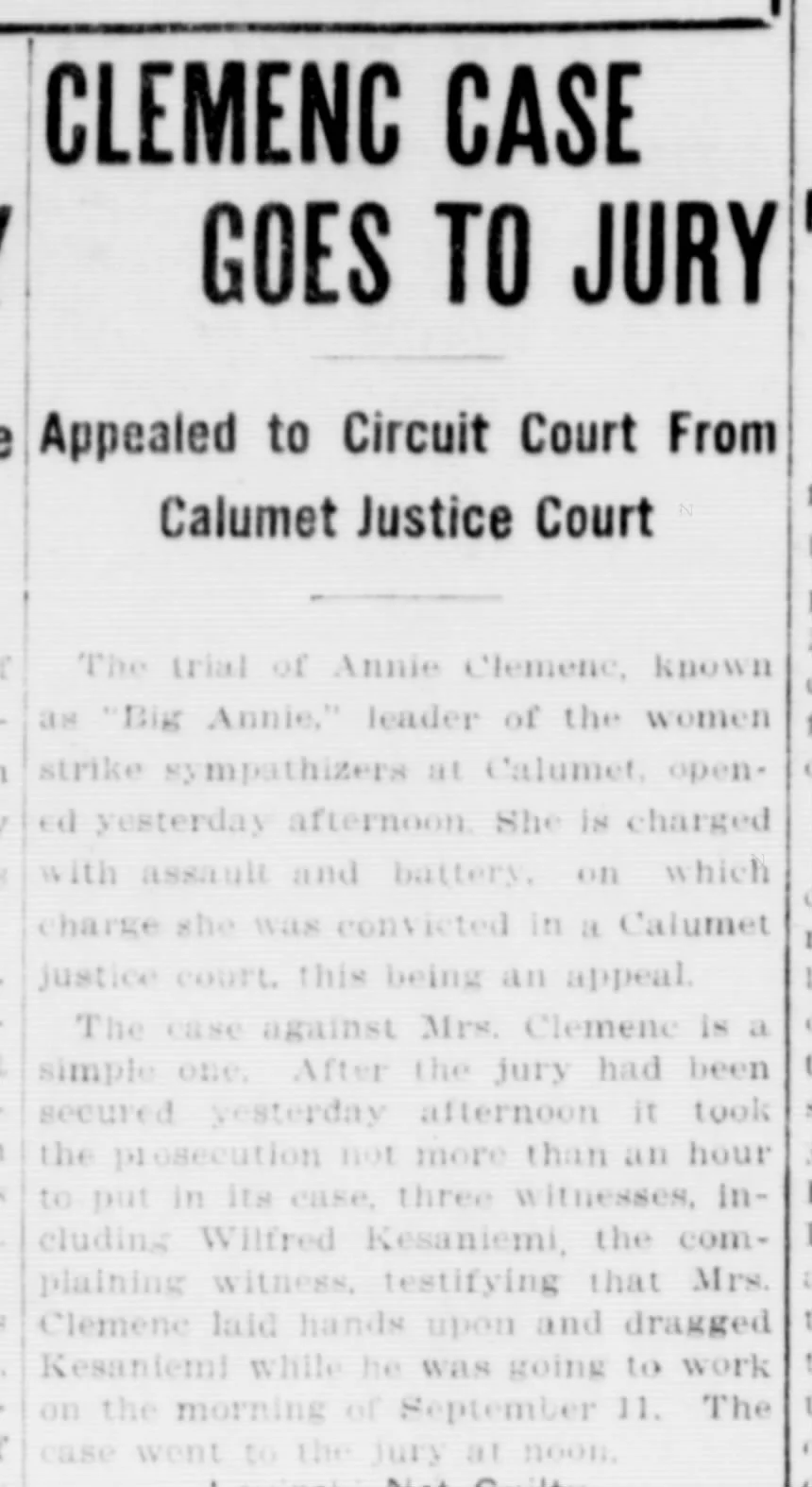
The Calumet News, 8 Nov 1913
CLEMENC CASE GOES TO JURY
Appealed to Circuit Court From Calumet Justice Court
The trial of Annie Clemenc, known as “Big Annie,” leader of the women strike sympathizers at Calumet, opened yesterday afternoon. She is charged with assault and battery, on which charge she was convicted in a Calumet justice court, this being an appeal.
The case against Mrs. Clemenc is a simple one. After the jury had been secured yesterday afternoon it took the prosecution not more than an hour to put in its case, three witnesses, including Wilfred Kesaniemi, the complaining witness, testifying that Mrs. Clemenc laid hands upon and dragged Kesaniemi while he was going to work on the morning of September 11. The case went to the jury at noon.
MRS. CLEMENC FOUND GUILTY
Case May Be Appealed to the Supreme Court
Mrs. Annie Clemenc, the Calumet woman strike leader, who rejoices in the sobriquet “Big Annie,” was convicted in the circuit court this morning of a charge of assault and battery, preferred by Wilfred Kesaniemi.
This verdict sustains a verdict brought against the woman in Justice Fisher’s court at Calumet by a jury. She appealed the case from that court and her bearing throughout the trial in the higher court showed that she had confidence in an acquittal.
The case went to the jury Saturday afternoon about 3 o’clock and Judge O’Brien left with the jury instructions to return a sealed verdict should one be reached. The jury agreed at 8 o’clock Saturday night and left the sealed verdict with the sheriff.
The court room was crowded this morning, not necessarily because of the interest in the woman’s case, but the expected verdict created a lot of interest and Mrs. Clemenc was the central figure in the court room when the verdict was read at 10 o’clock.
Mrs. Clemenc had taken an inconspicuous position in the rear of the court room but her height and the red hood she wore made her prominent. All eyes were turned on her when the verdict was read. At the announcement “guilty” “Big Annie’s” head dropped as though it had received a blow. But she gave no other sign.
Judge O’Brien has granted a stay of proceedings till the first day of the January term. A. W. Kerr, attorney for the Western Federation of Miners, in all strike cases, said that he could not at once state if an appeal in “Big Annie’s” case would be taken to the supreme court.
Pending his decision, the woman’s bail remains in force. She is enjoying her liberty under $200 bonds furnished in Justice Fisher’s court by Paul Schultz and Frank Johnson of Calumet.
Recalls Big Riot.
The case brought to trial this morning was that of Vasil Knezovich and two others, charged with assault with intent to do great bodily harm less than the crime of murder. The complaining witness is John Gasvoda, a deputy sheriff of Calumet.
This case recalls the worst strike riot in Calumet. It happened early in the strike and resulted from an attack on Gasvoda, in which he and Capt. John Ashton of Calumet were injured. On that occasion Red Jacket saw a riot that promised to develop into a serious affair. Oak and Sixth street were crowded for blocks with struggling soldiers, deputies, strikers and non-combatants and wholesale arrests resulted.
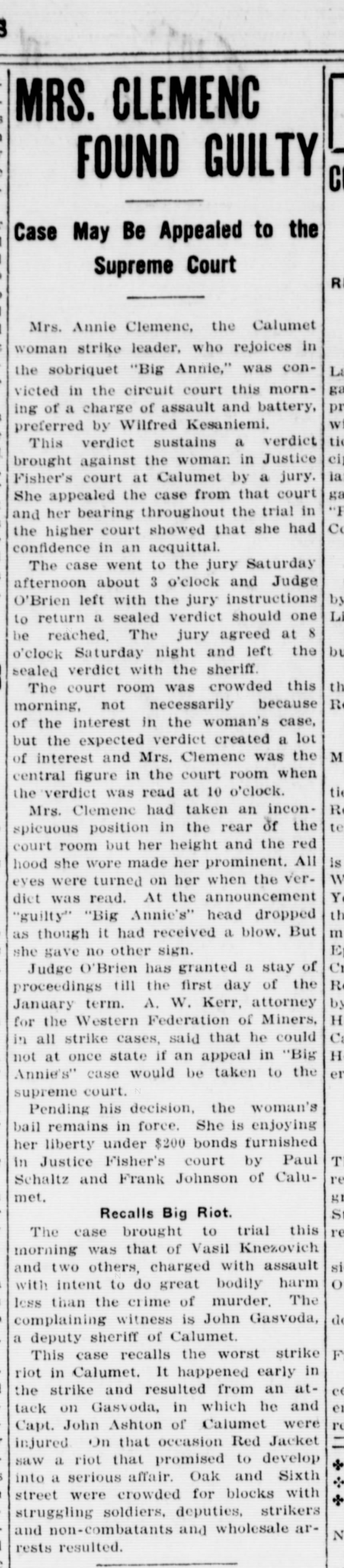
The Calumet News, 10 Nov 1913.
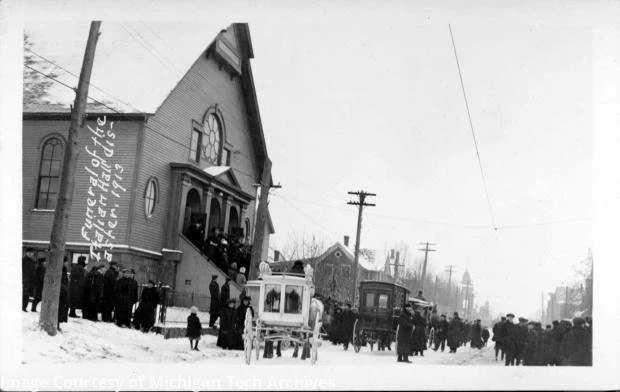
“Funeral of the Italian Hall Disaster, 1913. Finnish Lutheran church at Pine Street at Red Jacket. 28 funerals of Italian Hall disaster were held here.” ACC-400-12-13-1988-001-009-002. Louis Koepel. Accession 400 (12-13-1988) Collection. MTU Archives and Copper Country Historical Collections.
In December that year, Annie and other women organized a party for strikers’ children at the Italian Hall. What happened that Christmas Eve night deserves its own blog post, and many books have been written on the topic. To put it simply, through a false call of “fire!,” a stampede down the stairs led to the loss of 73 lives. Annie carried a flag in the funeral procession for the victims, mostly children. Afterwards, she led a relief campaign for the families who lost loved ones.

“Anna Clement Studio Portrait." NPS, Keweenaw NHP, CHMC Strike Album #161, Ana Clemenc studio portrait, 1913
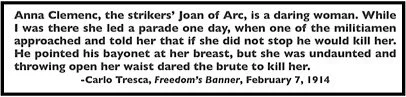
“Anna Clemenc, the striker’s Joan of Arc, is a daring woman. While I was there she led a parade one day, when one of the militiamen approached and told her that if she did not stop he would kill her. He pointed his bayonet at her breast, but she was undaunted, and throwing open her waist, dared the brute to kill her.” Hellraisers Journal, 28 Feb 1914.
Annie, the WFM, and their allies continued the fight throughout the beginning of 1914. In January 1914, Annie served a short jail sentence from her conviction. She also became pregnant with her only child around this time. After her release, she went on a speaking tour of the United States in February and March of 1914. She and other socialist speakers raised awareness and funds for the cause.
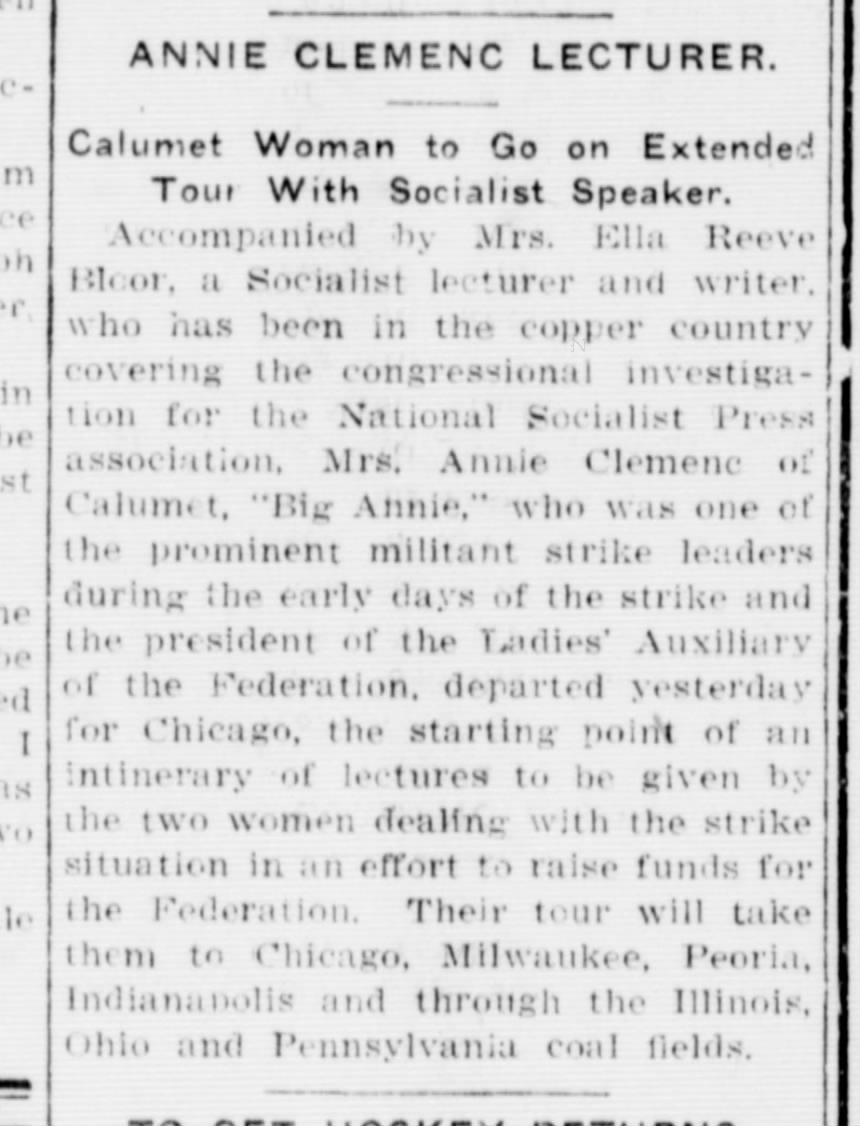
ANNIE CLEMENC LECTURER.
Calumet Woman to Go on Extended Tour With Socialist Speaker.
Accompanied by Mrs. Ella Reeve Bloor, a Socialist lecturer and writer, who has been in the copper country covering the congressional investigation for the National Socialist Press association, Mrs. Annie Clemenc of Calumet, “Big Annie,” who was one of the prominent militant strike leaders during the early days of the strike and the president of the Ladies’ Auxiliary of the Federation, departed yesterday for Chicago, the starting point of an itinerary of lectures to be given by the two women dealing with the strike situation in an effort to raise funds for the Federation. Their tour will take them to Chicago, Milwaukee, Peoria, Indianapolis and through the Illinois, Ohio and Pennsylvania coal fields.
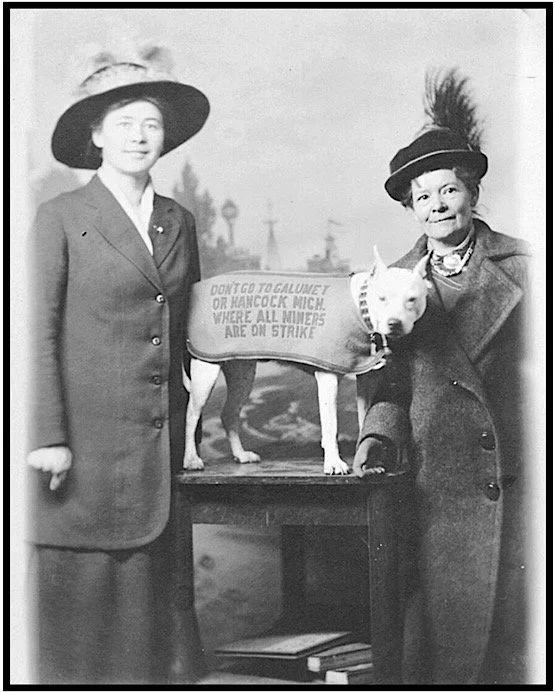
The Inter Ocean, 27 Feb 1914.
Article accompanying above image:
“Annie Clemenc, known as the Joan of Arc of Calumet, left the strike zone February 26th to go on tour with Ella Reeve Bloor, a well-known member of the Socialist Party of America, and a hard-working union organizer. Annie was given a rousing send-off at the train station by members of the Women’s Auxiliary of Western Federation of Miners. The Women’s Lodge of the Slovene National Benefit Society was also well represented. Annie holds the office of Local President in both organizations.
Annie was dressed in a new black suit and a handmade hat, both given to her especially for the tour. Dog Picket joined them for the send-off, and a photograph was taken of Annie and Mother Bloor with Picket standing on a table between them. Annie can be seen standing tall in her new suit and hat.
The speaking tour will include Milwaukee and Chicago and these states: Indiana, Ohio, Pennsylvania, and West Virginia. They will also visit Washington, D.C.”
In April of 1914, the mining strike finally ended. From Wikipedia: “Shortly after [the Italian Hall Disaster}, the president of the WFM, Charles Moyer, was shot and then forcibly placed on a train leaving the Keweenaw. However, support for the strike declined as organizers left (or were forced to leave) the Copper Country, the WFM ran out of money, and strikers' families experienced great hardships during the winter. The strikers voted to end the strike on April 13, 1914. Whereas the WFM reported having 9,000 members at the initial strike vote, only 2,500 members were left to vote on the referendum on calling off the strike. Mining companies required all strikers seeking a return to work to turn in or destroy their WFM membership cards.
The strike was mostly unsuccessful in achieving its major goals. The mining companies continued introducing the one-man drill, which eventually became a standard in all Copper Country mines. Collective bargaining was thoroughly rejected by the mines, leaving miners at the whim of the companies. Many miners simply left the Copper Country, or else returned to the mines for which they formerly worked on the mines' terms.”
Sometime before or during the strike, Annie met Slovenian immigrant and Proletarec editor Frank Shaws. According to Frank’s entry on Find a Grave, Annie and Frank became “so close [during the strike] that Slovenian-American leader, and their future housemate, Ivan Molek, accused Frank of paying more attention to Annie than the events of the strike when he was sent to Calumet to cover, and participate in, the strike….
She [later] identified Frank as the father on Darwina’s birth certificate.”
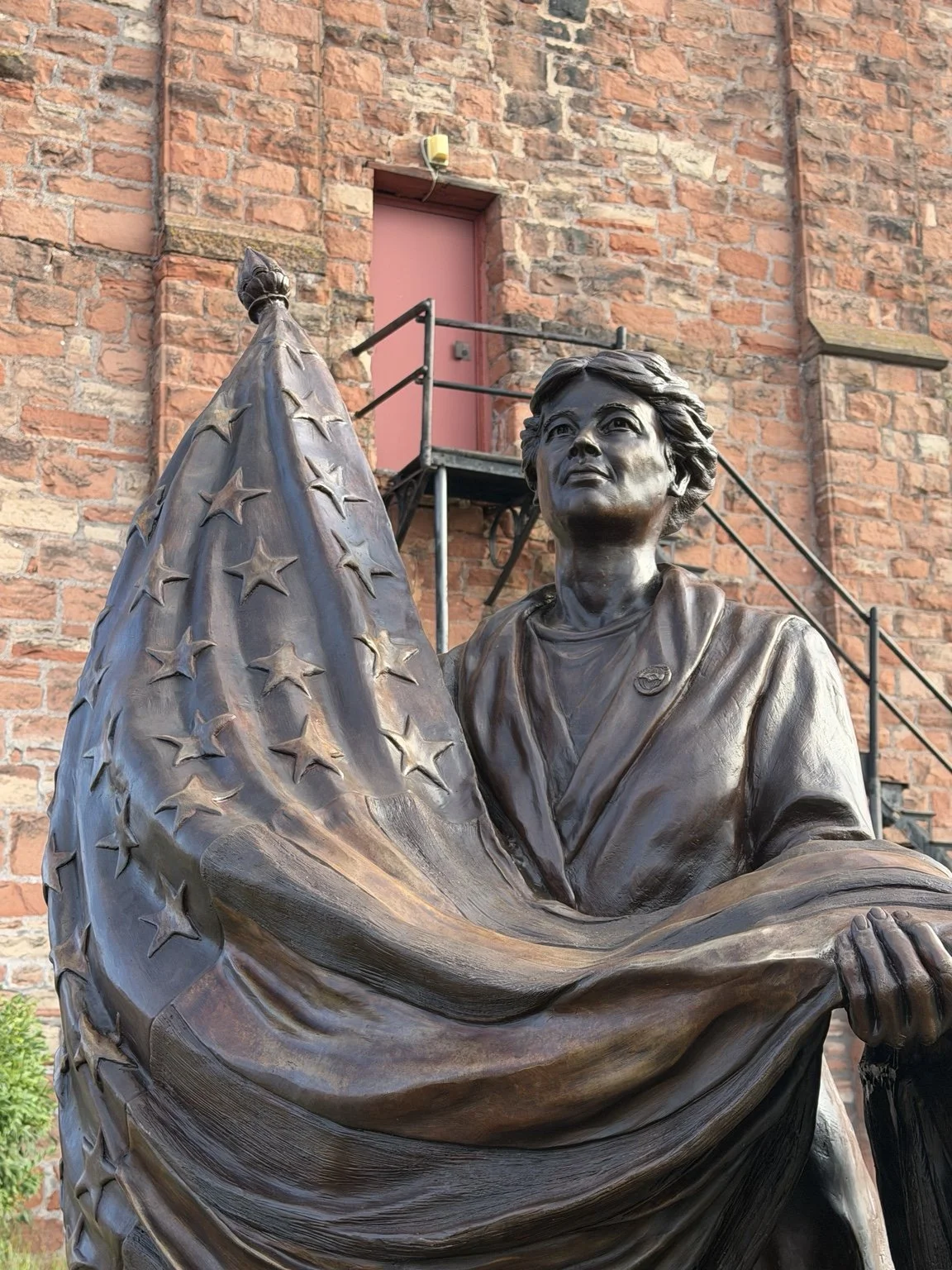
Photo by author.
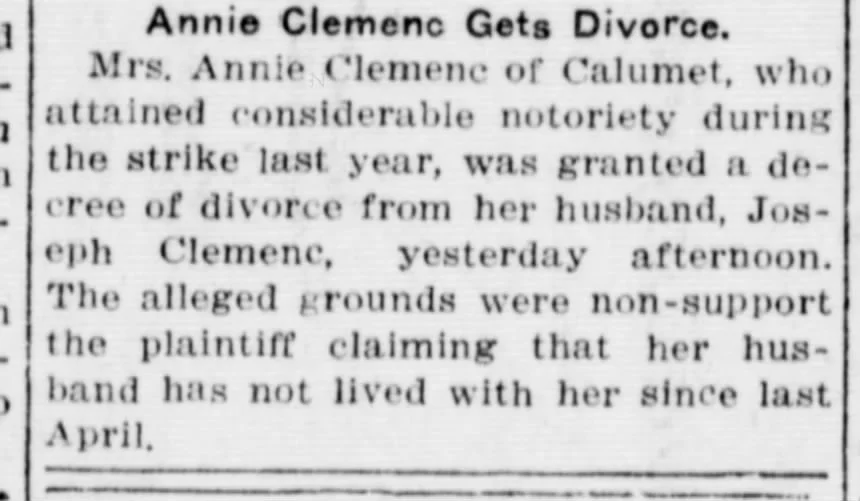
Annie Clemenc Gets Divorced
Mrs. Annie Clemenc of Calumet, who attained considerable notoriety during the strike last year, was granted a decree of divorce from her husband, Joseph Clemenc, yesterday afternoon. The alleged grounds were non-support the plaintiff claiming that her husband has not lived with her since last April.
The Calumet News, 12 Sep 1914, pg. 3.

Michigan, U.S. Divorce Records 1897-1952, 1913 Genesee-Montmorency.
Annie filed for divorce from her husband for “extreme and repeated cruelty” just nine days after the strike ended. The divorce was finalized on September 12, 1914. Four days later, Annie married Frank Shaws in Chicago. Frank and Annie’s only child, Darwina, was born on October 30. She spent the rest of her life in the Chicago area.
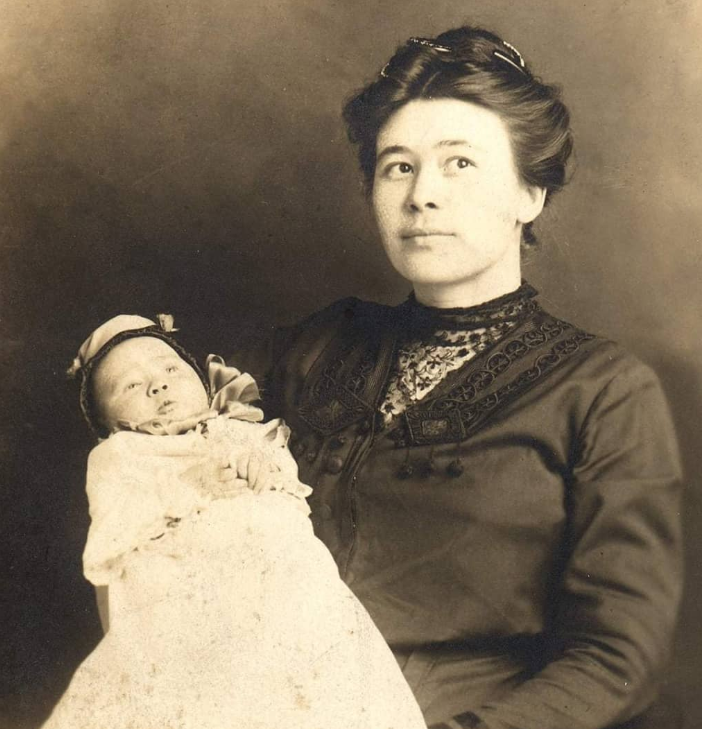
Annie with Darwina. Keweenaw National History Park via Anne Marie Kelly.

1920 U.S. Census, Chicago, Cook County, IL. Ward 34, District 2195, Roll T625_355, pg. 4A.
In 1920 Annie and Frank lived on 31st Street in Chicago, surrounded by fellow Slovenes. Their only child, Darwina, was five years old at this time. Annie’s brother, Joseph, also lived with them. According to Herle, they rented an apartment in the home of Slovenian writer Ivan Molek. While here, Frank worked at a twine factory and Joseph worked in a hat factory. Frank and Annie were active members of the Socialist Party.

1930 U.S. Census, Chicago, Cook County, IL. Ward 15, Enumeration District 0557, Film 2340174.
By 1930 Joseph had moved out and the family moved to Campbell Avenue. Frank worked as a watchman at a stockyard. Interestingly, Annie is now listed as employed by a “hat manufacturer.” She would continue her work in the millinery industry for the remainder of her life. According to Frank’s Find a Grave entry, the pair separated romantically around this time, but continued to live in the same home.
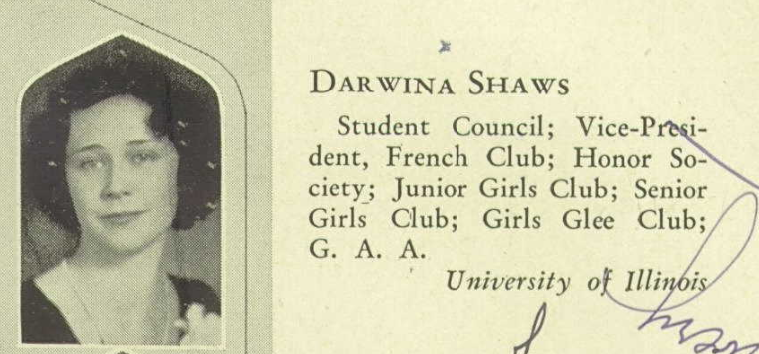
U.S., School Yearbooks, 1880-2012, Chicago, IL. Lindblom Technical High School, 1932-Jan. Ancestry.
The above photo shows the 1932 senior portrait of Darwina Shaws from the Lindblom Technical High School in Chicago. Reportedly, Darwina was even taller than her famously tall mother.
In April of 1936, Frank Shaws died in Chicago. Later that year, Annie married Andrew Roblek. The marriage lasted until 1938.

1940 U.S. Census. Chicago, Cook County, IL. Enumeration District 103-1019, Roll m-t0627-00951, pg. 62a.
By 1940, Annie returned to using her second married name of Shaws. She still lived in the same house on Campbell Ave and ran a hat cleaning shop, which employed her daughter and two boarders.
Darwina married Edward Stauber in 1942 and had a daughter, Patricia, in 1943, and a son, Robert, in 1944. She and Edward divorced in 1949.

1950 U.S. Census, Chicago, Cook County, IL. Ward 15, Enumeration District 103-1548, Roll 1537, pg. 6.
In 1950, Annie lived with her daughter and grandchildren in her home on Cleveland St., except Darwina was now listed as the “head.” Annie continued her work as a hat cleaner.
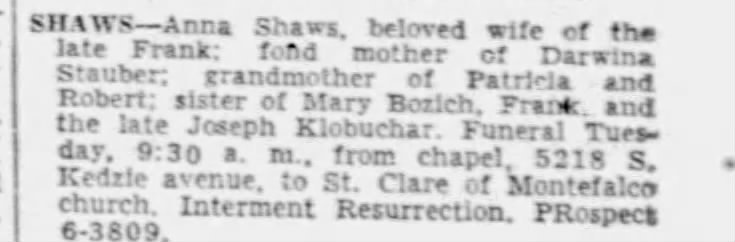
Chicago Daily Tribune, 28 Jul 1956, pg. 19.
“Anna Shaws, beloved wife of the late Frank; fond mother of Darwina Stauber; grandmother of Patricia and Robert; sister of Mary Bozich, Frank, and the late Joseph Klobuchar. Funeral Tuesday, 9:30 a. m., from chapel, 5218 S. Kedzie avenue, to St. Clare of Montefalco church. Interment Resurrection.”
When Anna Klobuchar Clemenc Shaws died in Chicago on July 27, 1956, her obituary was simple and did not reflect the courageous deeds of her younger years. According to Herle, “her nephew, Carl Bozich, remembered that at least one hundred people, perhaps two hundred, attended her funeral. The funeral took place at a Catholic church in Chicago, and she was buried at Resurrection Cemetery.”(2022, translated from Slovenian). Before her death, Annie may not have realized that her story had an impact on the labor rights movement across the country and that people would be writing about her for decades to come. In 1980, the Michigan House of Representatives declared June 17th as “Big Annie Day.” She was inducted into the Michigan Women’s Hall of Fame in 1996. She is one of only three Michigan women to be featured on the Michigan Women’s Hall of Fame Medallion. In 2013, Annie was inducted into Labor’s International Hall of Fame. Multiple books have been written about her, both fiction and nonfiction. With the new statue in Calumet, Annie’s memory is sure to live on for many generations to come.
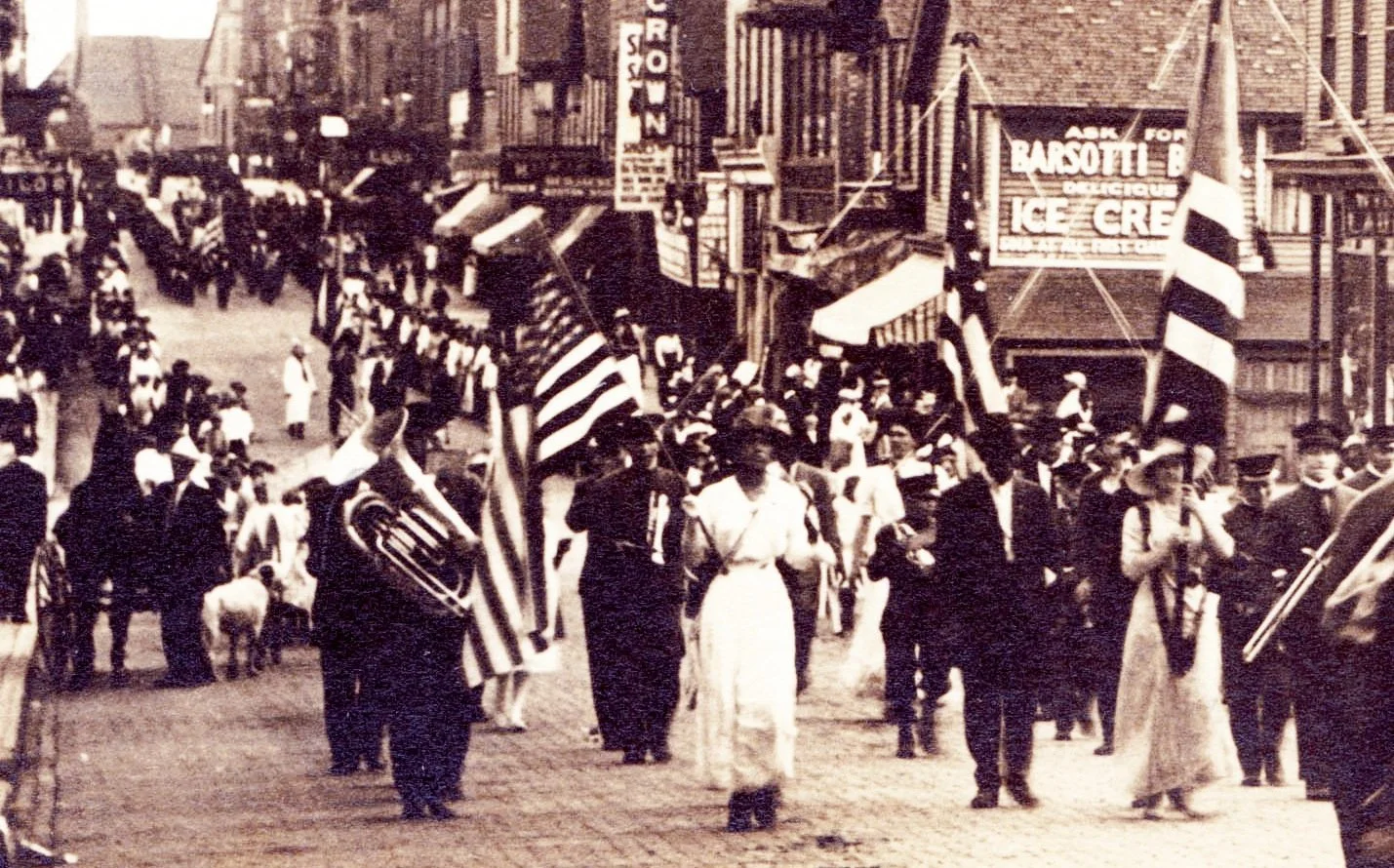
Annie marching down Fifth Street in Calumet. via Rackham Graduate School, University of Michigan.
Sources:
Zvon Magazine, 2022, no. 6.
https://www.mohorjeva.org/wp-content/uploads/zvon/ZVON_6_2022.pdf
MI Women’s Hall of Fame
https://miwf.org/celebrating-women/michigan-womens-hall-of-fame/anna-clemenc/
We Never Forget.org
https://weneverforget.org/hellraisers-journal-from-the-day-book-heroine-annie-clemenc-by-n-d-cochran-american-joan-of-arc-in-fight-for-liberty/
Maris Fancy, Northern Michigan History
https://northernmichiganhistory.com/big-annie-clemenc/
James Dau, 15 Jun 2022, University of Michigan
https://rackham.umich.edu/discover-rackham/copper-labor-and-michigans-joan-of-arc/
Graham Jaehnig, 29 Dec 2022
https://www.mininggazette.com/news/2022/12/calumet-council-pass-resolution-in-support-of-big-annie-statue/
Kayleigh White, Visit Keweenaw, 8 Mar 2024
https://www.visitkeweenaw.com/blog/post/celebrating-womens-history-month-in-the-keweenaw/
https://en.wikipedia.org/wiki/Copper_Country_strike_of_1913
https://en.wikipedia.org/wiki/Anna_Clemenc
https://www.findagrave.com/memorial/91085972/frank-shaws
https://www.findagrave.com/memorial/91085972/frank-shaws
